The post Romans Ch13 first appeared on Calvary Chapel Portsmouth.
]]>In essence, Paul instructs believers to maintain a posture of submission to governing authorities, asserting that all legitimate authority is ordained by God. Consequently, to resist such authority is to oppose the ordinance of God, potentially incurring the punitive measures administered by those in power, who are appointed by God for the maintenance of order and the chastisement of evildoers. Conversely, those who conduct themselves lawfully have no legitimate cause for apprehension.
But what do we do when those authorities are themselves corrupt? How does Paul’s teaching apply to a democracy, where the government officials are elected by the people – in effect they are our employees!
Where should Christians stand in regard to capital punishment? Why were there no prisons in ancient Israel? Should a Christian pay taxes to a corrupt government who then use that money to propagate that which is clearly against the moral and ethical teaching of Scripture?
This is a complex subject!
Paul concludes by reminding us that we must love our neighbour, the fulfilment of this commandment inherently satisfies the requirements of the law. We are also to forsake ‘deeds of darkness’ and to conduct ourselves with propriety, eschewing evil. Instead, we are to ‘put on the Lord Jesus Christ’ and not give any occasion to the flesh to fulfil the desire thereof.
In essence, Romans chapter 13 outlines the Christian’s duty regarding civil obedience, financial responsibility, neighbourly love as the epitome of legal compliance, and a manner of living that reflects the imminence of their faith.
May you be challenged and encouraged by this study.

The post Romans Ch13 first appeared on Calvary Chapel Portsmouth.
]]>The post Christ the King first appeared on Calvary Chapel Portsmouth.
]]>In this 2nd session we look at the other half of the Christmas message – Christ the King!
In our previous session we saw that the truth of Christmas has been obfuscated by tradition, and how that Jesus came as the Lamb of God to take away the sins of the world, born in Bethlehem, the town of sacrificial lambs, and specifically in ‘In the Tower of the Flock’ (Migdal Edar) on the outskirts of Bethlehem as prophesied by Micah. We noted how, as a lamb destined to be offered as a sacrificial offering in Jerusalem, He had to be without blemish and so was wrapped in ‘swaddling cloths’ and laid in a manger.
The Levitical shepherds were chosen by God to be the first to see this new born baby precisely because it was their job to inspect the sacrificial lambs that would later be offered in Jerusalem.
But as we now come to consider ‘Christ the King’ we jump forward around two years to the time the wise men (Magi) from the east arrived.
As with the Lamb, the story of Israel’s King begins back in the book of Genesis and is unfolded throughout the Old Testament. In Genesis 14 we see a line of kings and priests, which included Melchizedek, that ruled and reigned in Jerusalem for a period of 1000 years – and incredible model in advance of the Millennial reign of Christ! God established the monarchy in Israel but through the prophet Hosea stated His ultimate goal that “I will be thy king: where is any other that may save thee in all thy cities? and thy judges of whom thou saidst, Give me a king and princes?” (Hosea 13:10).
The last king to sit and reign on the Throne of David in Jerusalem was Zedekiah. He was subjugated and eventually defeated by Nebuchadnezzar in 587 B.C. The ‘crown’ was then effectively taken to Babylon , where it remained for 500 years until a group of Magi – a priestly Medo-Persian sect that the prophet Daniel had once been made ruler over – brought the crown back from Babylon intent on giving it to the rightful King of Israel!
Daniel had evidently instructed these Magi regarding the prophesied coming of the Jewish Messiah. The Magi were ren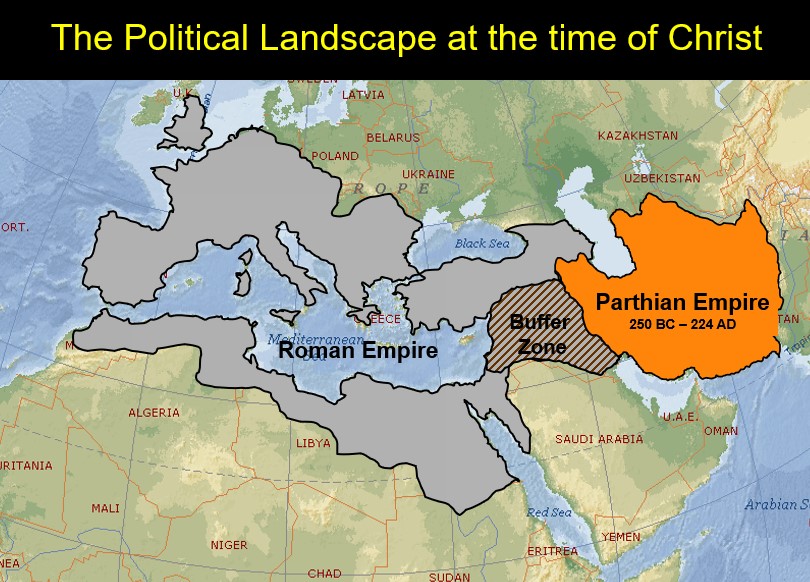 owed for their wise counsel and thus they were consulted by Eastern rulers regarding affairs of state, in particular, the appointment of a new king!
There had been a long rivalry between the Roman Empire, who had granted Herod the title ‘king of the Jews’ and the Parthian Empire, that had been far more sympathetic toward Israel.
Into the midst of this highly charged political environment come – not three kings on camels (tradition is very wide of the mark here!) – but, a great number of Magi looking to anoint and bring their homage to the rightful King of the Jews! No wonder Herod was shaken – and all Jerusalem with him!
As Dr Chuck Missler comments: “The Magi, likely traveling in force with unimaginable oriental pomp and adequate cavalry escort to insure their safe penetration of Roman territory, certainly alarmed Herod and the entire populace of Jerusalem”
Jesus was of the Jewish royal line through both Joseph (via Solomon – Matthew Ch1) and Mary (via Nathan – Luke Ch3), now the Magi ratified that fact.
Before becoming King, Jesus had to first fulfil His role as ‘Lamb of God’ to take away the sins of the world. But when Jesus returns, He will establish His throne and rule over Israel and the whole world from Jerusalem.
“He shall be great, and shall be called the Son of the Highest: and the Lord God shall give unto him the throne of his father David: And he shall reign over the house of Jacob for ever; and of his kingdom there shall be no end”. (Luke 1:32)
“The Lord hath sworn in truth unto David; he will not turn from it; Of the fruit of thy body will I set upon thy throne” (Psalm 132:10)
“And in the days of these kings shall the God of heaven set up a kingdom, which shall never be destroyed: and the kingdom shall not be left to other people, but it shall break in pieces and consume all these kingdoms, and it shall stand for ever”. (Daniel 2:44)
“But thou, Bethlehem Ephratah, though thou be little among the thousands of Judah, yet out of thee shall he come forth unto me that is to be ruler in Israel; whose goings forth have been from of old, from everlasting.” (Micah 5:2)
“And the Lord shall be king over all the earth: in that day shall there be one Lord, and his name one… And it shall come to pass, that every one that is left of all the nations which came against Jerusalem shall even go up from year to year to worship the King, the Lord of hosts, and to keep the feast of tabernacles”. (Zechariah 14:9, 16)
–So, when you think ‘Christmas, think…
‘Sacrificial Lamb’!
–This has been fulfilled!”
–Then think…
The King of the Jews
–This will be fulfilled – soon!
May you know God’s richest blessings this Christmastime.
The audio recording and PowerPoint slides used in the study are available for free download.
The post Christ the King first appeared on Calvary Chapel Portsmouth.
]]>The post The Monarchy – Past Present Future first appeared on Calvary Chapel Portsmouth.
]]>This topical teaching by pastor Barry Forder was given on 18th September 2022.
Since Egbert in 827 A.D. the British Isles have had a Monarchy. Over the past week we have seen King Charles III travel to Scotland, Northern Ireland, Wales and various places in England – all places where the proclamation of his reign has been announced – and he has been greeted with almost unanimous joy, with huge crowds lining streets and shouting ‘God save the king!’
But should we pray ‘God save the king’? What about the small minority that do not want to be under a monarchy?
In this teaching pastor Barry looks at:
- The Biblical foundation of the Monarchy
- The Biblical mandate for Monarchy
- The Biblical future for the Monarchy
In these times of change and uncertainty, may this teaching give you confidence in our coming King.
The post The Monarchy – Past Present Future first appeared on Calvary Chapel Portsmouth.
]]>The post Jude vs 8-10 first appeared on Calvary Chapel Portsmouth.
]]>Jude has been reminding his readers that it really does matter how you life your life as a Christian. Although your salvation is secure and guaranteed, your rewards and inheritance are not.
John says “Look to yourselves, that we lose not those things which we have wrought, but that we receive a full reward”. (2 John vs 8).
Peter says that we should strive that we might have an ‘abundant entrance’ into Heaven (2 Peter :11).
Paul says that if we sow to the flesh, and spend our time and affections on worldly things (wood, hay and straw), we will still be saved (because Salivation is based solely on the completed work of Christ), but we ourselves will suffer loss when we stand before the Judgement seat of Christ (1 Cor 3:15 / Gal 6:7-8 / 2 Cor 5:10).
Jude has given us three examples to make his point:
- 1st Example
–Though saved from Egypt, those who did not believe all died in the wilderness and did not receive their inheritance
- 2nd Example
–The Angels who left their natural abode (though having been in the presence of God, became subject to His wrath and judgment
- 3rd Example
–The cities of Sodom & Gomorrah, though situated in the fertile plain of Jordan, ‘as beautiful as the Garden of Eden’ (Gen 13:10), were destroyed by God on account of their giving themselves over to immoral lusts.
The warning is given: those who give themselves over to the flesh will suffer loss.
In verses 8-10 Jude starts to detail just what those who are given over to worldly lust are really like.
The first characteristic is that they have no regard for authority, and even despise and mock those who are above them. The example Jude gives to illustrate this point however, must be one of the strangest remarks found in the Bible! In this study we explore what Jude was speaking of when he said: “Yet Michael the archangel, when contending with the devil he disputed about the body of Moses, durst not bring against him a railing accusation, but said, The Lord rebuke thee”.
The conclusion and point Jude is making is clear. God takes the issue of authority (and the respect we should show toward it) very seriously. Whether it be order in a nation… – Romans 13:1
…order in the church – 1 Cor 14:40 / 1 Tim 3 / Titus 2 …order in the family – Titus 1:6 / Eph 6:1-4 or order in a marriage – 1 Cor 11 / Eph 5:23 / 1 Peter 3:1-7
May you be blessed and encouraged by this study.
The post Jude vs 8-10 first appeared on Calvary Chapel Portsmouth.
]]>The post 1 Peter Ch2 11-25 first appeared on Calvary Chapel Portsmouth.
]]>In the second half of 1 Peter chapter 2 Peter turns his focus to relationships – and specifically how a Christian should act toward others.
v11-12 – The Believers’ relationship to others (which is dependant on our relationship to God)
v13-17 – The Believers’ relationship to rulers & those in authority (which is defined by our relationship to God)
v18-20 – The Believers’ relationship: servants to masters (employees to employers) (which is derived from our relationship to God & Christ’s example which we must follow).
In all of these relationships, we should remember that we are to bring Glory to God by our conduct. No longer can we just go around saying what we please, putting down any who disagree with us, rejecting rule and authority because we have a different political persuasion. Our opinions (and even more importantly our speech!) must be filtered through God’s Word first.
God’s created and loves all people, and has shown grace to all those who have received Jesus Christ as their Lord and Saviour. We are to follow the example of Christ, who, although wronged, never retaliated, replied sarcastically, or sought to get even. Rather, He left it all in His Father’s hands.
Remember that you have been chosen, you are part of a Royal Priesthood. Now you must reflect His glory and show respect and honour to all men.
May you be blessed, encouraged and challenged by this teaching!
The PowerPoint slides used in this study are available from free download in PDF format.
The post 1 Peter Ch2 11-25 first appeared on Calvary Chapel Portsmouth.
]]>