The post John Chapter 3v16 (… and the rest) first appeared on Calvary Chapel Portsmouth.
]]>To quote from scripture, then from the sermon:
"For God so loved the world that he gave his only begotten son
That whosoever believes in him should not perish but have everlasting life." ...
It stands as the supreme distillation of the divine narrative.
And then there follows further expansion of the theme and closely related concepts.
V^V^V^V^V^V^V^V^V^V^V^V^V^V^V^V^V^V^V
TRANSCRIPT OF THE SERMON
To download the transcript text-file, click on the “button” labelled “Save Video” (or “Download Video” sometimes). See below (“PS0” for full info)
PS2: ::: The latest development on the “Transcript” section is that the text-file will be subject to far less editing than before. It will still be converted to sentence-column form as before, but any trimming and polishing will be left to the user (according to their own taste of format, etc). Any shortcomings in the transcription software should be pretty obvious and so not a problem in getting the meaning (and the audio file will provide the necessary clarification if required 
 )
)
PS1: ::: {not-so-}NEW FORMAT of the transcript.
To ease the processing and preparation of the transcript, and we hope improve the readability of the text, a new format was been adopted in mid October. This breaks the text into sentences instead of arbitrarily-sized “paragraphs”. When the reader opens the file in a program such as Notepad (in MS Windows), then the appearance can be just like a newspaper column. The format is such that the user has many options available, depending on preferences and what software they like to use.
Any feedback on usefulness, improvement suggestions, or whatever, would be most welcome.
PS0 ::::: TRANSCRIPT OF THE SERMON >>>>>>>>>>>>>>>>
There is a “button” labelled “Save Video” (or “Download Video” sometimes). This actually links to a text-file to download. It is a transcript of the sermon. At present it is at an experimental stage: it is an aid to getting the most out of the sermon audio. There is no substitute for listening to the verbal delivery of a sermon. However, searching through an audio file lasting the best part of an hour can be somewhat difficult. When you approach the search knowing that you’re sure there is something about “redemption”, for example, then a transcript text-search can take you right there and show you the time in the recording where you will find it! The file is simple “text” rather than a more sophisticated form so that you can edit or reformat as you prefer.
This transcript is in 2 forms (in the one file). One half consists of normal text arrangement. The other section is short bunches of words (8 to 12 nomally) beneath the TIMES at which they occur (for the whole sermon).
This facility is in development (“experimental” as mentioned above) so any feedback on usefulness, improvement suggestions, or whatever, would be most welcome.

The post John Chapter 3v16 (… and the rest) first appeared on Calvary Chapel Portsmouth.
]]>The post Ruth – Session 5 first appeared on Calvary Chapel Portsmouth.
]]>Having gone verse-by-verse through the Book of Ruth, in this session we look at the models that God had intentially woven into the naritive of this incredible book.
We will see how the story itself is a model of the gospel; how Naomi is a type of Israel, Ruth a type of the Church, Boaz a type of Christ, Orpha a model of the unbeliever, and even the position of the book is by Diving design!
We also look at the one character that, up to now, has not been mentioned! He plays a major role and yet is never mentiond in the book! But unlocking the mystery of this man who ‘hides in plain sight’ it helps us to see the brethtaking magnitude of God’s plan of Redemption!
May you be blessed and encouraged by this study!
The post Ruth – Session 5 first appeared on Calvary Chapel Portsmouth.
]]>The post Ruth Chapter 4 first appeared on Calvary Chapel Portsmouth.
]]>In this final chapter of the book of Ruth we see Boaz go up to the city gate to settle the legal right of redemption before ten elders of the city. Though a nearer kinsman initially agrees to buy the land, he quickly backs out when he learns he must also marry Ruth the Moabitess, refusing to risk marring his own inheritance. Boaz triumphantly steps forward to perform the kinsman’s part, drawing off the shoe to confirm the covenant, buying back all that belonged to Elimelech’s family, and purchasing Ruth to be his wife. This magnificent climax beautifully mirrors how Jesus Christ made Himself of no reputation, willingly making the sacrifice to purchase His Gentile Bride and buy the field of this world. Ultimately, Ruth’s barrenness is turned to fruitfulness in Bethlehem as she brings forth Obed, completing a breathtaking design that perfectly anticipates the lineage of King David and the ultimate restoration of blessing.
We look at the Biblical significance of ‘gates’, ‘shoes’, ‘the tenth man’ and discover an incredible hidden code within the text of Genesis 38 and see how this highlights God’s preference for using what the world disqualifies. David’s line should have been ruined by the shame of Genesis 38. The line was infused with Gentile blood through Tamar, Rahab and Ruth the Moabitess. Yet, God took a line that was legally “shut out” for ten generations, redeemed it through a faithful Kinsman-Redeemer (Boaz), and used the tenth man to establish the eternal royal throne of Israel.
It serves as a direct blueprint for how Jesus (the ultimate descendant of this line) takes our spiritually bankrupt, disqualified status and legally qualifies us to sit with Him in heavenly places!
May you be blessed and ancouraged by this study.
The post Ruth Chapter 4 first appeared on Calvary Chapel Portsmouth.
]]>The post Ruth Chapter 3 first appeared on Calvary Chapel Portsmouth.
]]>The book of Ruth is one of the most amazing in the bible on account of the models and types found in its 86 verses. The surface narrative of the Book of Ruth is a literary masterpiece, it is the perfect ‘rags to riches’ story. But concealed within the text we have:
‒The entire gospel from Genesis to Revelation
‒The history and future of the Nation of Israel
‒The account of the Kinsman Redeemer who is willing to forfeit his own standing to claim a gentile bride
‒The jubilee principle, where that which was lost is found, where the land is returned to its rightful owner
‒The reason for Bethlehem’s significance
‒The practical demonstration of Romans 8:28
Chapter 3
In chapter 3 we see Naomi genuinely concerned about Ruth’s future happiness so poses the question ‘My dear Ruth, have you thought of getting remarried and settling down?’
It is interesting that we find Naomi use the expression ‘seek rest’ as an idiom for marriage. Throughout scripture the idea of rest is prophetically linked to the marriage of the Bride and our Heavenly Groom. The ultimate rest will be found in Him, when we are joined to Him and free from the toil and trials of this world. The Hebrew word for rest is ‘manowach’ (maw-no’-akh); which literally means ‘quiet’, i.e. (concretely) a settled spot, or (figuratively) a home. This is how a marriage should be, a place of loving fulfilment and peace. As Matthew Henry comments: “A married state is, or should be, a state of rest to young people. Wandering affections are then fixed, and the heart must be at rest.”
Sadly, we are bombarded with the world’s view of marriage as a place of strife and turmoil, where dreams go to die and to endure is the best we can hope for.
Love is hard to conceal and it may well have been that Naomi had already noticed a spark between Ruth and Boaz, after all, it would seem they had spent a couple of months daily in each other’s company by this point in time. Ruth however, being a foreigner, would no doubt have felt it not her place to initiate anything with her wealthy relative.
Signifcantly, we finally see Ruth and Boaz together at the end of the harvest! What a picture of Christ and the church, who will be finally united once the time of eartholy harvest is over and His ‘wheat’ has been safely gathered into His barn (see John 14:2-3 & 1 Thes 4:16-17).
There are many lessons to glean from this chapter! May you be blessed and encouraged as you study God’s Word.
The post Ruth Chapter 3 first appeared on Calvary Chapel Portsmouth.
]]>The post Ruth Chapter 2 first appeared on Calvary Chapel Portsmouth.
]]>In this study we continue over verse-by-verse joutney through the book of Ruth. It has been said that this book stands out like a diamond on a black cloth, ‘a beautiful day in the midst of a season of storms’. Spurgeon said “The Book of Ruth is like a lovely flower in a garden of weeds. It shows us that even in the darkest times of the Judges, God had a people, and His grace was at work in the most unexpected places”.
If the surface story in the book of Ruth is wonderful, then the models that God has given us are nothing short of breath-taking! As we look at the similitudes, we will begin to see how this book is a wonderful and powerful model that prefigures God’s work of redemption and plan for mankind. Specifically, we see how Naomi, as a type of Israel, through unbelief and rejection of God is expelled from the land, being dispersed among the gentiles, later to be brought home in bitterness before being restored. •We also see Ruth, as a type of the Church, being a gentile bride who finds grace in the eyes of Boaz who, as a Kinsman-Redeemer, purchases her for himself! •Then there is the land itself; as in the book of Ruth where the land was lost, only to be redeemed again by Boaz, so Adam lost the ‘title deed’ of this earth to Satan, only to find that the Second Adam, our Kinsman-Redeemer will redeem this earth and claim back what Adam lost!
Chapter 2
As we move into chapter two we meet the kinsman-redeemer, Boaz, who was of the family of Elimelech.
The opening verse is the type of verse that preachers like Spurgeon would have spent an entire sermon expounding! We must be careful not to just read over the magnitude of what this verse is saying, for it ultimately speaks of Jesus Christ. Psalm 40:7 tells us “in the volume of the book it is written of me”, and many Bible commentators have pointed out that you can find Jesus on every page of the Bible, either boldly presented, or subtly concealed in the types, shadows and details. Proverbs 25:2 says: “It is the glory of God to conceal a thing: but the honour of kings is to search out a matter”, and Paul explains, in regard to the feasts of Israel, that they too are “a shadow of things to come; but the substance (i.e. the fulfilment) is of Christ” (Col 2:17).
It seemed to have slipped Naomi’s mind that there was a relative who could, potentially at least, act as the kinsman-redeemer, to purchase back that which had belonged to Elimelech. As we will go on to see, Boaz was a wealthy man and of great standing in the community, but it’s when we turn to the types and shadows we see the depth in this verse. Four key facts that are revealed:
1) Naomi had a kinsman,
2) He was a mighty man of wealth
3) He was of the family of Elimelech
4) His name was Boaz
Firstly, Naomi had a kinsman: Later in the book we will not find Naomi complaining that she didn’t have a number of able kinsmen who could have redeemed her, nor will she complain that it was too restrictive, narrow and dogmatic to only have been offered one way out of her predicament – a predicament that had been brought about by her decision to leave the Land God had given her, ultimately, the lust of the eyes, the lust of the flesh, and the pride of life (1 John 2:16). The incredible fact here is the Naomi had a kinsman, there was a way, it was possible for a sinner to be restored because there was a kinsman-redeemer! Of course this speaks of Jesus; He is The way, The truth and The life. None can come (back) to the Father but through Him (John 14:6). The world may foolishly complain that Christianity is too exclusive, that it is narrow and dogmatic to affirm there is just One way to heaven – through Jesus Christ, but the most amazing fact is, that there is A way. It is actually possible. We have a Kinsman; one who is able and willing to redeem us (purchase us back). Furthermore, our Kinsman came to rescue us while we were yet sinners, lost and alienated from the commonwealth of Israel (just as Naomi had been).
“For when we were yet without strength, in due time Christ died for the ungodly. For scarcely for a righteous man will one die: yet peradventure for a good man some would even dare to die. But God commendeth his love toward us, in that, while we were yet sinners, Christ died for us. Much more then, being now justified by his blood, we shall be saved from wrath through him” (Rom 5:6-9).The second point to mention is that ‘he was a mighty man of wealth’. Speaking of Boaz, we know that he was a wealthy land owner with a number of servants, and also that he was a man of great importance within the town, and the Hebrew implies he was mighty in valour. But this verse also speaks of Jesus. You could have a mighty man who had little in the terms of wealth; or you could have a wealthy man who had little or no might, but our Boaz (Jesus Christ) is both Mighty and of unfathomable wealth. Not only do we have a Kinsman, but He is mighty to save (Isaiah 63:1); He is the captain of the armies of the LORD (Joshua 5:14), who will destroy His enemies with the brightness of His coming (2 Thess 2:8).
In regard to His wealth, Paul says: “O the depth of the riches both of the wisdom and knowledge of God! how unsearchable are his judgments, and his ways past finding out!” (Rom 11:33) God’s riches are not just confined to the material, and here Paul speaks of the unfathomable depth of the riches of both God’s wisdom and knowledge. God is all knowing, all powerful and all wise. I wonder how poverty stricken Ruth felt to discover she was related to a philanthropist millionaire? How would you react to such a discovery? To discover that you have such a Kinsman in Jesus Christ, who is willing and able to redeem you, provide for your, establish you, and Whom will never forsake you, should fill your heart and mind with unspeakable joy and peace!
The third fact we are told is that Boaz was of the family of Elimelech. As we have noted, the name Elimelech means ‘God is my king’. Boaz was of the family of ‘God is my king’; his was a Godly family. His mother was Rahab, a gentile who had been saved by her faith in Yeshua. Although Rahab had once been known as a harlot, even by the time we are introduced to her in the book of Joshua, there is evidence that her life was changing, for we are told she was drying flax in the roof of her house. This was time consuming and would have been to produce garments for sale, to earn her living in a more honourable way (linen etc. was made from flax). Rahab’s encounter with the God of Israel changed her forever, and as Jesus Himself testified of another ex-harlot “Wherefore I say unto thee, Her sins, which are many, are forgiven; for she loved much: but to whom little is forgiven, the same loveth little” (Luke 7:47). As with Boaz, Christ also is of the family of ‘God is my King’. God alone was His King; He came to do the will of His Father (John 5:30 / 6:38). Only one who seeks first the kingdom of God can be truly pleasing to Him (Matt 3:17 / Matt 6:33).
Finally, we are told that ‘his name was Boaz’. Boaz’ name means ‘to strengthen’. You can mix sand, stones and water together all day long and you will have a soggy mix of sand, stones and water. However when you add cement to your sand, stones and water you have something that you can make the largest buildings from. This is what Christ does for us. He puts into us something that was not there before. “I can do all things through Christ which strengthens me.” (Phil 4:13). Christ is our strength, and His strength is made perfect in our weakness (1 Peter 5:10 / 2 Corinthians 12:9). He was strong enough to endure temptation in the wilderness, to endure the trial in Gethsemane, to endure the mockery and scourging of the Pharisees and Romans, to endure the agony and humiliation of crucifixion, and ultimately to endure the wrath of God poured on Him for the sins of the world. What strength! What a Saviour!
“For consider him that endured such contradiction of sinners against himself, lest ye be wearied and faint in your minds” (Heb 12:3). Boaz must have make an impression on his great grandson, Solomon, for when Solomon was building the temple “ he reared up the pillars before the temple, one on the right hand, and the other on the left; and called the name of that on the right hand Jachin, and the name of that on the left Boaz.” (2 Chron 3:17) Jacinth means ‘to establish’, and Boaz, ‘to strengthen’.
As we continue through this chapter there are many more insights and shadows that point to Christ.
May you be blessed and encouraged by this study.
The post Ruth Chapter 2 first appeared on Calvary Chapel Portsmouth.
]]>The post Ruth Chapter 1 first appeared on Calvary Chapel Portsmouth.
]]>The book of Ruth is considered one of the most beautiful stories in the Bible. The events recorded took place during the time of the judges, which was a period of national spiritual chaos and darkness where ‘every man did that which was right in his own eyes’ (Judges 21:25) Against this background the book of Ruth stands out like a diamond on a black cloth, a beautiful day in the midst of a season of storms. However this book is far more than just a story of love and commitment. As we will discover, the key theme to the book is ‘redemption’. One dictionary definition of ‘redeem’ is: “to recover possession or ownership of by payment of a price or service; regain” On the surface we see the account of Naomi and her loss and subsequent regaining (redemption) of that which was lost. We also see the redemption of the land that had been sold, and the redemption and purchasing of Ruth by a kinsman-redeemer named Boaz. However, as we will see, the book also has another level. In Hosea 12:10 God says: “I have also spoken by the prophets, and I have multiplied visions, and used similitudes, by the ministry of the prophets.”. The word ‘similitudes’ means a ‘type’ or a ‘model’. A model is simply a representation of something for our insight and instruction.
If the surface story in the book of Ruth is wonderful, then the models that God has given us are nothing short of breath-taking! As we look at the similitudes we will begin to see how this book is a wonderful and powerful model that prefigures God’s work of redemption and plan for mankind. Specifically we see how Naomi, as a type of Israel, through unbelief and rejection of God is expelled from the land, being dispersed among the gentiles, later to be brought home in bitterness before being restored. We also see Ruth, as a type of the Church, being a gentile bride who finds grace in the eyes of Boaz who, as a Kinsman-Redeemer, is a type of Jesus. Then there is the land itself; as in the book of Ruth where the land was lost, only to be redeemed again by Boaz, so Adam lost the ‘title deed’ of this earth to Satan, only to find that the Second Adam, our Kinsman-Redeemer will redeem this earth as we see unfolded in the book of Revelation.
For a book that is only 85 verses long, it is truly amazing!
As we have noted, there are at least 3 levels to the book:
- Firstly, it is an historical account of the events that took place at that time
- Secondly, it serves as a tutor for all who read it in regard to commitment, faithfulness and trust. The lessons we learn here are practical instructions for every day living.
- Thirdly, it is a model laid out in advance of God’s plan of redemption through Jesus.
In the 85 verses:
- God’s name is used 17x (When you see LORD written in capitals it means that in the Hebrew it was written as YAWH, which we pronounce as ‘Yahweh’ or ‘Jehovah’ and was considered by the Jews to be the unpronounceable name of God.) ‘the God who keeps His covenants’
- El hoeim is used x 3 (this is the plural for God and hints at the trinity – Father, Son & Spirit.) – ‘the Creator God’
- El shadai x 2 – God almighty / all powerful
- Redeem / Redeemer / Kinsman over 20 x in just 85 verses.
Hence the theme of the book is established as the ‘redemption by God’.
Timing: – As we have mentioned the events in the book of Ruth occurred during the time of the Judges (Ruth 1:1). Judges itself covers the period around 1400 – 1050 B.C. We know from the genealogy in Matthew 1 that Boaz’s father was Salmon and his mother was Rahab – who was spared in the destruction of Jericho by Joshua. This would place these events fairly early on and probably around the time of chapter 3 – 4 of Judges. It is just a conjecture but we read in Judges 3 that God raised up a man called Ehud to deliver Israel from the hand of the King of Moab. After Ehud’s personal victory, we read in verses 27 – 30, how Ehud blew a trumpet in Ephraim and rallied an army that went and defeated the Moabites. It may have been that Elimelech, being from that area and old enough to fight, was part of the army that went into and conquered Moab. We are told that as a result of this victory: “So Moab was subdued that day under the hand of Israel. And the land had rest fourscore years.” (Judges 3:30) Given this situation, it would make sense that Elimelech, having already been to Moab on a military exercise, and in order to escape the famine now in Israel, chose to take his family to a land that Israel had subdued and was therefore under Israeli control at that time.
If this conjecture is correct, how ironic (and yet familiar in our own circumstances) that whilst being given a victory from God, Elimelech was impressed by the land of Moab, and hence it becomes the place he chooses to go to at this time. The blessing that God had given became the very thing that drove him and his family away from their God. How often have we enjoyed blessings from God’s hand, only to let them become that thing that drives a wedge between us and God? Maybe you have prayed that God will give you a new job, but when you get it you find that now you are too busy to read the Bible or pray anymore, or attend church meetings; maybe you have prayed for a child, only to find that when God answers your prayer, unlike Hannah in 1 Samuel, you don’t always go to church because you want to spend time with your family. The list goes on so fill in the blanks. Blessings that are not given back to God but kept for ourselves are like the manna that was taken and ‘hid under the tent’, they turn to rottenness. (See Exodus 16:14-20)
Author? – Some think that it may have been Samuel and that one of the reasons for writing the book was to show the genealogy of King David as recorded in chapter 4.
Position of the book: It is interesting to note that the book is the eighth book in the Bible. Eight signifies new beginnings – 8th note in an octave is the start of a new octave; 8th day of the week is the start of a new week; 8th colour in the rainbow starts a new spectrum etc. The book records a new beginning for Naomi, Ruth and Boaz and prophetically speaks of a new beginning for Israel, the Church and Jesus who will be united with His bride and begin to rule.
The book is a story of grace and bridges the gap between the darkness and chaos of the times of the Judges and the time when God’s appointed king will be established in Jerusalem as recorded in Samuel. Again, viewed prophetically, the world was in spiritual darkness until Jesus came, who is the light of the world. Since the cross we are now living in a period of God’s grace and are looking forward to God’s appointed King of Kings to establish His throne and rule from Jerusalem.
Importance of the book: All scripture is God-breathed and is profitable for doctrine, reproof, correction and instruction in righteousness so that we might be thoroughly furnished – have all that we need – in order that we might do work of Him who called us. This book is no exception; there is abundant instruction here.
Without this book the reason why the Messiah was born in Bethlehem would not be known, and the field that the shepherds were in when the angel spoke may have been unoccupied if it were not for the events that take place here. Again, as we have noted many times, this book serves to remind us that there are no meaningless details in the Bible. Every number, every word, every name and every place-name are all there by deliberate supernatural design proving once again that the Bible is the work of someone outside of our space-time who can tell the end from the beginning and from ancient times things not yet done!
(2 Timothy 3:16 / Isaiah 46:10)
May you be blessed and ancouraged by this study.
The post Ruth Chapter 1 first appeared on Calvary Chapel Portsmouth.
]]>The post 1 Corinthians Ch16 first appeared on Calvary Chapel Portsmouth.
]]>Paul uses his ‘farewell’ address to remind the Corinthian beleivers of the things he had taught them and to encourage them to stand firm, hold fast, and not waiver in their faith, but to also do everything in a spirit of love.
May you be blessed and encouraged by this teaching.
The post 1 Corinthians Ch16 first appeared on Calvary Chapel Portsmouth.
]]>The post 1 Corinthians Ch13 first appeared on Calvary Chapel Portsmouth.
]]>G. Campbell Morgan said that examining this chapter was like “dissecting a flower to understand it. If you tear it apart too much, you lose the beauty”.
Alan Redpath said one could get a spiritual suntan from the warmth of this chapter!
There is so much depth and instruction in these 13 verses that we can learn and glean from.
Love is, and what should be, the one thing that holds us all together wihtin the body of Christ – the Church. God is love. We are to take the free gift of His love and let it flow from us to those around us. Paul said: “the love of God is shed abroad in our hearts by the Holy Ghost which is given unto us” (Rom 5:5).
Without the love of God imparted to us by the Holy Spirit we cannot truly love others.
Of all the gifts Paul speaks about, love is the greatest.
May you be blessed and encouraged by this study.
The post 1 Corinthians Ch13 first appeared on Calvary Chapel Portsmouth.
]]>The post 1 Corinthians Ch11 first appeared on Calvary Chapel Portsmouth.
]]>In this chapter, the Apostle Paul clearly lays out God’s authority structure, how He intends it to be. Sadly, because many have taken verses in this chapter out of context, it has led to much legalism and erroneous doctrines being taught.
Jesus declared “I am my Father are one!” (John 10:30), yet we see throughout Jesus’ ministry that He was willing to submit to the will of His Father for the sake of the Divine order. Jesus said: “I seek not mine own will, but the will of the Father which hath sent me” (John 5:30). Jesus is clearly no less important or no less God than the Father, but for the sake of the order He was willing to submit to the Father’s will.
In just the same way, Paul tells us in this chapter that the ‘head’ of the woman is man (either her father for an unmarried woman, or her husband for a married woman). Woman is no less than man, and man is as much dependant on the woman as the woman is of the man, but for the sake of the order, she is to acknowledge the man as the head in the family. In fact, the influence she can exert from her proper place is great and more effective than if she discredits and usurps her husband’s authority.
God’s structure and order is not intended to elevate man and put down women, but to elevate both men and women to their rightful place in God’s design.
Paul gives a clear authority structure in the third verse: God > Jesus > Man > Woman. It is dishonouring for a woman to reject the authority of her husband (or father), and it is dishonouring to Christ for man to allow another authority over his life than Christ alone.
Today’s world, in it’s drive for equality has rejected God’s order and paid the consequences as the following comments for Calvary Pastor, David Guzik make clear:
- Citizens do not have the same respect for government’s authority; students do not have the same respect for the teacher’s authority; women do not have the same respect for men’s authority; children do not have the same respect for parent’s authority; employees do not have the same respect for their employer’s authority; people do not have the same respect for the police’s authority; and Christians no longer have the same respect for church authority.
- It’s important to ask: have the changes been good? Do we feel safer? Are we more confident in our culture? Have television and other entertainment gotten better or worse? In fact, our society is presently in, and rushing towards, complete anarchy – the state where no authority is accepted, and the only thing that matters is what I want to do.
- iii. It is fair to describe our present moral state as one of anarchy. There is no moral authority in our culture. When it comes to morality, the only thing that matters is what one wants to do. And in a civil sense, many neighborhoods in our nation are given over to anarchy. Do you think that government’s authority is accepted in gang-infested portions of our inner city? The only thing that matters is what one wants to do.
- We must see the broader attack on authority as a direct Satanic strategy to destroy our society and millions of individual lives. The devil is accomplishing this with two main attacks: first, the corruption of authority; second, the rejection of authority.
- These ideas of authority and submission to authority are so important to God that they are part of His very being. The First Person of the Holy Trinity is called the Father; the Second Person of the Holy Trinity is called the Son. Inherent in those titles is a relationship of authority and submission to authority. The Father exercises authority over the Son, and the Son submits to the Father’s authority – and this is in the very nature and being of God! Our failure to exercise Biblical authority, and our failure to submit to Biblical authority, isn’t just wrong and sad, it sins against the very nature of God. Remember 1 Samuel 15:23: For rebellion is as the sin of witchcraft. (Taken from The Blue Letter Bible commentary on 1 Corinthians 11 by David Guzik)
- https://www.blueletterbible.org/comm/guzik_david/study-guide/1-corinthians/1-corinthians-11.cfm?a=1073001
Paul concludes the chapter by reminding us of the sanctity and purpose of our times of meeting together as a congregation. It is for edification and love with Christ at the centre.
May you be blessed and engouraged by this study.
The post 1 Corinthians Ch11 first appeared on Calvary Chapel Portsmouth.
]]>The post 1 Corinthians Ch10:13-33 first appeared on Calvary Chapel Portsmouth.
]]>In this study, we continue Paul’s admonition to the Corinthian believers to consider others before ouselves. Our lives should show forth the love and compassion we have recieved from God. Our freedom and liberty should never become a stumbling block for another believer.
May you be blessed and encouraged by this study.
The post 1 Corinthians Ch10:13-33 first appeared on Calvary Chapel Portsmouth.
]]>The post 1 Corinthians Ch8-9 first appeared on Calvary Chapel Portsmouth.
]]>In these chapters, Paul continues addressing the questions the Corinthain believers had raised, particularly here in regard to whether or not they should eat food offered to idols. To understand the context of the question, David Guzik comments: “The meat offered on pagan altars was usually divided into three portions. One portion was burnt in honor of the god, one portion was given to the worshipper to take home and eat, and the third portion was given to the priest. If the priest didn’t want to eat his portion, he sold it at the temple restaurant or meat market. The meat served and sold at the temple was generally cheaper. Then, as well as now, people loved a bargain (including Christians).”
Some believers, knowing that idols were really nothing but figments of man’s imagination (see Psalm 115:4-8 / Jeremiah 10:3-5), had no qualms about eating this meat that could be purchased at a discounted price. However, for other believers, this was a real problem of conscience. Paul’s teaching is emphatic “it is a sin against Christ to sin against your brother by encouraging him to do something he thinks is wrong. So if eating meat offered to idols is going to make my brother sin, I’ll not eat any of it as long as I live because I don’t want to do this to him.” (Living Bible Paraphrase).
Paul’s message is clear: Don’t do anything that, although you may a freedom of conscience regarding, is going to be a stumbling block to another believer. We should not be set upon serving ourselves, but upon thinking about and serving others. Our ‘knowledge’, however great, should always be subservient to love. Loving one another is more important than making a point to prove we are right!
This in no way negates the importance of the truth, but we are admonished to ‘speak the truth in love!’ (Eph 4:15).
May you be encouraged and blessed by this teaching.
The post 1 Corinthians Ch8-9 first appeared on Calvary Chapel Portsmouth.
]]>The post 1 Corinthians Ch7 first appeared on Calvary Chapel Portsmouth.
]]>1 Corinthians chapter 7 is one of those chapters we don’t readily go to if we want to preach a good ol’ gospel message!
It is probably fair to say that, unless your church teaches expositionaly (chapter-by-chapter, verse-by-verse) through the Bible, your pastor will more than likely avoid this chapter!
It is said that, if you want to avoid contention, you should avoid talking about politics, religion and sex!
Yet here, in God’s Word, is a chapter about sex and it’s proper place in a loving relationship between a man and a woman.
The world has a totally distorted view of sex, seeing it as more as a means of personal gratification, rather than a gift you lovingly give to one you intimately love.
Sadly, the world’s focus on lust instead of love has led much of the church throughout history to view sex as something unclean or sordid just as the Corinthians were doing in this chapter. The question they had asked Paul was “Is it not better to not marry at all?”
David Guzik comments: “Why would the Corinthian Christians suggest complete celibacy – which is what they mean by a man not to touch a woman? They probably figured that if sexual immorality was such a danger, then one could be more pure by abstaining from sex altogether, even in marriage”.
Hodge comments: “The idea that marriage was a less holy state than celibacy, naturally led to the conclusion that married persons ought to separate, and it soon came to be regarded as an evidence of eminent spirituality when such a separation was final.”
Adam Clarke holds no punches when he responds: “What miserable work has been made in the peace of families by a wife or a husband pretending to be wiser than the apostle, and too holy and spiritual to keep the commandments of God!”
May you be blessed and encouraged by this teaching.
Note: In this study pastor Barry alludes to an article that was published in Reders Digest some years ago. The article was as follows:
Johnny Lingo’s Eight-Cow Wife
My trip to the Kiniwata Island in the Pacific was a memorable one. Although the island was beautiful and I had an enjoyable time, the thing I remember most about my trip was the fact “Johnny Lingo gave eight cows for his wife.” I’m reminded of it every time I see a woman belittle her husband or a wife wither under her husband’s scorn. I want to say to them, “You should know why Johnny Lingo gave eight cows for his wife.”
Johnny Lingo is known throughout the islands for his skills, intelligence, and savvy. If you hire him as a guide, he will show you the best fishing spots and the best places to get pearls. Johnny is also one of the sharpest traders in the islands. He can get you the best possible deals. The people of Kiniwata all speak highly of Johnny Lingo. Yet, when they speak of him, they always smile just a little mockingly.
A couple days after my arrival to Kiniwata, I went to the manager of the guesthouse to see who he thought would be a good fishing guide. “Johnny Lingo,” said the manager. “He’s the best around. When you go shopping, let him do the bargaining. Johnny knows how to make a deal.”
“Johnny Lingo!” hooted a nearby boy. The boy rocked with laughter as he said, “Yea, Johnny can make a deal alright!”
“What’s going on?” I demanded.
“Everybody tells me to get in touch with Johnny Lingo and then they start laughing. Please, let me in on the joke.”
“Oh, the people like to laugh,” the manager said, shrugging. “Johnny’s the brightest and strongest young man in the islands. He’s also the richest for his age.”
“But …” I protested. “… if he’s all you say he is, why does everyone laugh at him behind his back?”
“Well, there is one thing. Five months ago, at fall festival, Johnny came to Kiniwata and found himself a wife. He gave her father eight cows!”
I knew enough about island customs to be impressed. A dowry of two or three cows would net a fair wife and four or five cows would net a very nice wife.
“Wow!” I said. “Eight cows! She must have beauty that takes your breath away.”
“She’s not ugly, …” he conceded with a little smile, “… but calling her ‘plain’ would definitely be a compliment. Sam Karoo, her father, was afraid he wouldn’t be able to marry her off. Instead of being stuck with her, he got eight cows for her. Isn’t that extraordinary? This price has never been paid before.”
“Yet, you called Johnny’s wife ‘plain?’ ”
“I said it would be a compliment to call her plain. She was skinny and she walked with her shoulders hunched and her head ducked. She was scared of her own shadow.”
“Well,” I said, “I guess there’s just no accounting for love.”
“True enough.” agreed the man. “That’s why the villagers grin when they talk about Johnny. They get special satisfaction from the fact the sharpest trader in the islands was bested by dull old Sam Karoo.”
“But how?”
“No one knows and everyone wonders. All of the cousins urged Sam to ask for three cows and hold out for two until he was sure Johnny would pay only one. To their surprise Johnny came to Sam Karoo and said, ‘Father of Sarita, I offer eight cows for your daughter.’ ”
“Eight cows.” I murmured. “I’d like to meet this Johnny Lingo.”
I wanted fish and pearls, so the next afternoon I went to the island of Nurabandi. As I asked directions to Johnny’s house, I noticed Johnny’s neighbors were also amused at the mention of his name. When I met the slim, serious young man I could see immediately why everyone respected his skills. However, this only reinforced my confusion over him.
As we sat in his house, he asked me, “You come here from Kiniwata?”
“Yes.”
“They speak of me on that island?”
“Yes. They say you can provide me anything I need. They say you’re intelligent, resourceful, and the sharpest trader in the islands.”
He smiled gently. “My wife is from Kiniwata.”
“Yes, I know.”
“They speak of her?”
“A little.”
“What do they say?”
“Why, just … .” The question caught me off balance. “They told me you were married at festival time.”
“Nothing more?” The curve of his eyebrows told me he knew there had to be more.
“They also say the marriage settlement was eight cows.” I paused. “They wonder why.”
“They ask that?” His eyes lighted with pleasure. “Everyone in Kiniwata knows about the eight cows?”
I nodded.
“And in Nurabandi, everyone knows it too?” His chest expanded with satisfaction. “Always and forever, when they speak of marriage settlements, it will be remembered that Johnny Lingo paid eight cows for Sarita.”
So that’s the answer, I thought: Vanity.
Just then Sarita entered the room to place flowers on the table. She stood still for a moment to smile at her husband and then left. She was the most beautiful woman I have ever seen. The lift of her shoulders, the tilt of her chin, and the sparkle in her eyes all spelled self-confidence and pride. Not an arrogant and haughty pride, but a confident inner beauty that radiated in her every movement.
I turned back to Johnny and found him looking at me.
“You admire her?” he murmured.
“She … she’s gorgeous.” I said. “Obviously, this is not the one everyone is talking about. She can’t be the Sarita you married on Kiniwata.”
“There’s only one Sarita. Perhaps, she doesn’t look the way you expected.”
“She doesn’t. I heard she was homely. They all make fun of you because you let yourself be cheated by Sam Karoo.”
“You think eight cows was too many?” A smile slid over his lips.
“No, but how can she be so different from the way they described her?”
Johnny said, “Think about how it must make a girl feel to know her husband paid a very low dowry for her? It must be insulting to her to know he places such little value on her. Think about how she must feel when the other women boast about the high prices their husbands paid for them. It must be embarrassing for her. I would not let this happen to my Sarita.”
“So, you paid eight cows just to make your wife happy?”
“Well, of course I wanted Sarita to be happy, but there’s more to it than that. You say she is different from what you expected. This is true. Many things can change a woman. There are things that happen on the inside and things that happen on the outside. However, the thing that matters most is how she views herself. In Kiniwata, Sarita believed she was worth nothing. As a result, that’s the value she projected. Now, she knows she is worth more than any other woman in the islands. It shows, doesn’t it?”
“Then you wanted …”
“I wanted to marry Sarita. She is the only woman I love.”
“But …” I was close to understanding.
“But,” he finished softly, “I wanted an eight-cow wife.”
The above story was based partially on an article found in Reader’s Digest (February, 1988). The original work was copyrighted by Patricia McGerr in 1965.
The post 1 Corinthians Ch7 first appeared on Calvary Chapel Portsmouth.
]]>The post Luke Ch15 first appeared on Calvary Chapel Portsmouth.
]]>In this study we see Jesus, in reponse to the Pharisees’ murmuring about His time spent with ‘sinners’, give three of His most well known parables:
- The parable of the lost sheep
- The parable of the lost coin
- The parable of the lost son
Each once challenges the Pharisees notion of salvation and their view of ‘sinners’, and who was ‘worthy’ and who was not!
Each also shows God’s compassion for those who have gone astray, and that He initiates the mechanism by which they might return. It is shown to be entirely a work of Grace.
The PowerPoint slides used in this study are available for free download.
May you be blessed and encouraged by this study.
The post Luke Ch15 first appeared on Calvary Chapel Portsmouth.
]]>The post Luke Ch10 25-42 first appeared on Calvary Chapel Portsmouth.
]]>As Jesus continues His journey toward Jerusalem, He meets an expert in the Jewish Law who tries to entrap him with a question. The question itself is a good one, and one that we should all ask: “What shall I do to inherit eternal life?” How sad that so many people go through life never giving a through to their eternal destiny. This has to be one of the most important questions of all. Certainly, it is of more importance than ‘Who am I’ or ‘What am I doing here’ – for you can have oodles of self-confidence and a great career plan for your life, but as Jesus said, what’s the point in gaining the world but ultimately losing your soul? (Matt 16:26).
However, this lawyer’s question wasn’t out of a genuine concern for his own eternal destiny, it was an attempt to justify himself and expose some flaw in Jesus’ teaching.
As was typical with Jesus when asked a question, He turned the question around and asked the lawyer “What is written in the Law? How do you read it”. As an expert, this man surely should have known what the Law said, so Jesus puts him in the spotlight.
John Gill, friend and colleague of Charles Spurgeon, highlights how blessed we are to have access to the written Law in the first place: “It is a great mercy that we have the law written, that we have it thereby reduced to certainty, and that thereby it is capable of spreading the further, and lasting the longer. Having it written, it is our duty to read it, to read it with understanding, and to treasure up what we read, so that when there is occasion, we may be able to tell what is written in the law, and how we read. To this we must appeal; by this we must try doctrines and end disputes; this must be our oracle, our touchstone, our rule, our guide. What is written in the law? How do we read? if there be light in us, it will have regard to this light.”
The lawyer’s answer is spot on: “love the Lord thy God with all thy heart, and with all thy soul, and with all thy strength, and with all thy mind; and thy neighbour as thyself”, but there is a slight twist. His question had been “What single thing must I do…” He was looking to justify himself and his way of living, a ‘quick fix’ solution that would allow him to carry on right as he was. Jesus tears through the heart of his self assuredness, saying that if he can continually do this, continually without ever wavering, never for a moment ceasing to love God fully, or to always and consistently unfeignedly love his neighbour, then he would be saved!
John Gill, once again, gets to the heart of this:
“We must love God with all our hearts, must look upon him as the best of beings, in himself most amiable, and infinitely perfect and excellent; as one whom we lie under the greatest obligations to, both in gratitude and interest. We must prize him, and value ourselves by our elation to him; must please ourselves in him, and devote ourselves entirely to him. Our love to him must be sincere, hearty, and fervent; it must be a superlative love, a love that is as strong as death, but an intelligent love, and such as we can give a good account of the grounds and reasons of. It must be an entire love; he must have our whole souls, and must be served with all that is within us. We must love nothing besides him, but what we love for him and in subordination to him.
We must love our neighbours as ourselves, which we shall easily do, if we, as we ought to do, love God better than ourselves. We must wish well to all and ill to none; must do all the good we can in the world and no hurt, and must fix it as a rule to ourselves to do to others as we would they should do to us; and this is to love our neighbour as ourselves.”
Rather than expose a flaw in Jesus’ doctrine, this lawyer had exposed the problem that we all face in reged to God’s perfect Law… namely, we can’t keep it!
In the book fo Romans, the Apostle Paul explains the real purpose for the Law: “Now we know that what things soever the law saith, it saith to them who are under the law: that every mouth may be stopped, and all the world may become guilty before God” (Romans 3:19). In other words, the Law was given to show us that we cannot meet or keep God’s righteous standard.
Paul continues in Galatians: “For as many as are of the works of the law are under the curse: for it is written, Cursed is every one that continueth not in all things which are written in the book of the law to do them.” (Galatians 3:10). Even if you could keep 99% of the Law, and only make one mistake, you would be guilty before a holy God whose standard is (and has to be) absolute perfection! ‘Close’ is a gulf still so fathomlessly great as to still separate man from God for all eternity.
This underlines the very purpose for the Law. “But the scripture hath concluded all under sin, that the promise by faith of Jesus Christ might be given to them that believe. But before faith came, we were kept under the law, shut up unto the faith which should afterwards be revealed. Wherefore the law was our schoolmaster to bring us unto Christ, that we might be justified by faith”.
In a nutshell, the Law was given to show us that we cannot come close to God’s perfect holy standard, so we need a Saviour!
Maybe for the first time in this lawyer’s life he had come face to face to face with his own predicament, but rather than humbly seeking salvation from the One before Him, in Whose name alone salvation can be found, he sought to justify himself, and so asks “And who is my neighbour?”
Jesus then tells the famous story of ‘The Good Samaritan’. A number of commentators think this may have been an actual event that may have recently have happened, and that Jesus’ hearers would have been aware of. Certainly, the road from Jerusalem to Jericho was a treacherous winding path down from the mountainous region around Jerusalem to the flat plain around Jericho.


The story is self-explanatory, our neighbours are anyone in need that it is in our power to help, regardless of colour or creed. But there is also within this account the whole of the Gospel message:
- We were (before the fall) in a place of blessing and God’s presence (represented by Jerusalem in this account)
- We ended up descending to a cursed place (represented by Jericho here)
- We were robbed by an enemy and left for dead.
- The Law and religion offered no help.
- The Priest represents all religion.
- There is the hope of help and restoration, but it cannot perform it
- The best religion can do is leave you in the same condition you were found!
- The Levite represents the Law. Note the statement “and looked on him”
- The Law knows our condition……yet “passes by on the other side”
- There is a gulf between the Law and Salvation
- As with religion, it cannot redeem fallen humanity.
- Then One despised and rejected of men came our way.
- He rescued us, bound our wounds took it upon Himself to pay for our restoration.
- Note that the robbed and injured man had nothing to pay for his sojourn, restoration…
- Nor had he anything with which to repay the Samaritan.
- This was entirely the work of Grace.
- He entrusted us to the care and safekeeping of another whilst we remain in this temporary accommodation – all our needs are taken care of!
- He promised to return, our gratitude will be great!
We are not told what the lawyer did. Maybe he humbled himself at the feet of Jesus, and now genuinely sought the salvation he had initially so casually inquired about? Maybe he hardened his heart and walked away, unwilling to acknowledge his own desperate need?
His response is not your concern, for it is your response that matters.
This is what you must do to inherit eternal life: Accept the mercy of the One who was despised and rejected of men, yet Who picked you up when you were without strength, bound your wounds, paid for your restoration in His own blood, has undertaken to provide all you need, and leaves you in the safekeeping of the Holy Spirit until He return.
May you be blessed by this teaching.
The post Luke Ch10 25-42 first appeared on Calvary Chapel Portsmouth.
]]>The post Calvary Chapel Distinctives Pt2 first appeared on Calvary Chapel Portsmouth.
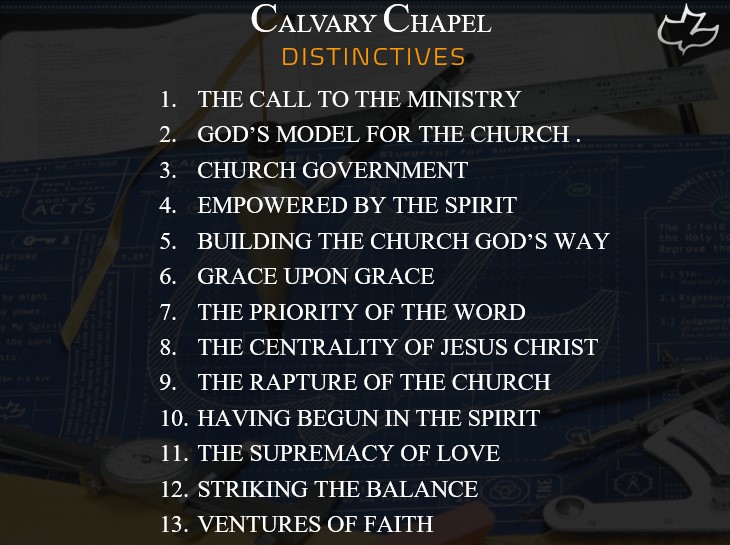
]]>What is it that makes Calvary Chapel different from other Bible-believing, evangelical churches? It’s always good to have a grasp of the unique work that God has done in our fellowship. If Calvary Chapel is exactly like the church across the street it would be better to simply merge the two. But, if there are distinctives that make us different, then we have a unique and special place in the plan of God. Certainly there are churches that share many of our beliefs and practices. We’re not renegades. But God has done a wonderful work of balance in the Calvary Chapel movement that does make us different in many areas.
In this teaching Pastor Barry concludes our study of the distinctives that set Calvary Chapel apart as we seek to understand God’s plan and purpose for us as individuals and as a fellowship.
The post Calvary Chapel Distinctives Pt2 first appeared on Calvary Chapel Portsmouth.
]]>The post Malachi Ch1-2 first appeared on Calvary Chapel Portsmouth.
]]>Malachi (whose name means ‘my messenger’) comes onto the scene around 60 years after the Jews had returned from the captivity in Babylon. Dr Chuck Missler comments:
- “The Temple was rebuilt; priestly worship carried on; but the people had fallen into spiritual decline, and their attitudes developed later into the sects of the Pharisees and Sadducees”
Malachi, as God’s messenger to the people challenges the people’s apathy and idolatry. God is a God of love, so much so that Malachi refers to God’s love for Israel as a burden, but God is also a God of justice and cannot condone of overlook sin.
Malachi warns the people that God’s judgment is coming. Only after that will they once again return to the LORD and walk in His blessing.
Malachi is the third & last of the post-exile prophets (Haggai and Zechariah being the other two).
–Written around 486-464 B.C.
- His name means ‘My messenger’
- Jewish tradition states that Malachi was a member of the “Great Synagogue,“ and a Levite from Supha, in Zebulun
- Through Malachi God speaks one more time to the nation before the ‘big day’
- Israel had become apathetic, entering into mixed marriages & withheld that which should have been given to the LORD
The message of Malachi could just as easily have been written directly to us:
- God has delivered us from out captivity
- Do we now think we can just live and worship in the way we please?
- Have we become apathetic?
- Have we entered into mixed marriages with the things of this world?
- Have we withheld from God that which we should have given Him?
- Maybe God is speaking to us one last time before our ‘big day’?
The outline of the book is as follows:
- Introduction 1:1
- God’s unchanging love for His own 1:2-5
- The total failure of the priests 1:6-2:9
–The priests should preserve knowledge!
- Their failure to value covenants 2:10-16
–Their covenant with God, symbolised by the covenant of marriage
- The Messiah’s coming in judgment 2:17-3:6
- Israel’s sin yet future restoration 3:7-18
- The coming & mission of Elijah 4:1-5
May you be blessed and encouraged by this study.
The post Malachi Ch1-2 first appeared on Calvary Chapel Portsmouth.
]]>The post 1 John ch4 first appeared on Calvary Chapel Portsmouth.
]]>In this chapter John reminds us again that false prophets have come, and will continue to deceive until the finally global deception is unveiled in the person of Antichrist.
The world is being conditioned right now to unconditionally accept a global leader who will bring peace and order out of the world’s chaos. Covid 19 is proving to be an interesting test case for what is to come. The world is more ready than ever before to do away with cash and move to electronic payment – something that will become compulsory under Antichrist’s regime. We are becoming all too familiar with having someone point a digital thermometer at our hand or head to check our temperature; we are also used to the idea of ‘track and trace’ to keep tabs on where we have been and who we might have come into contact with. How long do you suppose it will be before all of these things are combined into some form of implant, in the right and or forehead, that will track and trace, take our temperature, and be able to be used as currency – it would be a lot easier and safer to scan your hand or forehead and would prevent almost all fraud! Yet the Bible says that all this – regardless how practical and good it might sound to many – will usher in a system where all the world will be required to worship Antichrist. Those who do will forfeit their chance of eternity with God, leaving just one other option.
John then goes on to remind believers that God has shown His incredible love to us – as undeserving as we were – so we in response should freely show our love for our fellow brothers and sisters in Christ. His Holy Spirit places within us the Love of God and it should simply overflow to those around us.
1 Corinthians 13 is considered the chapter on Love in the NT, yet 1 John 4 should be considered a contender!
- 27x in this chapter John speaks of Love
- In verse 10 John will give us the definition of Love, and it is diametrically opposed to the world’s view!
It is unconditional giving to another without thought of what you will get in return.
- We say “I love you” and we mean, “I love how you make me feel” – or “I love what you do for me”
- True love says: “I love what I can do for you! I love how I can bless you”
John also makes that point that no one has seen God (v12). This echoes what we read in John 1:18: “No man hath seen God at any time; the only begotten Son, which is in the bosom of the Father, he hath declared him”.
Yet in Genesis 18:20-33, Abraham has a face to face conversation with God. In Genesis 32:24-30, Jacob not only sees God face to face, he wrestles with Him all night. In Exodus 24:9-11 Moses and the elders of Israel go up the mount, see God, and eat and drink in His presence! Later, Moses specifically asks God if he can see Him, God obliges on the condition that Moses can only see the ‘after glow’ of God’s presence as He passes by. Later, Joshua, Gideon, Samson’s parents and others see God, and their lives are spared. So how do we reconcile this issue?
The key is found in John chapter 4, verse 24. There we read: “God is a Spirit: and they that worship him must worship him in spirit and in truth” As a spirit being, God does not have a physical body. Physical objects are part of this order of things; ‘In the beginning (time), God created the heavens (space) and the earth (matter)’ (Gen 1:1). Before this, there was no time, no space and no matter. All three came into existence when God began His work of creation. It is therefore impossible for us, in this present order of things to see a God who ‘inhabits eternity’.
There will come a time when we will see Him…
“Beloved, now are we the sons of God, and it doth not yet appear what we shall be: but we know that, when he shall appear, we shall be like him; for we shall see him as he is.” (1 John 3:2)
“For now we see through a glass, darkly; but then face to face: now I know in part; but then shall I know even as also I am known.” (1 Cor 13:12)
Thus, no man has seen God as He truly is. For now, God has chosen to reveal Himself through physical manifestations as noted in the scriptures above. Jesus Christ is the ultimate (and final) physical manifestation of God. It is important to note that Father, Son and Spirit, all existed before the beginning, before matter. The Son did not ‘come into being’ at the point of conception with Mary; the Son has always existed, and has always enjoyed a relationship with the Father and the Spirit. For God’s purposes, the Son became a man (became flesh) and dwelt among us to declare the Father to us; to be a ‘lamp to our feet & a light to our path’ (thy Word is… Psalm 119:105), and to ultimately show us God.
May you be blessed and encouraged by this study.
The audio and PowerPoint slides used in this teaching are available for free download.
The post 1 John ch4 first appeared on Calvary Chapel Portsmouth.
]]>