The post Ruth – Session 5 first appeared on Calvary Chapel Portsmouth.
]]>Having gone verse-by-verse through the Book of Ruth, in this session we look at the models that God had intentially woven into the naritive of this incredible book.
We will see how the story itself is a model of the gospel; how Naomi is a type of Israel, Ruth a type of the Church, Boaz a type of Christ, Orpha a model of the unbeliever, and even the position of the book is by Diving design!
We also look at the one character that, up to now, has not been mentioned! He plays a major role and yet is never mentiond in the book! But unlocking the mystery of this man who ‘hides in plain sight’ it helps us to see the brethtaking magnitude of God’s plan of Redemption!
May you be blessed and encouraged by this study!

The post Ruth – Session 5 first appeared on Calvary Chapel Portsmouth.
]]>The post Ruth Chapter 4 first appeared on Calvary Chapel Portsmouth.
]]>In this final chapter of the book of Ruth we see Boaz go up to the city gate to settle the legal right of redemption before ten elders of the city. Though a nearer kinsman initially agrees to buy the land, he quickly backs out when he learns he must also marry Ruth the Moabitess, refusing to risk marring his own inheritance. Boaz triumphantly steps forward to perform the kinsman’s part, drawing off the shoe to confirm the covenant, buying back all that belonged to Elimelech’s family, and purchasing Ruth to be his wife. This magnificent climax beautifully mirrors how Jesus Christ made Himself of no reputation, willingly making the sacrifice to purchase His Gentile Bride and buy the field of this world. Ultimately, Ruth’s barrenness is turned to fruitfulness in Bethlehem as she brings forth Obed, completing a breathtaking design that perfectly anticipates the lineage of King David and the ultimate restoration of blessing.
We look at the Biblical significance of ‘gates’, ‘shoes’, ‘the tenth man’ and discover an incredible hidden code within the text of Genesis 38 and see how this highlights God’s preference for using what the world disqualifies. David’s line should have been ruined by the shame of Genesis 38. The line was infused with Gentile blood through Tamar, Rahab and Ruth the Moabitess. Yet, God took a line that was legally “shut out” for ten generations, redeemed it through a faithful Kinsman-Redeemer (Boaz), and used the tenth man to establish the eternal royal throne of Israel.
It serves as a direct blueprint for how Jesus (the ultimate descendant of this line) takes our spiritually bankrupt, disqualified status and legally qualifies us to sit with Him in heavenly places!
May you be blessed and ancouraged by this study.
The post Ruth Chapter 4 first appeared on Calvary Chapel Portsmouth.
]]>The post Ruth Chapter 3 first appeared on Calvary Chapel Portsmouth.
]]>The book of Ruth is one of the most amazing in the bible on account of the models and types found in its 86 verses. The surface narrative of the Book of Ruth is a literary masterpiece, it is the perfect ‘rags to riches’ story. But concealed within the text we have:
‒The entire gospel from Genesis to Revelation
‒The history and future of the Nation of Israel
‒The account of the Kinsman Redeemer who is willing to forfeit his own standing to claim a gentile bride
‒The jubilee principle, where that which was lost is found, where the land is returned to its rightful owner
‒The reason for Bethlehem’s significance
‒The practical demonstration of Romans 8:28
Chapter 3
In chapter 3 we see Naomi genuinely concerned about Ruth’s future happiness so poses the question ‘My dear Ruth, have you thought of getting remarried and settling down?’
It is interesting that we find Naomi use the expression ‘seek rest’ as an idiom for marriage. Throughout scripture the idea of rest is prophetically linked to the marriage of the Bride and our Heavenly Groom. The ultimate rest will be found in Him, when we are joined to Him and free from the toil and trials of this world. The Hebrew word for rest is ‘manowach’ (maw-no’-akh); which literally means ‘quiet’, i.e. (concretely) a settled spot, or (figuratively) a home. This is how a marriage should be, a place of loving fulfilment and peace. As Matthew Henry comments: “A married state is, or should be, a state of rest to young people. Wandering affections are then fixed, and the heart must be at rest.”
Sadly, we are bombarded with the world’s view of marriage as a place of strife and turmoil, where dreams go to die and to endure is the best we can hope for.
Love is hard to conceal and it may well have been that Naomi had already noticed a spark between Ruth and Boaz, after all, it would seem they had spent a couple of months daily in each other’s company by this point in time. Ruth however, being a foreigner, would no doubt have felt it not her place to initiate anything with her wealthy relative.
Signifcantly, we finally see Ruth and Boaz together at the end of the harvest! What a picture of Christ and the church, who will be finally united once the time of eartholy harvest is over and His ‘wheat’ has been safely gathered into His barn (see John 14:2-3 & 1 Thes 4:16-17).
There are many lessons to glean from this chapter! May you be blessed and encouraged as you study God’s Word.
The post Ruth Chapter 3 first appeared on Calvary Chapel Portsmouth.
]]>The post Ruth Chapter 2 first appeared on Calvary Chapel Portsmouth.
]]>In this study we continue over verse-by-verse joutney through the book of Ruth. It has been said that this book stands out like a diamond on a black cloth, ‘a beautiful day in the midst of a season of storms’. Spurgeon said “The Book of Ruth is like a lovely flower in a garden of weeds. It shows us that even in the darkest times of the Judges, God had a people, and His grace was at work in the most unexpected places”.
If the surface story in the book of Ruth is wonderful, then the models that God has given us are nothing short of breath-taking! As we look at the similitudes, we will begin to see how this book is a wonderful and powerful model that prefigures God’s work of redemption and plan for mankind. Specifically, we see how Naomi, as a type of Israel, through unbelief and rejection of God is expelled from the land, being dispersed among the gentiles, later to be brought home in bitterness before being restored. •We also see Ruth, as a type of the Church, being a gentile bride who finds grace in the eyes of Boaz who, as a Kinsman-Redeemer, purchases her for himself! •Then there is the land itself; as in the book of Ruth where the land was lost, only to be redeemed again by Boaz, so Adam lost the ‘title deed’ of this earth to Satan, only to find that the Second Adam, our Kinsman-Redeemer will redeem this earth and claim back what Adam lost!
Chapter 2
As we move into chapter two we meet the kinsman-redeemer, Boaz, who was of the family of Elimelech.
The opening verse is the type of verse that preachers like Spurgeon would have spent an entire sermon expounding! We must be careful not to just read over the magnitude of what this verse is saying, for it ultimately speaks of Jesus Christ. Psalm 40:7 tells us “in the volume of the book it is written of me”, and many Bible commentators have pointed out that you can find Jesus on every page of the Bible, either boldly presented, or subtly concealed in the types, shadows and details. Proverbs 25:2 says: “It is the glory of God to conceal a thing: but the honour of kings is to search out a matter”, and Paul explains, in regard to the feasts of Israel, that they too are “a shadow of things to come; but the substance (i.e. the fulfilment) is of Christ” (Col 2:17).
It seemed to have slipped Naomi’s mind that there was a relative who could, potentially at least, act as the kinsman-redeemer, to purchase back that which had belonged to Elimelech. As we will go on to see, Boaz was a wealthy man and of great standing in the community, but it’s when we turn to the types and shadows we see the depth in this verse. Four key facts that are revealed:
1) Naomi had a kinsman,
2) He was a mighty man of wealth
3) He was of the family of Elimelech
4) His name was Boaz
Firstly, Naomi had a kinsman: Later in the book we will not find Naomi complaining that she didn’t have a number of able kinsmen who could have redeemed her, nor will she complain that it was too restrictive, narrow and dogmatic to only have been offered one way out of her predicament – a predicament that had been brought about by her decision to leave the Land God had given her, ultimately, the lust of the eyes, the lust of the flesh, and the pride of life (1 John 2:16). The incredible fact here is the Naomi had a kinsman, there was a way, it was possible for a sinner to be restored because there was a kinsman-redeemer! Of course this speaks of Jesus; He is The way, The truth and The life. None can come (back) to the Father but through Him (John 14:6). The world may foolishly complain that Christianity is too exclusive, that it is narrow and dogmatic to affirm there is just One way to heaven – through Jesus Christ, but the most amazing fact is, that there is A way. It is actually possible. We have a Kinsman; one who is able and willing to redeem us (purchase us back). Furthermore, our Kinsman came to rescue us while we were yet sinners, lost and alienated from the commonwealth of Israel (just as Naomi had been).
“For when we were yet without strength, in due time Christ died for the ungodly. For scarcely for a righteous man will one die: yet peradventure for a good man some would even dare to die. But God commendeth his love toward us, in that, while we were yet sinners, Christ died for us. Much more then, being now justified by his blood, we shall be saved from wrath through him” (Rom 5:6-9).The second point to mention is that ‘he was a mighty man of wealth’. Speaking of Boaz, we know that he was a wealthy land owner with a number of servants, and also that he was a man of great importance within the town, and the Hebrew implies he was mighty in valour. But this verse also speaks of Jesus. You could have a mighty man who had little in the terms of wealth; or you could have a wealthy man who had little or no might, but our Boaz (Jesus Christ) is both Mighty and of unfathomable wealth. Not only do we have a Kinsman, but He is mighty to save (Isaiah 63:1); He is the captain of the armies of the LORD (Joshua 5:14), who will destroy His enemies with the brightness of His coming (2 Thess 2:8).
In regard to His wealth, Paul says: “O the depth of the riches both of the wisdom and knowledge of God! how unsearchable are his judgments, and his ways past finding out!” (Rom 11:33) God’s riches are not just confined to the material, and here Paul speaks of the unfathomable depth of the riches of both God’s wisdom and knowledge. God is all knowing, all powerful and all wise. I wonder how poverty stricken Ruth felt to discover she was related to a philanthropist millionaire? How would you react to such a discovery? To discover that you have such a Kinsman in Jesus Christ, who is willing and able to redeem you, provide for your, establish you, and Whom will never forsake you, should fill your heart and mind with unspeakable joy and peace!
The third fact we are told is that Boaz was of the family of Elimelech. As we have noted, the name Elimelech means ‘God is my king’. Boaz was of the family of ‘God is my king’; his was a Godly family. His mother was Rahab, a gentile who had been saved by her faith in Yeshua. Although Rahab had once been known as a harlot, even by the time we are introduced to her in the book of Joshua, there is evidence that her life was changing, for we are told she was drying flax in the roof of her house. This was time consuming and would have been to produce garments for sale, to earn her living in a more honourable way (linen etc. was made from flax). Rahab’s encounter with the God of Israel changed her forever, and as Jesus Himself testified of another ex-harlot “Wherefore I say unto thee, Her sins, which are many, are forgiven; for she loved much: but to whom little is forgiven, the same loveth little” (Luke 7:47). As with Boaz, Christ also is of the family of ‘God is my King’. God alone was His King; He came to do the will of His Father (John 5:30 / 6:38). Only one who seeks first the kingdom of God can be truly pleasing to Him (Matt 3:17 / Matt 6:33).
Finally, we are told that ‘his name was Boaz’. Boaz’ name means ‘to strengthen’. You can mix sand, stones and water together all day long and you will have a soggy mix of sand, stones and water. However when you add cement to your sand, stones and water you have something that you can make the largest buildings from. This is what Christ does for us. He puts into us something that was not there before. “I can do all things through Christ which strengthens me.” (Phil 4:13). Christ is our strength, and His strength is made perfect in our weakness (1 Peter 5:10 / 2 Corinthians 12:9). He was strong enough to endure temptation in the wilderness, to endure the trial in Gethsemane, to endure the mockery and scourging of the Pharisees and Romans, to endure the agony and humiliation of crucifixion, and ultimately to endure the wrath of God poured on Him for the sins of the world. What strength! What a Saviour!
“For consider him that endured such contradiction of sinners against himself, lest ye be wearied and faint in your minds” (Heb 12:3). Boaz must have make an impression on his great grandson, Solomon, for when Solomon was building the temple “ he reared up the pillars before the temple, one on the right hand, and the other on the left; and called the name of that on the right hand Jachin, and the name of that on the left Boaz.” (2 Chron 3:17) Jacinth means ‘to establish’, and Boaz, ‘to strengthen’.
As we continue through this chapter there are many more insights and shadows that point to Christ.
May you be blessed and encouraged by this study.
The post Ruth Chapter 2 first appeared on Calvary Chapel Portsmouth.
]]>The post Ruth Chapter 1 first appeared on Calvary Chapel Portsmouth.
]]>The book of Ruth is considered one of the most beautiful stories in the Bible. The events recorded took place during the time of the judges, which was a period of national spiritual chaos and darkness where ‘every man did that which was right in his own eyes’ (Judges 21:25) Against this background the book of Ruth stands out like a diamond on a black cloth, a beautiful day in the midst of a season of storms. However this book is far more than just a story of love and commitment. As we will discover, the key theme to the book is ‘redemption’. One dictionary definition of ‘redeem’ is: “to recover possession or ownership of by payment of a price or service; regain” On the surface we see the account of Naomi and her loss and subsequent regaining (redemption) of that which was lost. We also see the redemption of the land that had been sold, and the redemption and purchasing of Ruth by a kinsman-redeemer named Boaz. However, as we will see, the book also has another level. In Hosea 12:10 God says: “I have also spoken by the prophets, and I have multiplied visions, and used similitudes, by the ministry of the prophets.”. The word ‘similitudes’ means a ‘type’ or a ‘model’. A model is simply a representation of something for our insight and instruction.
If the surface story in the book of Ruth is wonderful, then the models that God has given us are nothing short of breath-taking! As we look at the similitudes we will begin to see how this book is a wonderful and powerful model that prefigures God’s work of redemption and plan for mankind. Specifically we see how Naomi, as a type of Israel, through unbelief and rejection of God is expelled from the land, being dispersed among the gentiles, later to be brought home in bitterness before being restored. We also see Ruth, as a type of the Church, being a gentile bride who finds grace in the eyes of Boaz who, as a Kinsman-Redeemer, is a type of Jesus. Then there is the land itself; as in the book of Ruth where the land was lost, only to be redeemed again by Boaz, so Adam lost the ‘title deed’ of this earth to Satan, only to find that the Second Adam, our Kinsman-Redeemer will redeem this earth as we see unfolded in the book of Revelation.
For a book that is only 85 verses long, it is truly amazing!
As we have noted, there are at least 3 levels to the book:
- Firstly, it is an historical account of the events that took place at that time
- Secondly, it serves as a tutor for all who read it in regard to commitment, faithfulness and trust. The lessons we learn here are practical instructions for every day living.
- Thirdly, it is a model laid out in advance of God’s plan of redemption through Jesus.
In the 85 verses:
- God’s name is used 17x (When you see LORD written in capitals it means that in the Hebrew it was written as YAWH, which we pronounce as ‘Yahweh’ or ‘Jehovah’ and was considered by the Jews to be the unpronounceable name of God.) ‘the God who keeps His covenants’
- El hoeim is used x 3 (this is the plural for God and hints at the trinity – Father, Son & Spirit.) – ‘the Creator God’
- El shadai x 2 – God almighty / all powerful
- Redeem / Redeemer / Kinsman over 20 x in just 85 verses.
Hence the theme of the book is established as the ‘redemption by God’.
Timing: – As we have mentioned the events in the book of Ruth occurred during the time of the Judges (Ruth 1:1). Judges itself covers the period around 1400 – 1050 B.C. We know from the genealogy in Matthew 1 that Boaz’s father was Salmon and his mother was Rahab – who was spared in the destruction of Jericho by Joshua. This would place these events fairly early on and probably around the time of chapter 3 – 4 of Judges. It is just a conjecture but we read in Judges 3 that God raised up a man called Ehud to deliver Israel from the hand of the King of Moab. After Ehud’s personal victory, we read in verses 27 – 30, how Ehud blew a trumpet in Ephraim and rallied an army that went and defeated the Moabites. It may have been that Elimelech, being from that area and old enough to fight, was part of the army that went into and conquered Moab. We are told that as a result of this victory: “So Moab was subdued that day under the hand of Israel. And the land had rest fourscore years.” (Judges 3:30) Given this situation, it would make sense that Elimelech, having already been to Moab on a military exercise, and in order to escape the famine now in Israel, chose to take his family to a land that Israel had subdued and was therefore under Israeli control at that time.
If this conjecture is correct, how ironic (and yet familiar in our own circumstances) that whilst being given a victory from God, Elimelech was impressed by the land of Moab, and hence it becomes the place he chooses to go to at this time. The blessing that God had given became the very thing that drove him and his family away from their God. How often have we enjoyed blessings from God’s hand, only to let them become that thing that drives a wedge between us and God? Maybe you have prayed that God will give you a new job, but when you get it you find that now you are too busy to read the Bible or pray anymore, or attend church meetings; maybe you have prayed for a child, only to find that when God answers your prayer, unlike Hannah in 1 Samuel, you don’t always go to church because you want to spend time with your family. The list goes on so fill in the blanks. Blessings that are not given back to God but kept for ourselves are like the manna that was taken and ‘hid under the tent’, they turn to rottenness. (See Exodus 16:14-20)
Author? – Some think that it may have been Samuel and that one of the reasons for writing the book was to show the genealogy of King David as recorded in chapter 4.
Position of the book: It is interesting to note that the book is the eighth book in the Bible. Eight signifies new beginnings – 8th note in an octave is the start of a new octave; 8th day of the week is the start of a new week; 8th colour in the rainbow starts a new spectrum etc. The book records a new beginning for Naomi, Ruth and Boaz and prophetically speaks of a new beginning for Israel, the Church and Jesus who will be united with His bride and begin to rule.
The book is a story of grace and bridges the gap between the darkness and chaos of the times of the Judges and the time when God’s appointed king will be established in Jerusalem as recorded in Samuel. Again, viewed prophetically, the world was in spiritual darkness until Jesus came, who is the light of the world. Since the cross we are now living in a period of God’s grace and are looking forward to God’s appointed King of Kings to establish His throne and rule from Jerusalem.
Importance of the book: All scripture is God-breathed and is profitable for doctrine, reproof, correction and instruction in righteousness so that we might be thoroughly furnished – have all that we need – in order that we might do work of Him who called us. This book is no exception; there is abundant instruction here.
Without this book the reason why the Messiah was born in Bethlehem would not be known, and the field that the shepherds were in when the angel spoke may have been unoccupied if it were not for the events that take place here. Again, as we have noted many times, this book serves to remind us that there are no meaningless details in the Bible. Every number, every word, every name and every place-name are all there by deliberate supernatural design proving once again that the Bible is the work of someone outside of our space-time who can tell the end from the beginning and from ancient times things not yet done!
(2 Timothy 3:16 / Isaiah 46:10)
May you be blessed and ancouraged by this study.
The post Ruth Chapter 1 first appeared on Calvary Chapel Portsmouth.
]]>The post Ezekiel Chapters 4-6 first appeared on Calvary Chapel Portsmouth.
]]>Ezekiel doesn’t just talk, he acts, he demonstrates, he graphically portrays. With great persistence!
Three major events were prophesied: Seige of Jerusalem; acting out many small details; about Israel being scattered among the nations (The Gentiles).
Pastor Barry made the following points as he went along:
– Israel was to be scattered (across the world)
– Lots of laws about eating
– Cooking with dung as heat source (Ezekiel given the choice between two types!) – designed to provoke horror in the people who saw it!
– Activities were designed to attract attention and provoke strong reactions
– Rationing of food & water made obvious
-The various conditional rulings are also given (“if this then that, otherwise …!.!)
A large section is devoted to the arithmetic of the lengths of sections of the history of Israel and the detailed prophecies defining them. Pastor Barry even describes a computer program that is provided by astronomers for examining planetary and stellar movements and which he used for examining times between specified dates, or dates that arise after a specified number of days.
Several examples are presented and the correspondence between prophecies and the dates of recent events is “staggering”.
Ezekiel’s hair plays a prominent part in the next section. The prophetic significance of cutting it (the shock-value) is detailed. Other defilements and their consequences are outlined. The modern-day situation of the Jews around the world is mentioned.
By the end of chapter 5 the pile of many punishments has grown!
In chapter 6 the land itself is being prophesied against!
The comparison with today – the idols that people set up for themselves – is touched on next.
A working out of prophecies which began in 1867 is described in some detail next (right up to the 1948 climax).
The Lord’s lament over the behaviour of the Israelites is highlighted and then God’s motives in the events that He is going to bring about are noted (“God wants to bring Israel back to him”). The progress along the way to that goal is noted (i.e. “Still in progress”)
Pastor Barry finished with the current trend of history and the likely worsening of Israel’s problems (as foretold by Jeremiah “The time of Jacob’s trouble”) but with the hope of a good outcome.
>>>>>>>>>>>>>>>>>>>>>>>>>
PS1 ::::: TRANSCRIPT OF THE SERMON
There is a “button” labelled “Save Video” (or “Download Video” sometimes). This is actually a text-file. It is a transcript of the sermon. At present it is at an experimental stage: it is an aid to getting the most out of the sermon audio. There is no substitute for listening to the verbal delivery of a sermon. However, searching through an audio file lasting the best part of an hour can be somewhat difficult. When you approach the search knowing that you’re sure you heard something about “redemption”, for example, then a transcript text-search can take you right there and show you the time in the recording where you will find it! The file is simple “text” rather than a more sophisticated form so that you can edit or reformat as you prefer. This transcript is in 2 forms (in the one file). One half consists of normal text arrangement of paragraph-blocks. These blocks have purely arbitrary boundaries (i.e. no attempt at grammatical accuracy). The boundaries are inserted at about 800 character intervals, purely to avoid having one huge unbroken deluge of text. The other section is short bunches of words (8 to 12 normally) beneath the TIMES at which they occur (for the whole sermon).
This facility is in development (“experimental” as mentioned above) so any feedback on usefulness, improvement suggestions, or whatever, would be most welcome.
The post Ezekiel Chapters 4-6 first appeared on Calvary Chapel Portsmouth.
]]>The post Romans 11 28-36 first appeared on Calvary Chapel Portsmouth.
]]>Paul’s assertion that Israel’s current spiritual blindness is temporary, and a future restoration assured, is not merely his opinion, but is firmly rooted in Old Testament prophecies. The sheer volume of scripture dedicated to Israel’s disobedience, dispersion, regathering, and restoration underscores its centrality to God’s redemptive plan.
May you be blessed and encouraged by this study.
The post Romans 11 28-36 first appeared on Calvary Chapel Portsmouth.
]]>The post Romans 11:26-27 first appeared on Calvary Chapel Portsmouth.
]]>Not only does the Apostle Paul state that Israel’s national spiritual blindness will be removed, but he tells us when it will happen, and the circumstances that will lead to it.
This topic is key to understanding scripture and the times we are living in.
May you be blessed and encouraged by this study.
The post Romans 11:26-27 first appeared on Calvary Chapel Portsmouth.
]]>The post Romans 11:1-25 first appeared on Calvary Chapel Portsmouth.
]]>That’s the question Paul asks in Romans chapter 11.
His emphatic answer should put an end to the debate, yet sadly, antisemitism has been as rife in the Christian church through the centuries as it has in the world.
Here, Paul not only makes his case from scripture, but warns against those who would just dismiss Israel.
Yes, ‘national Israel’ have been blinded, but that blindness is only temporary. Once God had gathered in all the Gentiles who will accept His call and the free-gift of Salvation through Jesus, Israel’s blindness will be removed and ‘so all Israel will be saved’ – both the believing remnant who formed the early church, and the unbelieving Jews who were blinded for their rejection of their Messiah.
May you be blessed and encouraged by this study.
The post Romans 11:1-25 first appeared on Calvary Chapel Portsmouth.
]]>The post Romans 10 – Introduction first appeared on Calvary Chapel Portsmouth.
]]>In Matthew 23:37-39 Jesus outlines Israel’s past, present & future.
O Jerusalem, Jerusalem, thou that killest the prophets, and stonest them which are sent unto thee, how often would I have gathered thy children together, even as a hen gathereth her chickens under her wings…
This tells us the purpose of all history: that God might gather His children together. (Jerusalem is a synecdoche for all of Israel). The image of the mother bird gathering and covering her brood is a familiar one. Moses used it in his farewell sermon (Deut. 32:11). It is a picture of love, tender care, and a willingness to die to protect others. Jesus did die for the sins of the world, including the nation of Israel: but “His own received Him not” (John 1:11).
Israel’s past is the underlying theme of Romans chapter 9.
and ye would not! Behold, your house is left unto you desolate.
As Chuck Missler says: The purpose of all history was that God might gather His children together. The tragedy of all history is that through disobedience and rejecting their Messiah, Israel ‘would not’, and consequently ‘her house has been left desolate’, with the Jews scattered around the world.
This sums up Israel’s present condition and is the underlying theme of Romans chapter 10.
For I say unto you, Ye shall not see me henceforth, till ye shall say, Blessed is he that cometh in the name of the Lord.
Jesus left the nation with a promise: He would one day return, the nation would see Him and say, “Blessed be He that cometh in the name of the Lord!” This is a quotation from Psalm 118:26, that great messianic psalm that was quoted so many times in His last week of ministry. The crowds had used those very words (Matt. 21:9). This is a statement of the hope Israel has, and that Paul alludes to, that the Nation of Israel will be regathered and restored, albeit a remnant.
This future hope is the theme of Romans chapter 11.
May you be blessed and encouraged by this study.
The PowerPoint slides used in the study are available for free download.
The post Romans 10 – Introduction first appeared on Calvary Chapel Portsmouth.
]]>The post Romans 9 1-5 Pt2 first appeared on Calvary Chapel Portsmouth.
]]>We see how God has used the Nation of Israel to reveal Himself to the world, and intertwined in their ‘appointed times’ and Feast days we see evidence of God’s divine control of history. We also look at 10 belssings, alluded to by the Apostle Paul, unique to the Nation of Israel found in Roamns 9: vs 1-5.
Note: Additional slides detailing the four unconditional covenants God has made with Israel, along with a summary of the history of the Nation are also included for further study.
May you be blessed and encouraged by this study given by pastor Barry on 12th January 2025.
If you want to support this ministry you can donate here: https://www.calvaryportsmouth.co.uk/product/make-a-donation/
The post Romans 9 1-5 Pt2 first appeared on Calvary Chapel Portsmouth.
]]>The post Romans 9 1-5 Pt1 first appeared on Calvary Chapel Portsmouth.
]]>It is a topic we cannot ignore! From Genesis 12 to Acts 2, the Nation of Israel is the major theme of the Bible; and we cannot escape the fact that Jesus was Jewish, as was all the early Christian church.
In chapters 9 to 11 of the book of Romans the apostle Paul asks the question, if God is so faithful and his promises sure, why have Israel as a nation been ‘cast off’? and what is to be the future for them? Have they really forfeited the blessings God promised them? Is it true that these blessings, (promised to Abraham, Isaac, Jacob and their biological descendants), now somehow fall on the church, as many in today’s church claim?
In this first part of our study on the opening five verses of Romans chapter 9, we look at some of the promises God made to Israel and consider the history of this nation, a nation unlike any other in the history of the world, and look at the staggering prophecies that foretold their future in advance.
May you be blessed and encouraged by this study given by pastor Barry on 5th January 2025.
If you want to support this ministry you can donante here: https://www.calvaryportsmouth.co.uk/product/make-a-donation/
The post Romans 9 1-5 Pt1 first appeared on Calvary Chapel Portsmouth.
]]>The post Romans Ch4 first appeared on Calvary Chapel Portsmouth.
]]>How can a just God justify sinful man? It doesn’t matter how good we may think we are, even our highest standard still falls short of the perfection of a holy God.
None of us could earn heaven by our efforts, no matter how hard we tried.
So how does God demonstrate His mercy and yet maintain His righteous justice?
The Apostle Paul takes us to two Old Testament examples, Abraham and David, to show that Salvation is not by works, nor by the keeping of the law, but by faith in His grace alone. But that faith will show itself to be genuine by the fruit it produces.
May you be blessed and encouraged by this study.
The post Romans Ch4 first appeared on Calvary Chapel Portsmouth.
]]>The post Romans Ch2 first appeared on Calvary Chapel Portsmouth.
]]>
May you be blessed and encouraged by this study.
The post Romans Ch2 first appeared on Calvary Chapel Portsmouth.
]]>The post Romans Ch 1 8-32 first appeared on Calvary Chapel Portsmouth.
]]>In this chapter Paul addresses the plight of the immoral / pagan man who has willfully rejected God, chosen to worship creation rather than the Creator, and reaped the consequences of wanting to do it ‘my way’!
May you be blessed and encouraged by this teaching.
The post Romans Ch 1 8-32 first appeared on Calvary Chapel Portsmouth.
]]>The post 1 Corinthians 10:1-12 first appeared on Calvary Chapel Portsmouth.
]]>In these verses, Paul builds the theme of the previous two chapters, namely, that we should be careful that our so-called ‘knowldge’ doesn’t become a stumbling block for another believer, and that we should be careful that our confidence, which can quickly become apathy, does not cause us to fall!
In his summary David Guzik says the following:
“i. In 1 Corinthians 8, Paul established two principles. First, an idol really is nothing, and it was fine for Corinthian Christians who understood this to act according to this knowledge, in regard to themselves. Second, for Christians love is more important than knowledge. So even though I may “know” eating meat sacrificed to an idol is all right for myself, if it causes my brother to stumble, I won’t do it, because it isn’t the loving thing to do.
ii. In 1 Corinthians 9, Paul showed how important it is for Christians to give up their “rights.” Just as Paul gave up his “right” to be supported by his own preaching of the gospel, so some of the Corinthian Christians must sometimes give up their “right” to eat meat sacrificed to idols, based on the principle of love towards a weaker brother. In the end of chapter 9, Paul showed how a Christian must be willing to give up some things – even “good” things – for the sake of winning the race God has set before us, otherwise we will become disqualified (1 Corinthians 9:27) in the competition of the Christian life.”
Now in this chapter Paul takes us back to consider the Children of Israel, who, despite their incredible beginning, being delivered from Egypt, passing through the midst of the Red Sea, seeing water come pouring from a rock, seeing God descend on Mt Sinai in fire… despite all of this they still stumbled and fell.
Paul urges us to not make the same mistakes.
Tragically, when we look at the history of Israel and compare it to the history of the Church, we see that the Church has made exactly the same mistakes. It seems we have learned nothing!
See the following comparission:
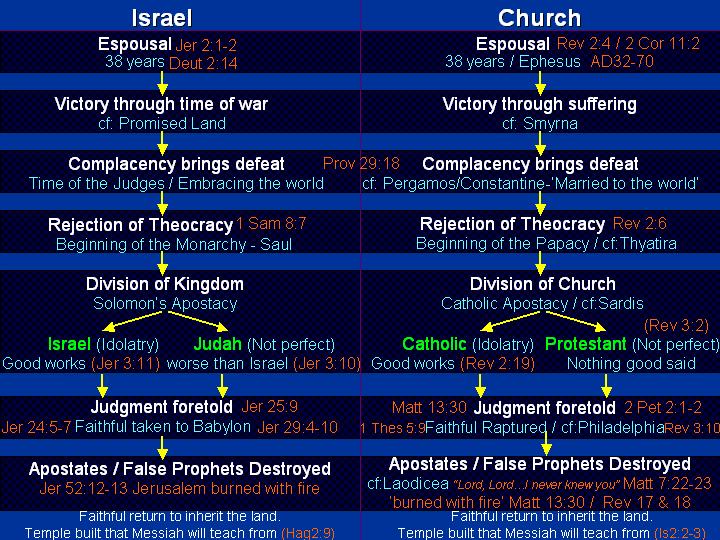
In this incredible evidence of design, we see a parallel of Israel’s history that has been repeated by the church.
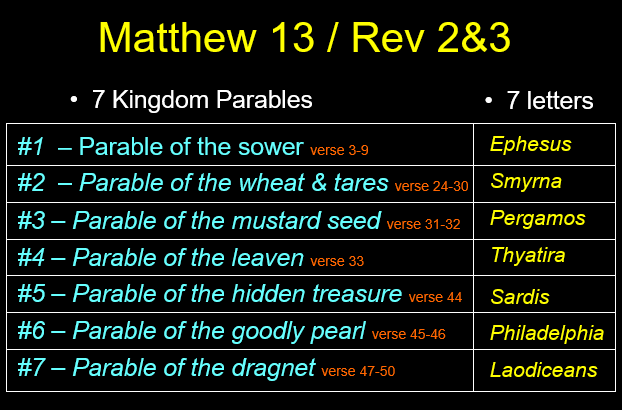
As an interesting study, compare the 7 parables in Matthew 13 with the 7 letters in Revelation 2 & 3.
May you be blessed and encouraged by this study
The post 1 Corinthians 10:1-12 first appeared on Calvary Chapel Portsmouth.
]]>The post Luke Ch22 first appeared on Calvary Chapel Portsmouth.
]]>In this study we look at the day leading up to Jesus’ arrest and trials before the crucifixion.
At the beginning of the chapter Luke gives us an important insight from a Jewish perspective that helps us plot the details of this week and clarify the timings of the events that took place. Rather than just ‘meaningless details’, we discover that Jesus was able to celebrate the Passover meal with His disciples in the upper room on evening of the 14th Nisan (our March/April time) – revealing to His disciples the stunning truth that all along the Passover had pointed to His ultimate death as the spotless Lamb of God, and yet He could still be offered as The sacrificial Lamb the next day, but still on the 14th Nisan as the Law of Moses decreed.
Part of our understanding of this comes from realising that the Jewish Day began in the evening (drawn from the days of Creation where God declared that ‘Evening and Morning were the first day.’).
May you be blessed and encouraged by this study.
The post Luke Ch22 first appeared on Calvary Chapel Portsmouth.
]]>The post Luke Ch21 first appeared on Calvary Chapel Portsmouth.
]]>The PowerPoint slides and notes used in this study are available for free download.
May you be blessed and encouraged by this study.
The post Luke Ch21 first appeared on Calvary Chapel Portsmouth.
]]>The post Luke Ch19:45-48 first appeared on Calvary Chapel Portsmouth.
]]>In this study we look at the incredible events of Palm Sunday. Why was this day so important? Why did Jesus hold Israel accountable for not knowing the significance of this day, and why did Jesus pronounce national blindness on Israel for ‘missing the day of their visitation’?
The answer is found in a prophecy recorded over 500 years beforehand in the book of Daniel chapter 9 – one of the most astonishing prophicies in the Bible!
May you be blessed and encouraged by this study.
The PowerPoint slides used in this study are available for free download.
The post Luke Ch19:45-48 first appeared on Calvary Chapel Portsmouth.
]]>The post Malachi Ch1-2 first appeared on Calvary Chapel Portsmouth.
]]>Malachi (whose name means ‘my messenger’) comes onto the scene around 60 years after the Jews had returned from the captivity in Babylon. Dr Chuck Missler comments:
- “The Temple was rebuilt; priestly worship carried on; but the people had fallen into spiritual decline, and their attitudes developed later into the sects of the Pharisees and Sadducees”
Malachi, as God’s messenger to the people challenges the people’s apathy and idolatry. God is a God of love, so much so that Malachi refers to God’s love for Israel as a burden, but God is also a God of justice and cannot condone of overlook sin.
Malachi warns the people that God’s judgment is coming. Only after that will they once again return to the LORD and walk in His blessing.
Malachi is the third & last of the post-exile prophets (Haggai and Zechariah being the other two).
–Written around 486-464 B.C.
- His name means ‘My messenger’
- Jewish tradition states that Malachi was a member of the “Great Synagogue,“ and a Levite from Supha, in Zebulun
- Through Malachi God speaks one more time to the nation before the ‘big day’
- Israel had become apathetic, entering into mixed marriages & withheld that which should have been given to the LORD
The message of Malachi could just as easily have been written directly to us:
- God has delivered us from out captivity
- Do we now think we can just live and worship in the way we please?
- Have we become apathetic?
- Have we entered into mixed marriages with the things of this world?
- Have we withheld from God that which we should have given Him?
- Maybe God is speaking to us one last time before our ‘big day’?
The outline of the book is as follows:
- Introduction 1:1
- God’s unchanging love for His own 1:2-5
- The total failure of the priests 1:6-2:9
–The priests should preserve knowledge!
- Their failure to value covenants 2:10-16
–Their covenant with God, symbolised by the covenant of marriage
- The Messiah’s coming in judgment 2:17-3:6
- Israel’s sin yet future restoration 3:7-18
- The coming & mission of Elijah 4:1-5
May you be blessed and encouraged by this study.
The post Malachi Ch1-2 first appeared on Calvary Chapel Portsmouth.
]]>The post Zechariah Ch13-14 first appeared on Calvary Chapel Portsmouth.
]]>In this concluding study in our verse-by-verse journey though Zechariah we see Zechariah reiterate the LORD’s promises to His people, Israel.
They will be blessed and one day dwell in peace and safety in their land, but first there must come a time of testing – the time of Jacob’s troubles (Jer 30:7), but though two-thirds of the Jews remaining in Jerusalem will be killed by the armies of Antichrist, Israel will emerge from this fire victorious because the LORD will fight for them.
These chapters allude to some huge geographical and meteorological changes to come and we get a glimpse of just how unlike anything the world has yet seen the ‘Day of the LORD’ will be.
This incredible prophetic book leaves us in no doubt that the kingdom Jesus told us to pray for really is coming! He will soon rule and reign over the whole earth from Jerusalem; the nations of this world will become subject to Him, and the unconditional promises made to Abraham, Isaac and Jacob will be fulfilled.
May you be blessed and encouraged by this book and this study.
The post Zechariah Ch13-14 first appeared on Calvary Chapel Portsmouth.
]]>The post Zechariah Ch6 first appeared on Calvary Chapel Portsmouth.
]]>In this study we look at the last of a series of eight visions that the prophet Zechariah had in one night. Each vision unveiled a little more of God’s plan to restore and rebuild the nation of Israel following the Babylonian captivity. The scope of these visions takes us from 518 B.C. when Zechariah had these visions, to the time ahead of us when Jesus will return to establish His kingdom on Earth.
In this eighth vision Zechariah sees two ‘mountains’ in juxtaposition, as if squaring up for battle. These may well represent the kingdom of Jesus Christ and the kingdom of this world, for we see that in the midst of them come riding four horsemen and chariots that bear a striking resemblance to the four horsemen we see in Revelation chapter 6. These are angelic beings that are ushering in a time of judgment, after which Israel’s enemies will be silenced and our King & high priest will be crowned.
May you be blessed and encouraged by this teaching.
The post Zechariah Ch6 first appeared on Calvary Chapel Portsmouth.
]]>The post Zechariah Ch3 first appeared on Calvary Chapel Portsmouth.
]]>Zechariah was part of the new generation of Jews born back in the land following the Babylonian captivity.
On night, God gave Zechariah a series of visions to encourage and strengthen the hearts of the people, and to reveal to them what their future would be; and even though the Devil himself would stand against them, God was on their side. God had chosen Jerusalem and see that His chosen people would eventually prosper and be at peace when their Messiah would one day establish His kingdom, not only over Israel, but over the whole earth.
In this 4th vision, Zechariah sees his friend and co-worker, Joshua, the High Priest, standing before the throne of God. Satan is there accusing him, tying to discourage him and pointing out his unworthiness – and in type, Israel’s unworthiness to stand before God. But God intervenes and silences Satan. God has chosen Jerusalem; Joshua’s sin is taken away and Joshua’s filthy robes are replaced by clean and perfect garments. As Joshua stands before God on behalf of his people, he is crowned with a mitre. The word mitre derives from the Greek mitra, which signifies a headband or diadem (royal crown).
For Joshua’s faithfulness and obedience God promises him that he will “judge my house, and shalt also keep my courts, and I will give thee places to walk among these that stand by” (Zech 3:7), in other words, be given the rule over the people and over the whole land.
This is the vision, and no doubt, it was a great encouragement to Zechariah, Joshua and the returned exiles; but this was more than just a vision of the present. It was a vision of what will be for the Nation of Israel, and for the whole world.
The Hebrew name ‘Joshua’ (Yeshua) means ‘The Lord Saves’; and when translated into Greek, is the name Jesus! Thus, this whole vision depicts Jesus standing before the throne of the Father on behalf of His people – both Jews and Gentiles. Satan, ‘the accuser of the brethren’ (Rev 12:10), constantly brings accusations and tries to make us think we are unworthy, that we are clothed in ‘filthy rages’ (our best efforts and our sin) none of which is befitting a child of God! But God declares that we have been ‘plucked from the fire’, pulled out before we were consumed by His wrath, because He has pronounced us clean!
We have been clothed in His righteousness because our Joshua (Jesus) took our sin and filthiness’ upon Himself… “For he hath made him to be sin for us, who knew no sin; that we might be made the righteousness of God in him” (2 Cor 5:21).
The problem of sin, which is the root of all suffering, sickness and death, which began in a garden some 6000 years ago, was dealt with once and for all, on a cross in Judea. It was all paid for in one day.
In the same way that all who have put their faith and trust in Jesus now are cleansed in a day, so one day, Israel will realise that Yeshua is their Messiah and will repent and put their trust in Him.
Our Messiah will return, receive the throne His Father will give Him, and then rule over the whole earth. The Gentiles will be at peace and Israel will dwell safely in their land.
May you be blessed and encouraged by this study.
The post Zechariah Ch3 first appeared on Calvary Chapel Portsmouth.
]]>The post Zechariah Ch1 first appeared on Calvary Chapel Portsmouth.
]]>The book of Zephaniah was written to the Jews who had returned from captivity in Babylon. The principle message was one of hope for the future of the nation of Israel, but Zechariah also writes to stir up their love for God who had delivered and preserved them, and who would deliver and preserve them.
Zechariah himself was part of the new generation of those born back in the land, but he opens this book by giving the warning that Israel’s forefathers had not heeded the warnings of the prophets, and as a result had brought judgment upon themselves – specifically the 70 years of captivity in Babylon. To whom much had been given much was required! Israel should have been a witness and a blessing to the world, instead they had become an object of ridicule among the nations – nations whom God had then used to judge His people. But those nations had gone too far; they had overstepped their remit and dealt cruelly with Israel. God was not ignorant of this and through Zechariah a solemn warning is given that God will not sit idly by while the gentiles afflict His people Israel.
God gives the young (17 yrs old?) Zechariah a series of 8 visions in one night that prophetically span the time from the return from Babylon to the 1st coming of the Messiah, to the 2nd coming of the Messiah. In these visions God unveils his love for His people Israel, His view of the gentile nations who had scattered and afflicted His people, and His plan to restore and bless national Israel, in fulfilment of His promises to Abraham, Isaac and Jacob.
The eight visions are:
- 1. Man Riding on a Red Horse 1:7–17
- 2. Four Horns and Four Craftsmen 1:18–21
- 3. Man with a Measuring Line Chap. 2
- 4. Joshua the High Priest Chap. 3
- 5. The Golden Lampstand & 2 Olive Trees Chap. 4
- 6. The Flying Scroll 5:1–4
- 7. The Woman in a Basket 5:5–11
- 8. The Four Chariots 6:1–8
As we go through each of these visions, we will see that they are all connected and each successive vision builds on the one before, painting a picture of the past, present and future of Israel.
May you be blessed and encouraged as we study this book.
The post Zechariah Ch1 first appeared on Calvary Chapel Portsmouth.
]]>The post Zephaniah Ch2 – 3 first appeared on Calvary Chapel Portsmouth.
]]>In Chapter 2, Zephaniah lays out the coming judgment upon the gentile nations surrounding Israel, for two key reasons: 1) they had not been content with the land allotted to them by the Lord and had wanted more – at Israel’s expense, 2) they had treated Israel cruelly and provoked God’s wrath.
In chapter 3, the attention turns once more to Israel’s leaders, who were given ample opportunity to change their ways, yet continued in immorality and injustice. God reminds them He had been in their midst all along and seen everything they had done, now it was time to give account!
Then Zephaniah zooms out to show that what took place in 606 B.C. and the following years, was a dress rehearsal for the ‘main event’ that is due to be played out on the world’s stage any moment now!
Just as God had judged the gentile nations in Zephaniah’s day, so He will gather all the nations of the world together as sheep and goats. Those who have treated Israel well, will be granted the joy of entering the millennial kingdom of Jesus. Those who have treated Israel with contempt will be destroyed, just as Philistia, Edom, Assyria and Babylon were long ago.
Zephaniah ends with a wonderful song of praise to the God who faithfully kept His word to Abraham, Isaac and Jacob, to give their descendants the land of Israel as a possession forever. The dispersed of Judah will return to their land from all the nations they had been driven to. There will be peace, healing, justice and joy. God will rule over the house of Israel and they, through their affliction, will come to the place of loving and serving their God and Messiah.
May you be blessed and encouraged by the faithfulness of our covenant-keeping God!
The post Zephaniah Ch2 – 3 first appeared on Calvary Chapel Portsmouth.
]]>The post Jonah Ch 3-4 first appeared on Calvary Chapel Portsmouth.
]]>Trusting God. It’s probably one of the hardest things in the believers walk. Sure, on a sunny day when all is going well, when you are in good health, with no worries, it’s easy to ‘trust’ God then; but in the dark times, when we go through the valleys, when we are grieving, suffering loss of something of someone, when we can’t see a way out of our current predicament, that’s when the walk of faith is really put to the test. That’s when our hearts are called upon to see if we really believe that ‘all things work together for good…’ (Romans 8:28).
That is the story of Jonah.
Jonah was not a coward who didn’t want to go and preach, he was a patriot, a man who loved the God of Abraham, Isaac and Jacob and loved the nation of Israel – his nation, and desperately wanted to avoid letting Israel’s enemies ‘off the hook’. He may of well prayed daily for deliverance from those who threatened to destroy God’s people. So, courageously, he stood up to defend his people, which meant running from the call to preach a message of hope and repentance to Assyria.
The problem was, he did not understand God’s plan. What Jonah thought would only end in disaster for his nation, was part of a much bigger picture, of which he could only see a part.
That is one of the greatest lessons that can be gleaned from this short book. Do you trust God no matter what? No matter how is seems to you right now?
After preaching to Nineveh and seeing one of the greatest revivals in history, Jonah is somewhat disgruntled that God did indeed spare Israel’s enemies. But God uses an object lesson with a plant that grows to provide much needed shade for Jonah as he sat in the baking Middle-Eastern sun. When the plant died the following morning, Jonah is once again disgruntled, in fact, he is downright angry! God then lets Jonah see that the plant is a picture of himself. His message of ‘relief’ for Assyria (and their subsequent repentance) was short-lived. The prophet Nahum would go on to prophesy of Assyria’s destruction, yet not until God had given a call to repentance for ‘whoever had ears to hear.’
Through Jonah, the message of Salvation went to the Gentiles, and a harvest was gleaned. In the book of Romans the Apostle Paul tells us that God has let the message of salvation go to the gentiles, in part to provoke Israel to jealousy. If the idolatrous gentiles repented and had been spared, the same could have been true if Jonah’s own nation had repented rather than continue on in idolatry. Instead, because of their disobedience, Israel would be led into captivity at the hands of the Assyrians. If Jonah could have seen the end of the story he would have known that all of God’s enemies will one-day be destroyed and Israel will be established in their Land, with their Messiah and King ruling over them. But God was also doing something even greater; through Christ He was bringing together both repentant Jews and repentant gentiles as one people, forever to walk with Him!
Never fear if it seems God is leading you along a path that doesn’t seem to make sense to you right now. His ways are above our ways, His thoughts are above our thoughts (Isaiah 55:8-9). All His ways are just and right (Deuteronomy 32:4), God is good and does good (Psalm 119:68), and all his judgments are good (Psalm 119:39). It might not feel like it right now in what you are going through, it may feel the exact opposite, but this is the walk of faith. Not when the way is clear, but when we can’t see how we can continue.
“Trust in the Lord with all thine heart; and lean not unto thine own understanding. In all thy ways acknowledge him, and he shall direct thy paths”. (Proverbs :5-6)
“Though he slay me, yet will I trust in him” (Job 13:15).
Jonah came to see this for himself. How do we know? Because we have his account; the very fact that we have Jonah chapter 4 in the Bible is testimony to the fact that Jonah acknowledged his own weakness and God’s strength.
May you be encouraged by Jonah’s zeal for God, for His people, for wanting to do the right thing, but may you come to the place of trusting God, regardless of the consequences.
“The idea is not that we do work for God, but that we are so loyal to Him that He can do His work through us – ‘I reckon on you for extreme service, with no complaining on your part and no explanation on mine’. God wants to use us as He used His own Son.” – Oswald Chambers
The post Jonah Ch 3-4 first appeared on Calvary Chapel Portsmouth.
]]>