The post John Chapter 3:1-15 first appeared on Calvary Chapel Portsmouth.
]]>What happens when the ultimate religious insider meets the living Son of God?
In John 3:1–15, we encounter Nicodemus—a Pharisee, a member of the Sanhedrin, and a man recognized as “the teacher of Israel.” He represented the absolute peak of human morality, religious devotion, and biblical scholarship. Yet, coming to Jesus under the cover of night, he represents something common to us all: an earnest search for truth that religion alone can never satisfy.
Nicodemus begins with polite respect, acknowledging Jesus as a great teacher sent by God. But Jesus cuts right through the pleasantries and religious performance with a radical declaration: “Except a man be born again, he cannot see the kingdom of God” (John 3:3).
- A New Nature, Not a Patch-Up Job
Jesus isn’t interested in fixing, patching up, or reforming our old nature. As Jeremiah observed, the human heart is incurably flawed (Jeremiah 17:9). Religion attempts to modify outward behavior, but Jesus demands a total spiritual rebirth—to be born anothen (from above).
Addressing Nicodemus’s confusion about natural versus spiritual birth, Jesus clarifies that physical birth (born of water) only produces physical life (flesh). To enter God’s Kingdom, we must be quickened by the Spirit of God. Just as we died spiritually in Adam (1 Corinthians 15:22), we are made alive unto God through Jesus Christ.
- The Model in the Wilderness
When Nicodemus asks, “How can these things be?”, Jesus points him straight back to the Old Testament Scriptures he knew so well—specifically the account of the bronze serpent in Numbers 21.
When Israel rebelled in the wilderness, poisonous serpents brought a deadly plague. God’s remedy was simple: Moses lifted up a bronze serpent on a pole, and anyone who looked upon it in faith was instantly healed.
Jesus reveals that this event was a divine model: “Even so must the Son of man be lifted up: That whosoever believeth in him should not perish, but have eternal life” (John 3:14–15).
The Key Takeaway
We have all been bitten by the deadly serpent of sin. No amount of religious prestige, good works, or moral effort can reverse the venom. God doesn’t ask us to pay for our cure or work our way back to health—He asks us to look and live.
When Jesus was lifted up on the cross, He bore the judgment our sin deserved. The moment an individual turns to Him in contrite faith, God does what no religion can ever do: He imparts new spiritual life, transforming us from the inside out.

The post John Chapter 3:1-15 first appeared on Calvary Chapel Portsmouth.
]]>The post Ezekiel Chapters 44 to 48 first appeared on Calvary Chapel Portsmouth.
]]>- The Holiness of God (and not just “Holy” == “Set apart”, but above and beyond that limited definition).
- ?How does a Holy God dwell among His people?
- Restoration of “The Priesthood” (including the demotion of the Levite tribe)
- The duty of a priest and a pastor is to teach (particularly The Word of God)
- The behaviour and character of a believer will have an influence on the people around her or him
There is a substantial section on “Weights and Measures”
 , necessary because chapter 45 goes into considerable detail about procedures and amounts to be used and such.
xxx
ZXZXZXZXZXZXZXZXZXZXZXZXZXZXZXZXZXZXZXZX
TRANSCRIPT OF THE SERMON
To download the transcript text-file, click on the “button” labelled “Save Video” (or “Download Video” sometimes). See below (“PS0” for full info)
PS2: ::: The latest development on the “Transcript” section is that the text-file will be subject to far less editing than before. It will still be converted to sentence-column form as before, but any trimming and polishing will be left to the user (according to their own taste of format, etc). Any shortcomings in the transcription software should be pretty obvious and so not a problem in getting the meaning (and the audio file will provide the necessary clarification if required 
 )
)
PS1: ::: {not-so-}NEW FORMAT of the transcript.
To ease the processing and preparation of the transcript, and we hope improve the readability of the text, a new format was been adopted in mid October. This breaks the text into sentences instead of arbitrarily-sized “paragraphs”. When the reader opens the file in a program such as Notepad (in MS Windows), then the appearance can be just like a newspaper column. The format is such that the user has many options available, depending on preferences and what software they like to use.
Any feedback on usefulness, improvement suggestions, or whatever, would be most welcome.
PS0 ::::: TRANSCRIPT OF THE SERMON >>>>>>>>>>>>>>>>
There is a “button” labelled “Save Video” (or “Download Video” sometimes). This actually links to a text-file to download. It is a transcript of the sermon. At present it is at an experimental stage: it is an aid to getting the most out of the sermon audio. There is no substitute for listening to the verbal delivery of a sermon. However, searching through an audio file lasting the best part of an hour can be somewhat difficult. When you approach the search knowing that you’re sure there is something about “redemption”, for example, then a transcript text-search can take you right there and show you the time in the recording where you will find it! The file is simple “text” rather than a more sophisticated form so that you can edit or reformat as you prefer.
This transcript is in 2 forms (in the one file). One half consists of normal text arrangement. The other section is short bunches of words (8 to 12 nomally) beneath the TIMES at which they occur (for the whole sermon).
This facility is in development (“experimental” as mentioned above) so any feedback on usefulness, improvement suggestions, or whatever, would be most welcome.
The post Ezekiel Chapters 44 to 48 first appeared on Calvary Chapel Portsmouth.
]]>The post Ezekiel Chapters 40 to 44 first appeared on Calvary Chapel Portsmouth.
]]>A major part of the exposition is a long description of The Third Temple – a clear manifestation of the existence of restoration of The Nation of Israel to the status that God intended. The wealth of detail is a significant factor in the magnitude of this section of the book.
Here’s a direct extract from the transcript:
“But in the wilderness and so on, they looked upon the fire. They looked upon the cloud.
They looked upon the glory of God in the temple.
But for us, the glory of God dwells within us.
Seven times in the New Testament, we are told that we are the temple of the Holy Spirit.
These details, and I know it’s a bit laborious going through it, but these details just speak of the awesomeness of God.“
ZXZXZXZXZXZXZXZXZXZXZXZXZXZXZXZXZXZXZXZXZXZXZXZXZXZXZXZXZXZX
TRANSCRIPT OF THE SERMON
{{This has been corrected and the current upload is now the accurate text}}.
To download the transcript text-file, click on the “button” labelled “Save Video” (or “Download Video” sometimes). See below (“PS0” for full info)
PS2: ::: The latest development on the “Transcript” section is that the text-file will be subject to far less preparation than before – less editing and correction. It will still be converted to sentence-column form as before, but any trimming and polishing will be left to the user. Any shortcomings in the transcription software should be pretty obvious and so not a problem in getting the meaning (and the audio file will provide the necessary clarification if required )
PS1: ::: {not-so-}NEW FORMAT of the transcript.
To ease the processing and preparation of the transcript, and we hope improve the readability of the text, a new format was been adopted in mid October. This breaks the text into sentences instead of arbitrarily-sized “paragraphs”. When the reader opens the file in a program such as Notepad (in MS Windows), then the appearance can be just like a newspaper column. The format is such that the user has many options available, depending on preferences and what software they like to use.
Any feedback on usefulness, improvement suggestions, or whatever, would be most welcome.
PS0 ::::: TRANSCRIPT OF THE SERMON >>>>>>>>>>>>>>>>
There is a “button” labelled “Save Video” (or “Download Video” sometimes). This actually links to a text-file to download. It is a transcript of the sermon. At present it is at an experimental stage: it is an aid to getting the most out of the sermon audio. There is no substitute for listening to the verbal delivery of a sermon. However, searching through an audio file lasting the best part of an hour can be somewhat difficult. When you approach the search knowing that you’re sure there is something about “redemption”, for example, then a transcript text-search can take you right there and show you the time in the recording where you will find it! The file is simple “text” rather than a more sophisticated form so that you can edit or reformat as you prefer.
This transcript is in 2 forms (in the one file). One half consists of normal text arrangement. The other section is short bunches of words (8 to 12 nomally) beneath the TIMES at which they occur (for the whole sermon).
This facility is in development (“experimental” as mentioned above) so any feedback on usefulness, improvement suggestions, or whatever, would be most welcome.
The post Ezekiel Chapters 40 to 44 first appeared on Calvary Chapel Portsmouth.
]]>The post Ezekiel Chapter 37 first appeared on Calvary Chapel Portsmouth.
]]>The main theme of this rather famous chapter (“The Valley of Dry Bones”) is the resurrection of Israel. The restoration of a dispersed, scattered, down-trodden population, the Nation of Israel, to their God-given patch of the world.
Following on from that is a section which relates some of the events in the present day to the present-day status of the nation of Israel. There is particular reference to the recently-issued statement by the Church Of England Synod: “Kairos Palestine II”.
Further description to follow …
TRANSCRIPT OF THE SERMON
This has already been produced (by two different processes) but has not yet been checked visually. It is intended that it will be uploaded … soon
There is a “button” labelled “Save Video” (or “Download Video” sometimes). See below (“PS0” for full info)
PS2: ::: The latest development on the “Transcript” section is that the text-file will be subject to far less preparation than before – less editing and correction. It will still be converted to sentence-column form as before, but any trimming and polishing will be left to the user. Any shortcomings in the transcription software should be pretty obvious and so not a problem in getting the meaning (and the audio file will provide the necessary clarification if required )
PS1: ::: {not-so-}NEW FORMAT of the transcript.
To ease the processing and preparation of the transcript, and we hope improve the readability of the text, a new format was been adopted in mid October. This breaks the text into sentences instead of arbitrarily-sized “paragraphs”. When the reader opens the file in a program such as Notepad (in MS Windows), then the appearance can be just like a newspaper column. The format is such that the user has many options available, depending on preferences and what software they like to use.
Any feedback on usefulness, improvement suggestions, or whatever, would be most welcome.
PS0 ::::: TRANSCRIPT OF THE SERMON >>>>>>>>>>>>>>>>
There is a “button” labelled “Save Video” (or “Download Video” sometimes). This actually links to a text-file to download. It is a transcript of the sermon. At present it is at an experimental stage: it is an aid to getting the most out of the sermon audio. There is no substitute for listening to the verbal delivery of a sermon. However, searching through an audio file lasting the best part of an hour can be somewhat difficult. When you approach the search knowing that you’re sure there is something about “redemption”, for example, then a transcript text-search can take you right there and show you the time in the recording where you will find it! The file is simple “text” rather than a more sophisticated form so that you can edit or reformat as you prefer.
This transcript is in 2 forms (in the one file). One half consists of normal text arrangement. The other section is short bunches of words (8 to 12 nomally) beneath the TIMES at which they occur (for the whole sermon).
This facility is in development (“experimental” as mentioned above) so any feedback on usefulness, improvement suggestions, or whatever, would be most welcome.
The post Ezekiel Chapter 37 first appeared on Calvary Chapel Portsmouth.
]]>The post Ruth – Session 5 first appeared on Calvary Chapel Portsmouth.
]]>Having gone verse-by-verse through the Book of Ruth, in this session we look at the models that God had intentially woven into the naritive of this incredible book.
We will see how the story itself is a model of the gospel; how Naomi is a type of Israel, Ruth a type of the Church, Boaz a type of Christ, Orpha a model of the unbeliever, and even the position of the book is by Diving design!
We also look at the one character that, up to now, has not been mentioned! He plays a major role and yet is never mentiond in the book! But unlocking the mystery of this man who ‘hides in plain sight’ it helps us to see the brethtaking magnitude of God’s plan of Redemption!
May you be blessed and encouraged by this study!
The post Ruth – Session 5 first appeared on Calvary Chapel Portsmouth.
]]>The post Ruth Chapter 4 first appeared on Calvary Chapel Portsmouth.
]]>In this final chapter of the book of Ruth we see Boaz go up to the city gate to settle the legal right of redemption before ten elders of the city. Though a nearer kinsman initially agrees to buy the land, he quickly backs out when he learns he must also marry Ruth the Moabitess, refusing to risk marring his own inheritance. Boaz triumphantly steps forward to perform the kinsman’s part, drawing off the shoe to confirm the covenant, buying back all that belonged to Elimelech’s family, and purchasing Ruth to be his wife. This magnificent climax beautifully mirrors how Jesus Christ made Himself of no reputation, willingly making the sacrifice to purchase His Gentile Bride and buy the field of this world. Ultimately, Ruth’s barrenness is turned to fruitfulness in Bethlehem as she brings forth Obed, completing a breathtaking design that perfectly anticipates the lineage of King David and the ultimate restoration of blessing.
We look at the Biblical significance of ‘gates’, ‘shoes’, ‘the tenth man’ and discover an incredible hidden code within the text of Genesis 38 and see how this highlights God’s preference for using what the world disqualifies. David’s line should have been ruined by the shame of Genesis 38. The line was infused with Gentile blood through Tamar, Rahab and Ruth the Moabitess. Yet, God took a line that was legally “shut out” for ten generations, redeemed it through a faithful Kinsman-Redeemer (Boaz), and used the tenth man to establish the eternal royal throne of Israel.
It serves as a direct blueprint for how Jesus (the ultimate descendant of this line) takes our spiritually bankrupt, disqualified status and legally qualifies us to sit with Him in heavenly places!
May you be blessed and ancouraged by this study.
The post Ruth Chapter 4 first appeared on Calvary Chapel Portsmouth.
]]>The post Ruth Chapter 3 first appeared on Calvary Chapel Portsmouth.
]]>The book of Ruth is one of the most amazing in the bible on account of the models and types found in its 86 verses. The surface narrative of the Book of Ruth is a literary masterpiece, it is the perfect ‘rags to riches’ story. But concealed within the text we have:
‒The entire gospel from Genesis to Revelation
‒The history and future of the Nation of Israel
‒The account of the Kinsman Redeemer who is willing to forfeit his own standing to claim a gentile bride
‒The jubilee principle, where that which was lost is found, where the land is returned to its rightful owner
‒The reason for Bethlehem’s significance
‒The practical demonstration of Romans 8:28
Chapter 3
In chapter 3 we see Naomi genuinely concerned about Ruth’s future happiness so poses the question ‘My dear Ruth, have you thought of getting remarried and settling down?’
It is interesting that we find Naomi use the expression ‘seek rest’ as an idiom for marriage. Throughout scripture the idea of rest is prophetically linked to the marriage of the Bride and our Heavenly Groom. The ultimate rest will be found in Him, when we are joined to Him and free from the toil and trials of this world. The Hebrew word for rest is ‘manowach’ (maw-no’-akh); which literally means ‘quiet’, i.e. (concretely) a settled spot, or (figuratively) a home. This is how a marriage should be, a place of loving fulfilment and peace. As Matthew Henry comments: “A married state is, or should be, a state of rest to young people. Wandering affections are then fixed, and the heart must be at rest.”
Sadly, we are bombarded with the world’s view of marriage as a place of strife and turmoil, where dreams go to die and to endure is the best we can hope for.
Love is hard to conceal and it may well have been that Naomi had already noticed a spark between Ruth and Boaz, after all, it would seem they had spent a couple of months daily in each other’s company by this point in time. Ruth however, being a foreigner, would no doubt have felt it not her place to initiate anything with her wealthy relative.
Signifcantly, we finally see Ruth and Boaz together at the end of the harvest! What a picture of Christ and the church, who will be finally united once the time of eartholy harvest is over and His ‘wheat’ has been safely gathered into His barn (see John 14:2-3 & 1 Thes 4:16-17).
There are many lessons to glean from this chapter! May you be blessed and encouraged as you study God’s Word.
The post Ruth Chapter 3 first appeared on Calvary Chapel Portsmouth.
]]>The post Ruth Chapter 2 first appeared on Calvary Chapel Portsmouth.
]]>In this study we continue over verse-by-verse joutney through the book of Ruth. It has been said that this book stands out like a diamond on a black cloth, ‘a beautiful day in the midst of a season of storms’. Spurgeon said “The Book of Ruth is like a lovely flower in a garden of weeds. It shows us that even in the darkest times of the Judges, God had a people, and His grace was at work in the most unexpected places”.
If the surface story in the book of Ruth is wonderful, then the models that God has given us are nothing short of breath-taking! As we look at the similitudes, we will begin to see how this book is a wonderful and powerful model that prefigures God’s work of redemption and plan for mankind. Specifically, we see how Naomi, as a type of Israel, through unbelief and rejection of God is expelled from the land, being dispersed among the gentiles, later to be brought home in bitterness before being restored. •We also see Ruth, as a type of the Church, being a gentile bride who finds grace in the eyes of Boaz who, as a Kinsman-Redeemer, purchases her for himself! •Then there is the land itself; as in the book of Ruth where the land was lost, only to be redeemed again by Boaz, so Adam lost the ‘title deed’ of this earth to Satan, only to find that the Second Adam, our Kinsman-Redeemer will redeem this earth and claim back what Adam lost!
Chapter 2
As we move into chapter two we meet the kinsman-redeemer, Boaz, who was of the family of Elimelech.
The opening verse is the type of verse that preachers like Spurgeon would have spent an entire sermon expounding! We must be careful not to just read over the magnitude of what this verse is saying, for it ultimately speaks of Jesus Christ. Psalm 40:7 tells us “in the volume of the book it is written of me”, and many Bible commentators have pointed out that you can find Jesus on every page of the Bible, either boldly presented, or subtly concealed in the types, shadows and details. Proverbs 25:2 says: “It is the glory of God to conceal a thing: but the honour of kings is to search out a matter”, and Paul explains, in regard to the feasts of Israel, that they too are “a shadow of things to come; but the substance (i.e. the fulfilment) is of Christ” (Col 2:17).
It seemed to have slipped Naomi’s mind that there was a relative who could, potentially at least, act as the kinsman-redeemer, to purchase back that which had belonged to Elimelech. As we will go on to see, Boaz was a wealthy man and of great standing in the community, but it’s when we turn to the types and shadows we see the depth in this verse. Four key facts that are revealed:
1) Naomi had a kinsman,
2) He was a mighty man of wealth
3) He was of the family of Elimelech
4) His name was Boaz
Firstly, Naomi had a kinsman: Later in the book we will not find Naomi complaining that she didn’t have a number of able kinsmen who could have redeemed her, nor will she complain that it was too restrictive, narrow and dogmatic to only have been offered one way out of her predicament – a predicament that had been brought about by her decision to leave the Land God had given her, ultimately, the lust of the eyes, the lust of the flesh, and the pride of life (1 John 2:16). The incredible fact here is the Naomi had a kinsman, there was a way, it was possible for a sinner to be restored because there was a kinsman-redeemer! Of course this speaks of Jesus; He is The way, The truth and The life. None can come (back) to the Father but through Him (John 14:6). The world may foolishly complain that Christianity is too exclusive, that it is narrow and dogmatic to affirm there is just One way to heaven – through Jesus Christ, but the most amazing fact is, that there is A way. It is actually possible. We have a Kinsman; one who is able and willing to redeem us (purchase us back). Furthermore, our Kinsman came to rescue us while we were yet sinners, lost and alienated from the commonwealth of Israel (just as Naomi had been).
“For when we were yet without strength, in due time Christ died for the ungodly. For scarcely for a righteous man will one die: yet peradventure for a good man some would even dare to die. But God commendeth his love toward us, in that, while we were yet sinners, Christ died for us. Much more then, being now justified by his blood, we shall be saved from wrath through him” (Rom 5:6-9).The second point to mention is that ‘he was a mighty man of wealth’. Speaking of Boaz, we know that he was a wealthy land owner with a number of servants, and also that he was a man of great importance within the town, and the Hebrew implies he was mighty in valour. But this verse also speaks of Jesus. You could have a mighty man who had little in the terms of wealth; or you could have a wealthy man who had little or no might, but our Boaz (Jesus Christ) is both Mighty and of unfathomable wealth. Not only do we have a Kinsman, but He is mighty to save (Isaiah 63:1); He is the captain of the armies of the LORD (Joshua 5:14), who will destroy His enemies with the brightness of His coming (2 Thess 2:8).
In regard to His wealth, Paul says: “O the depth of the riches both of the wisdom and knowledge of God! how unsearchable are his judgments, and his ways past finding out!” (Rom 11:33) God’s riches are not just confined to the material, and here Paul speaks of the unfathomable depth of the riches of both God’s wisdom and knowledge. God is all knowing, all powerful and all wise. I wonder how poverty stricken Ruth felt to discover she was related to a philanthropist millionaire? How would you react to such a discovery? To discover that you have such a Kinsman in Jesus Christ, who is willing and able to redeem you, provide for your, establish you, and Whom will never forsake you, should fill your heart and mind with unspeakable joy and peace!
The third fact we are told is that Boaz was of the family of Elimelech. As we have noted, the name Elimelech means ‘God is my king’. Boaz was of the family of ‘God is my king’; his was a Godly family. His mother was Rahab, a gentile who had been saved by her faith in Yeshua. Although Rahab had once been known as a harlot, even by the time we are introduced to her in the book of Joshua, there is evidence that her life was changing, for we are told she was drying flax in the roof of her house. This was time consuming and would have been to produce garments for sale, to earn her living in a more honourable way (linen etc. was made from flax). Rahab’s encounter with the God of Israel changed her forever, and as Jesus Himself testified of another ex-harlot “Wherefore I say unto thee, Her sins, which are many, are forgiven; for she loved much: but to whom little is forgiven, the same loveth little” (Luke 7:47). As with Boaz, Christ also is of the family of ‘God is my King’. God alone was His King; He came to do the will of His Father (John 5:30 / 6:38). Only one who seeks first the kingdom of God can be truly pleasing to Him (Matt 3:17 / Matt 6:33).
Finally, we are told that ‘his name was Boaz’. Boaz’ name means ‘to strengthen’. You can mix sand, stones and water together all day long and you will have a soggy mix of sand, stones and water. However when you add cement to your sand, stones and water you have something that you can make the largest buildings from. This is what Christ does for us. He puts into us something that was not there before. “I can do all things through Christ which strengthens me.” (Phil 4:13). Christ is our strength, and His strength is made perfect in our weakness (1 Peter 5:10 / 2 Corinthians 12:9). He was strong enough to endure temptation in the wilderness, to endure the trial in Gethsemane, to endure the mockery and scourging of the Pharisees and Romans, to endure the agony and humiliation of crucifixion, and ultimately to endure the wrath of God poured on Him for the sins of the world. What strength! What a Saviour!
“For consider him that endured such contradiction of sinners against himself, lest ye be wearied and faint in your minds” (Heb 12:3). Boaz must have make an impression on his great grandson, Solomon, for when Solomon was building the temple “ he reared up the pillars before the temple, one on the right hand, and the other on the left; and called the name of that on the right hand Jachin, and the name of that on the left Boaz.” (2 Chron 3:17) Jacinth means ‘to establish’, and Boaz, ‘to strengthen’.
As we continue through this chapter there are many more insights and shadows that point to Christ.
May you be blessed and encouraged by this study.
The post Ruth Chapter 2 first appeared on Calvary Chapel Portsmouth.
]]>The post Ruth Chapter 1 first appeared on Calvary Chapel Portsmouth.
]]>The book of Ruth is considered one of the most beautiful stories in the Bible. The events recorded took place during the time of the judges, which was a period of national spiritual chaos and darkness where ‘every man did that which was right in his own eyes’ (Judges 21:25) Against this background the book of Ruth stands out like a diamond on a black cloth, a beautiful day in the midst of a season of storms. However this book is far more than just a story of love and commitment. As we will discover, the key theme to the book is ‘redemption’. One dictionary definition of ‘redeem’ is: “to recover possession or ownership of by payment of a price or service; regain” On the surface we see the account of Naomi and her loss and subsequent regaining (redemption) of that which was lost. We also see the redemption of the land that had been sold, and the redemption and purchasing of Ruth by a kinsman-redeemer named Boaz. However, as we will see, the book also has another level. In Hosea 12:10 God says: “I have also spoken by the prophets, and I have multiplied visions, and used similitudes, by the ministry of the prophets.”. The word ‘similitudes’ means a ‘type’ or a ‘model’. A model is simply a representation of something for our insight and instruction.
If the surface story in the book of Ruth is wonderful, then the models that God has given us are nothing short of breath-taking! As we look at the similitudes we will begin to see how this book is a wonderful and powerful model that prefigures God’s work of redemption and plan for mankind. Specifically we see how Naomi, as a type of Israel, through unbelief and rejection of God is expelled from the land, being dispersed among the gentiles, later to be brought home in bitterness before being restored. We also see Ruth, as a type of the Church, being a gentile bride who finds grace in the eyes of Boaz who, as a Kinsman-Redeemer, is a type of Jesus. Then there is the land itself; as in the book of Ruth where the land was lost, only to be redeemed again by Boaz, so Adam lost the ‘title deed’ of this earth to Satan, only to find that the Second Adam, our Kinsman-Redeemer will redeem this earth as we see unfolded in the book of Revelation.
For a book that is only 85 verses long, it is truly amazing!
As we have noted, there are at least 3 levels to the book:
- Firstly, it is an historical account of the events that took place at that time
- Secondly, it serves as a tutor for all who read it in regard to commitment, faithfulness and trust. The lessons we learn here are practical instructions for every day living.
- Thirdly, it is a model laid out in advance of God’s plan of redemption through Jesus.
In the 85 verses:
- God’s name is used 17x (When you see LORD written in capitals it means that in the Hebrew it was written as YAWH, which we pronounce as ‘Yahweh’ or ‘Jehovah’ and was considered by the Jews to be the unpronounceable name of God.) ‘the God who keeps His covenants’
- El hoeim is used x 3 (this is the plural for God and hints at the trinity – Father, Son & Spirit.) – ‘the Creator God’
- El shadai x 2 – God almighty / all powerful
- Redeem / Redeemer / Kinsman over 20 x in just 85 verses.
Hence the theme of the book is established as the ‘redemption by God’.
Timing: – As we have mentioned the events in the book of Ruth occurred during the time of the Judges (Ruth 1:1). Judges itself covers the period around 1400 – 1050 B.C. We know from the genealogy in Matthew 1 that Boaz’s father was Salmon and his mother was Rahab – who was spared in the destruction of Jericho by Joshua. This would place these events fairly early on and probably around the time of chapter 3 – 4 of Judges. It is just a conjecture but we read in Judges 3 that God raised up a man called Ehud to deliver Israel from the hand of the King of Moab. After Ehud’s personal victory, we read in verses 27 – 30, how Ehud blew a trumpet in Ephraim and rallied an army that went and defeated the Moabites. It may have been that Elimelech, being from that area and old enough to fight, was part of the army that went into and conquered Moab. We are told that as a result of this victory: “So Moab was subdued that day under the hand of Israel. And the land had rest fourscore years.” (Judges 3:30) Given this situation, it would make sense that Elimelech, having already been to Moab on a military exercise, and in order to escape the famine now in Israel, chose to take his family to a land that Israel had subdued and was therefore under Israeli control at that time.
If this conjecture is correct, how ironic (and yet familiar in our own circumstances) that whilst being given a victory from God, Elimelech was impressed by the land of Moab, and hence it becomes the place he chooses to go to at this time. The blessing that God had given became the very thing that drove him and his family away from their God. How often have we enjoyed blessings from God’s hand, only to let them become that thing that drives a wedge between us and God? Maybe you have prayed that God will give you a new job, but when you get it you find that now you are too busy to read the Bible or pray anymore, or attend church meetings; maybe you have prayed for a child, only to find that when God answers your prayer, unlike Hannah in 1 Samuel, you don’t always go to church because you want to spend time with your family. The list goes on so fill in the blanks. Blessings that are not given back to God but kept for ourselves are like the manna that was taken and ‘hid under the tent’, they turn to rottenness. (See Exodus 16:14-20)
Author? – Some think that it may have been Samuel and that one of the reasons for writing the book was to show the genealogy of King David as recorded in chapter 4.
Position of the book: It is interesting to note that the book is the eighth book in the Bible. Eight signifies new beginnings – 8th note in an octave is the start of a new octave; 8th day of the week is the start of a new week; 8th colour in the rainbow starts a new spectrum etc. The book records a new beginning for Naomi, Ruth and Boaz and prophetically speaks of a new beginning for Israel, the Church and Jesus who will be united with His bride and begin to rule.
The book is a story of grace and bridges the gap between the darkness and chaos of the times of the Judges and the time when God’s appointed king will be established in Jerusalem as recorded in Samuel. Again, viewed prophetically, the world was in spiritual darkness until Jesus came, who is the light of the world. Since the cross we are now living in a period of God’s grace and are looking forward to God’s appointed King of Kings to establish His throne and rule from Jerusalem.
Importance of the book: All scripture is God-breathed and is profitable for doctrine, reproof, correction and instruction in righteousness so that we might be thoroughly furnished – have all that we need – in order that we might do work of Him who called us. This book is no exception; there is abundant instruction here.
Without this book the reason why the Messiah was born in Bethlehem would not be known, and the field that the shepherds were in when the angel spoke may have been unoccupied if it were not for the events that take place here. Again, as we have noted many times, this book serves to remind us that there are no meaningless details in the Bible. Every number, every word, every name and every place-name are all there by deliberate supernatural design proving once again that the Bible is the work of someone outside of our space-time who can tell the end from the beginning and from ancient times things not yet done!
(2 Timothy 3:16 / Isaiah 46:10)
May you be blessed and ancouraged by this study.
The post Ruth Chapter 1 first appeared on Calvary Chapel Portsmouth.
]]>The post Ezekiel Ch19 &Ch20-to-v44 first appeared on Calvary Chapel Portsmouth.
]]>- The timeline picture (850 to 425 BC);
- Comparison of “The Path of Life” and “The Path of Death” (Psalm 1)
- Two lamentions by The Lord Himself
- The end of the ordinary human dynasty of King David
- Chapter 20 – The History of Rebellion, then …
- The return of a section of the Israelites to the Promised Land
- Releatively modern History: Diaspora
- People journeying to Israel (Mark Twain; Charles Warren)
- Future Creation of Mount Zion
>>>>>>>>>>>>>>>>>>>>>>>>>>>>>>
Transcript to be added in due course 
XZXZXZXZXZXZXZXZXZXZXZXZXXZXZXZXZXZXZXZXXZXZXZXZXZXZXZXZXZXZX
NB:::: There is a “button” labelled “Save Video” (or “Download Video” sometimes). This actually links to a text-file to download. It is a transcript of the sermon.
PS2: ::: The latest development on the “Transcript” section is that the text-file will be subject to far less preparation than before – less editing and correction. It will still be converted to sentence-column form as before, gross errors (like repetitions of lines) will be removed, but any trimming and polishing will be left to the user. Any shortcomings in the transcription software should be pretty obvious and so not a problem in getting the meaning (and the audio file will provide the necessary clarification if required )
PS1: ::: {not-so-}NEW FORMAT of the transcript.
To ease the processing and preparation of the transcript, and we hope improve the readability of the text, a new format was been adopted in mid October. This breaks the text into sentences instead of arbitrarily-sized “paragraphs”. When the reader opens the file in a program such as Notepad (in MS Windows), then the appearance can be just like a newspaper column. The format is such that the user has many options available, depending on preferences and what software they like to use.
Any feedback on usefulness, improvement suggestions, or whatever, would be most welcome.
PS0 ::::: TRANSCRIPT OF THE SERMON
There is a “button” labelled “Save Video” (or “Download Video” sometimes). This actually links to a text-file to download. It is a transcript of the sermon. At present it is at an experimental stage: it is an aid to getting the most out of the sermon audio. There is no substitute for listening to the verbal delivery of a sermon. However, searching through an audio file lasting the best part of an hour can be somewhat difficult. When you approach the search knowing that you’re sure there is something about “redemption”, for example, then a transcript text-search can take you right there and show you the time in the recording where you will find it! The file is simple “text” rather than a more sophisticated form so that you can edit or reformat as you prefer. This transcript is in 2 forms (in the one file). One half consists of normal text arrangement. These ‘blocks’ were at purely arbitrary boundaries (boundaries were inserted at about 800 character intervals, purely to avoid having one huge unbroken deluge of text, i.e. no attempt at grammatical accuracy). The format has now been changed as described above in PS1. The other section is short bunches of words (8 to 12 nomally) beneath the TIMES at which they occur (for the whole sermon).
This facility is in development (“experimental” as mentioned above) so any feedback on usefulness, improvement suggestions, or whatever, would be most welcome.
The post Ezekiel Ch19 &Ch20-to-v44 first appeared on Calvary Chapel Portsmouth.
]]>The post Christmas 2025 Part 3 first appeared on Calvary Chapel Portsmouth.
]]>Who were the wise men? Where did they come from, and why did they undertake a three-month journey to visit Jesus? Why were Herod and all of Jerusalem so shaken by their arrival? In this study, we discover why these Parthian king-makers came to Israel 2,000 years ago, and why their declaration regarding the rightful King of Israel is poised to shake the world yet again in our time.”
(Further introduction/summary will be inserted when the transcript has been produced)
Transcript will be added in due course.
The post Christmas 2025 Part 3 first appeared on Calvary Chapel Portsmouth.
]]>The post Romans 11:26-27 first appeared on Calvary Chapel Portsmouth.
]]>Not only does the Apostle Paul state that Israel’s national spiritual blindness will be removed, but he tells us when it will happen, and the circumstances that will lead to it.
This topic is key to understanding scripture and the times we are living in.
May you be blessed and encouraged by this study.
The post Romans 11:26-27 first appeared on Calvary Chapel Portsmouth.
]]>The post Romans 11:1-25 first appeared on Calvary Chapel Portsmouth.
]]>That’s the question Paul asks in Romans chapter 11.
His emphatic answer should put an end to the debate, yet sadly, antisemitism has been as rife in the Christian church through the centuries as it has in the world.
Here, Paul not only makes his case from scripture, but warns against those who would just dismiss Israel.
Yes, ‘national Israel’ have been blinded, but that blindness is only temporary. Once God had gathered in all the Gentiles who will accept His call and the free-gift of Salvation through Jesus, Israel’s blindness will be removed and ‘so all Israel will be saved’ – both the believing remnant who formed the early church, and the unbelieving Jews who were blinded for their rejection of their Messiah.
May you be blessed and encouraged by this study.
The post Romans 11:1-25 first appeared on Calvary Chapel Portsmouth.
]]>The post Romans 10:1-17 first appeared on Calvary Chapel Portsmouth.
]]>In these verses Paul begins to lay out the fact that Israel had every opportunity to respond in obedience to the Word of God, but instead they ‘would not’, and so their ‘house was left unto them desolate’. (see Matt 23:37-39)
Paul drives home the simple fact, using Abraham and Moses as his witnesses, that righteousness does not come through our works – however well intentioned – but by God grace alone. The Law was given to reveal to us God’s perfect standard, and to show that we can never attain to that standard. But Christ came and fulfilled the Law, offering to exchange our sin for His righteousness, so that we can be declared ‘not guilty’ before a Holy God.
As has been said; He paid a debt He didn’t owe because we owed a price we couldn’t pay.
We conclude by considering just how important the Word of God is to our faith.
May you be blessed and encouraged by this study.
The post Romans 10:1-17 first appeared on Calvary Chapel Portsmouth.
]]>The post Romans 10 – Introduction first appeared on Calvary Chapel Portsmouth.
]]>In Matthew 23:37-39 Jesus outlines Israel’s past, present & future.
O Jerusalem, Jerusalem, thou that killest the prophets, and stonest them which are sent unto thee, how often would I have gathered thy children together, even as a hen gathereth her chickens under her wings…
This tells us the purpose of all history: that God might gather His children together. (Jerusalem is a synecdoche for all of Israel). The image of the mother bird gathering and covering her brood is a familiar one. Moses used it in his farewell sermon (Deut. 32:11). It is a picture of love, tender care, and a willingness to die to protect others. Jesus did die for the sins of the world, including the nation of Israel: but “His own received Him not” (John 1:11).
Israel’s past is the underlying theme of Romans chapter 9.
and ye would not! Behold, your house is left unto you desolate.
As Chuck Missler says: The purpose of all history was that God might gather His children together. The tragedy of all history is that through disobedience and rejecting their Messiah, Israel ‘would not’, and consequently ‘her house has been left desolate’, with the Jews scattered around the world.
This sums up Israel’s present condition and is the underlying theme of Romans chapter 10.
For I say unto you, Ye shall not see me henceforth, till ye shall say, Blessed is he that cometh in the name of the Lord.
Jesus left the nation with a promise: He would one day return, the nation would see Him and say, “Blessed be He that cometh in the name of the Lord!” This is a quotation from Psalm 118:26, that great messianic psalm that was quoted so many times in His last week of ministry. The crowds had used those very words (Matt. 21:9). This is a statement of the hope Israel has, and that Paul alludes to, that the Nation of Israel will be regathered and restored, albeit a remnant.
This future hope is the theme of Romans chapter 11.
May you be blessed and encouraged by this study.
The PowerPoint slides used in the study are available for free download.
The post Romans 10 – Introduction first appeared on Calvary Chapel Portsmouth.
]]>The post Romans 8 18-39 first appeared on Calvary Chapel Portsmouth.
]]>In this study we conclude Romans 8 – one of the most incredible chapters in the Bible!
What does it mean to be saved? How secure is our salvation? Is there anything that can separate us from the love of God?
May you be blessed and encouraged by this study.
The post Romans 8 18-39 first appeared on Calvary Chapel Portsmouth.
]]>The post Romans Ch7 first appeared on Calvary Chapel Portsmouth.
]]>The Law leaves us defeated and like Paul we find we end up doing the things we know are wrong, and feeling powerless to do the things we know are right. Thus, the Law drives to cry out: “O wretched man that I am! who shall deliver me from the body of this death?” (Rom 7:24)
If that were the end is would be a sad conclusion! But it is not the end of the matter, for Paul declares that there can be deliverance, there can be freedom, there can be the reality of walking in victory of the demands and dictates of the flesh life – and it is though the Person and power of the indwelling Spirit of Christ!
May you be blessed and encouraged by this study.
The post Romans Ch7 first appeared on Calvary Chapel Portsmouth.
]]>The post Romans Ch6 first appeared on Calvary Chapel Portsmouth.
]]>What does it mean to be buried with Christ? How sould someone who has given their life to Christ now live?
Some have tried to argue that we should continue living in sin that God’s grace may abound. In Romans chatpter 6, the Apostle Paul addresses this and makes it clear that a Christian is, by very definition, someone who has been changed from the inside out and is no longer to be a slave to sin.
May you be blessed as pastor Arron teaches through this chapter.
For more teaching from pastor Aaron, go to: https://discipleschurch.co.uk/sermon-speaker/aaron-evans/
The post Romans Ch6 first appeared on Calvary Chapel Portsmouth.
]]>The post Romans Ch4 first appeared on Calvary Chapel Portsmouth.
]]>How can a just God justify sinful man? It doesn’t matter how good we may think we are, even our highest standard still falls short of the perfection of a holy God.
None of us could earn heaven by our efforts, no matter how hard we tried.
So how does God demonstrate His mercy and yet maintain His righteous justice?
The Apostle Paul takes us to two Old Testament examples, Abraham and David, to show that Salvation is not by works, nor by the keeping of the law, but by faith in His grace alone. But that faith will show itself to be genuine by the fruit it produces.
May you be blessed and encouraged by this study.
The post Romans Ch4 first appeared on Calvary Chapel Portsmouth.
]]>The post Romans Ch 1 8-32 first appeared on Calvary Chapel Portsmouth.
]]>In this chapter Paul addresses the plight of the immoral / pagan man who has willfully rejected God, chosen to worship creation rather than the Creator, and reaped the consequences of wanting to do it ‘my way’!
May you be blessed and encouraged by this teaching.
The post Romans Ch 1 8-32 first appeared on Calvary Chapel Portsmouth.
]]>The post 1 Corinthians Ch15 12-58 first appeared on Calvary Chapel Portsmouth.
]]>In his clasic work, ‘Church History in Plain Language’ Bruce Shelley stated: ““1 Corinthians fixes belief in the historical resurrection of Jesus as the indispensable basis of salvation”
In this study on 1 Corinthains chapter 15, we consider Paul’s words which do indeed place the resurrection as the indispensible basis of salvation and the Christian faith. Without the fact of the resurrection we (as Christians) have no hope and no assurance that our sins are forgiven. The resurection of Jesus gives us both!
As Theoosus Harnack said: “To me Christianity stands of falls with the Resurrection!”
May you be blessed by this teaching.
This study was given by Pastor Barry Forder on 31st March 2024.
The post 1 Corinthians Ch15 12-58 first appeared on Calvary Chapel Portsmouth.
]]>The post Palm Sunday 2024 first appeared on Calvary Chapel Portsmouth.
]]>Palm Sunday… It was, of course, the day we remember Jesus riding into Jerusalem on a donkey – famously fulfilling the prophecy from Zechariah 9:9 given sone 500 years earlier. We know from scripture that a ‘multitude’ of Jesus disciples spread their coats on the ground, waved palm branches and sang praises to God (actually singing from Psalm 118) as Jesus rode by. That much tradition has passed down to us. (Palm Sunday is one of the few things tradition actually gets right!). We know too that this really angered the Pharisees! – but why?
But why was this day really so important? Why does Psalm 118 speak of this specific day saying “This is the day which the LORD hath made; we will rejoice and be glad in it” (Psalms 118:24).
Did you also know that not only Zechariah but Daniel also recorded details of this specific day 500 years before it happened?
David spoke of this day one thousand years before it came to pass! That is mind-boggling! Try to think of an event on a specific day that will take place 1000 years in the future!
But we discover that even Moses recorded details about this day almost one thousand five hundred years before!
In fact, we can go back two thousand years before this day, to the time of Abraham, and find it alluded to in Genesis 22!
So what is really so special about this day? Why does this day stand out from the crowd and demand our attention?
The answer lies in one of the greatest conundrums in the Bible!
Jesus came to reveal Himself to Israel and the world, right? So why, for almost His entire ministry, did He play-down who He really was? He constantly told people He healed to not make him known! “See you tell no man” was Jesus’ reply to those who wanted to shout abroad His greatness. He even silenced evil spirits from revealing His identity: “And unclean spirits, when they saw him, fell down before him, and cried, saying, Thou art the Son of God. And he straitly charged them that they should not make him known“. (Mark 3:11-112). Incredibly, after feeding the 5000 the multitude wanted to crown Him and make Him their king there and then! But “When Jesus therefore perceived that they would come and take him by force, to make him a king, he departed again into a mountain himself alone” (John 6:15).
Whilst all this ‘downplaying’ his identity was going on, another strange phenomenon was taking place. On a number of occasions, Jesus’ enemies came to take Him by force to silence Him. Yet each time Jesus simply walked through their midst as if protected by a spiritual force-field! They just could not touch him!
But then, on Palm Sunday everything changed! Jesus not only allowed the crowds to worship Him as the Messiah (“Blessed be he that cometh in the name of the LORD” ( Psalms 118:26 )), He actually arranged the whole event, telling the disciples to go and get the donkey, and riding into Jerusalem as a king (just as Solomon had ridden into Jerusalem as a king in 1 Kings 1:38). When the Pharisees tried to silence the disciples Jesus retorted that even the stones would sing out His praise, such was the significance of this day!
So why this day? Why reveal Himself now?
Because this was the one and only day, prophesied by the angel Gabriel (and recorded by Daniel) when the Messiah would reveal Himself to Israel!
The prophecy is found in Daniel chapter 9, and foretells the exact day that Israel’s Messiah would come – and He did! But although a group of His disciples acknowledged it, the nation slept on in their ignorance and unbelief. They missed the ‘time of their visitation‘ (Luke 19:44). As a result, Jesus pronounced national blindness upon them – which Paul tells us in Romans 11:25 will last until ‘the fulness of the Gentiles be come in‘.
The significance of this day to Jews and Gentiles alike cannot be overstated!
It stands as a testimony to a God who is outside of time and can tell the end from the beginning (Isaiah 46:9-10) foretelling events thousands of years before they happen. It stands as a warning to not neglect the prophetic scriptures and the signs of the times, and it stands as a reminder that the Gentiles have been ‘grafted in’ to the family of Abraham by faith.
19 “Thou wilt say then, The branches were broken off, that I might be grafted in. 20 Well; because of unbelief they were broken off, and thou standest by faith. Be not highminded, but fear: 21 For if God spared not the natural branches, take heed lest he also spare not thee. 22 Behold therefore the goodness and severity of God: on them which fell, severity; but toward thee, goodness, if thou continue in his goodness: otherwise thou also shalt be cut off”. Romans 11:19-22
May you be blessed and encouraged by this study.
The post Palm Sunday 2024 first appeared on Calvary Chapel Portsmouth.
]]>The post 1 Corinthians Ch15 1-11 first appeared on Calvary Chapel Portsmouth.
]]>In this study, Pastor Barry starts to unpack this chapter asking ‘why do we believe’? ‘What is the basis for our hope and faith’?
The Apostle Paul begins by reminding the Corinthian believers that he had come to them and declared the gospel, the good news about salvation through Jesus Christ, the good news that was foretold in the scriptures.
Sadly, today many see little value in the Old Testament, viewing it a just a collection of ancient stories. Paul contends otherwise! The gospel – good news – is all hidden in the Old Testament. The early church taught the gospel from the Old Testament scriptures alone. In Acts chapter 7, Stephen gave the Sanhedrin a Bible study about Jesus exclusively from their own Jewish scriptures!
After the resurrection Jesus joined two disciples as they travelled from Jerusalem to Emmaus. They did not recognise Jesus at first, and seeing their sadness Jesus said to them “O fools, and slow of heart to believe all that the prophets have spoken: Ought not Christ to have suffered these things, and to enter into his glory? And beginning at Moses and all the prophets, he expounded unto them in all the scriptures the things concerning himself” (Luke 24:25-27).
The whole gospel story is given to us in the pages of the Old Testament, starting in Genesis with the promise of the Seed of the woman who would one-day conquer man’s great adversary the Devil, though every chapter and every page, to the Messiah who will return to rule and reign on the Thone of David.
The New Testament does not add to the Old Testament, it clarifies, explains and unveils what God had already concealed.
May you be blessed and encouraged by this study.
p.s. The closing part of this study contains a warning for any who would consider questioning the accuracy and integrity of the Word of God. A lack of understanding on our part does not give sufficient cause to claim that God’s word is in error!
“The words of the Lord are pure words:
as silver tried in a furnace of earth, purified seven times.
Thou shalt keep them, O Lord,
thou shalt preserve them from this generation for ever.” – Psalm 12:6-7
The post 1 Corinthians Ch15 1-11 first appeared on Calvary Chapel Portsmouth.
]]>The post The Hidden Treasures of Christmas – Part 1 (2023) first appeared on Calvary Chapel Portsmouth.
]]>The story of Christmas doesn’t begin 2000 years ago in a manger in Bethlehem, the origin of Christmas can be traced back to before the foundation of the world!
Join with pastor Barry in this, the first part of a two-part series, looking at the hidden treasures that can be found in the Christmas story we all think we know!
May you be blessed and encouraged by this study.
(The PowerPoint slides used in this study are available for free download – in PDF format).
The post The Hidden Treasures of Christmas – Part 1 (2023) first appeared on Calvary Chapel Portsmouth.
]]>The post The Other Christmas Story first appeared on Calvary Chapel Portsmouth.
]]>You know the traditional Christmas story right? You might know ‘the truth’ about Christmas… But do you know the other Christmas story?
By the time December comes around, the other Christmas has been been sung about for weeks. Supermarkets and Shopping malls have been declaring it; yet 90% of churches in this country deny it! Bible colleges will not teach it and world governments actively seek to undermine it.
It is not politically correct, but scripture gives 8x more print to the other Christmas story than to the traditional one!
Listen to pastor Barry as he takes you through this study that gives all Christians a reason to celebrate Christmas!
May you be blessed and encouraged by this teaching.
(The PowerPoint slides used in this teaching are available for free download – in PDF format)
The post The Other Christmas Story first appeared on Calvary Chapel Portsmouth.
]]>The post 1 Corinthians Ch4 first appeared on Calvary Chapel Portsmouth.
]]>In this chapter, Paul continues his words of correction for the Corinthian believers who had allowed divisions to occur in the church. Paul reminds them that God’s servants are not to be exalted. Christ alone is the head of the church.
Paul highlights that, rather spend our time on pointless arguments over who is the most important, and rather than trying to artificially create a sence of self-worth, we should realise that we have been entrusted with divine insights, ‘mysteries’, that make sense of our world, God’s plan and the time we are living in. We should know and understand these mysteries and then communicate them to a desperate world that ‘those who have ears to hear’ would hear and come to a saving-faith in Jesus Christ.
Paul uses this word ‘mystērion’ (meaning something that was once hidden, but now had been revealed) 21 times.
Scholars have tried to catalogue these, and the list below is a helpful summary:
- Mystery of the Kingdom of God
- Luke 8:10; Mark 4:11;
- Mystery of the Kingdom of Heaven
- Matt 13:11
- Mystery of Manifestation in the Flesh
- 1 Tim 3:16
- Mystery of Salvation by Faith
- Eph 3:19; Rom 16:25,26; 1 Tim 3:9
- Mystery of the Will of God
- Eph 1:9
- Mystery of Jews & Gentiles in same Body
- Rom 16:25; Eph 3:3
- Mystery of the Bride of Christ
- Eph 5:10; Eph 2:6; 1 Cor 6:17
- Col 1:26,27; 2:2; 4:3
- The Mystery of the Harpazo
- 1 Cor 15:51; 1 Thes 4:12-18
- OT: Isa 26:19-21; Ps 27:5; Zep 2:3
- The Mystery of Iniquity
- 2 Thes 2:6-12
- Mystery of the Seven Churches
- Rev 1:20
- Mystery of Israel’s Blindness
- Luke 19:42-44; Rom 11:25
- Mystery Babylon (Counterfeit Kingdom)
- Rev 17, 18 (Cf Gen 10:10, 1st mention)
May you be blessed and encouraged by this study.
The post 1 Corinthians Ch4 first appeared on Calvary Chapel Portsmouth.
]]>The post 1 Corinthians Ch2 first appeared on Calvary Chapel Portsmouth.
]]>In this study we consider the wisdom of God’s plan of redemption, hidden (but very present) in the Old Testament, but revealed in the New Testament. Through it we see the importance of the whole Bible in unveiling God’s will for all things to be brought together in Christ.
May you be blessed and encouraged by this study.
The post 1 Corinthians Ch2 first appeared on Calvary Chapel Portsmouth.
]]>The post 1 Corinthians Ch1 first appeared on Calvary Chapel Portsmouth.
]]>In this opening chapter Paul focuses on the centrality of Christ for our salvation, sanctification, enrichment, growing in grace, sustaining and eventually to present us faultless before the throne in Heaven.
Christ is our all in all.
May you be blessed and encouraged by this study.
The post 1 Corinthians Ch1 first appeared on Calvary Chapel Portsmouth.
]]>The post The hope laid up for us in Heaven first appeared on Calvary Chapel Portsmouth.
]]>This topical study – given on 10th September 2023 – is a continuation of our theme from last week, looking at ‘The Inheritacne of the Saints’ amd what awaits us in Heaven.
In this study pastor Barry reminds us of the faithfulness of God who is not unjust to forget our labour and the love we have shown to others in His Name, but rather has promised us eternal rewards for our obedience and faithfulness.
It is easy to get weary in doing good, to sometimes feel that it’s not worth all the effort when we seem to see so little fruit at times; but that is precisely when we need to take hold of the shield of faith and let scripture remind us that we will reap in due season if we don’t lose heart, and as the Apostle Paul affirms, our labour is not in vain.
We need to keep on keeping on as we see the day of rejoicing drawing near!
May you be refreshed and encouraged by this teaching.
The post The hope laid up for us in Heaven first appeared on Calvary Chapel Portsmouth.
]]>The post Looking Forward To Our Heavenly Home first appeared on Calvary Chapel Portsmouth.
]]>This first part of a three-part topical study on ‘The Inheritance of the Saints’ was given by pastor Barry on 3rd September 2023.
The Bible says much about what we can expect in our eternal home, yet so often it is not thought about or considered.
In this study we ask what Heaven will be like? Why does the Bible speak of our eternal home as a tangible hope we should have? Why should our understanding of Heaven shape the way we live our lives here and now?
The PowerPoint slides used in this study are available for free download.
May you be encouraged and strengthened by this study.
The post Looking Forward To Our Heavenly Home first appeared on Calvary Chapel Portsmouth.
]]>The post Luke Ch23-24 first appeared on Calvary Chapel Portsmouth.
]]>May you be blessed and encouraged by this study.
The post Luke Ch23-24 first appeared on Calvary Chapel Portsmouth.
]]>The post Luke Ch22 first appeared on Calvary Chapel Portsmouth.
]]>In this study we look at the day leading up to Jesus’ arrest and trials before the crucifixion.
At the beginning of the chapter Luke gives us an important insight from a Jewish perspective that helps us plot the details of this week and clarify the timings of the events that took place. Rather than just ‘meaningless details’, we discover that Jesus was able to celebrate the Passover meal with His disciples in the upper room on evening of the 14th Nisan (our March/April time) – revealing to His disciples the stunning truth that all along the Passover had pointed to His ultimate death as the spotless Lamb of God, and yet He could still be offered as The sacrificial Lamb the next day, but still on the 14th Nisan as the Law of Moses decreed.
Part of our understanding of this comes from realising that the Jewish Day began in the evening (drawn from the days of Creation where God declared that ‘Evening and Morning were the first day.’).
May you be blessed and encouraged by this study.
The post Luke Ch22 first appeared on Calvary Chapel Portsmouth.
]]>The post Luke Ch21 first appeared on Calvary Chapel Portsmouth.
]]>The PowerPoint slides and notes used in this study are available for free download.
May you be blessed and encouraged by this study.
The post Luke Ch21 first appeared on Calvary Chapel Portsmouth.
]]>The post Luke Ch19:45-48 first appeared on Calvary Chapel Portsmouth.
]]>In this study we look at the incredible events of Palm Sunday. Why was this day so important? Why did Jesus hold Israel accountable for not knowing the significance of this day, and why did Jesus pronounce national blindness on Israel for ‘missing the day of their visitation’?
The answer is found in a prophecy recorded over 500 years beforehand in the book of Daniel chapter 9 – one of the most astonishing prophicies in the Bible!
May you be blessed and encouraged by this study.
The PowerPoint slides used in this study are available for free download.
The post Luke Ch19:45-48 first appeared on Calvary Chapel Portsmouth.
]]>The post Luke Ch18:15-43 first appeared on Calvary Chapel Portsmouth.
]]>In the study we continue our journey through Luke, as Jesus moves closer to Jerusalem for the ‘final showdown’.
We see here the disciples rebuked for trying to stop the children from coming to Jesus, to which Jesus explains that the kingdom of God is for those with a child-like simple confident faith. He then answers the question of a ‘certain’ Jewish leader – probably a member of the Sanhedrin. Contrary to the commonly held belief, riches are not a sign of God’s approval, and very often those with them allow them to become a barrier to trusting God.
The chapter ends with yet another healing, as Jesus shows compassion on a blind man.
May you be blessed and encouraged by this study.
The post Luke Ch18:15-43 first appeared on Calvary Chapel Portsmouth.
]]>The post Luke Ch17:11-37 first appeared on Calvary Chapel Portsmouth.
]]>In this study we see 10 lepers healed by Jesus, as yet a further demonstration that He was indeed the long-awaited Messiah of Israel. The lepers were then sent to the High Priest, according to the Law of Moses to confirm their healing and to offer the sacrifices prescribed by the law. Throughout Israel’s history there had never been a case where leprosy ad been healed, the priests had never had to turn to Leviticus 13 and follow the instructions. Now, a single leaper had been healed back in Luke 5:12 – that had been remarkable enough! But now ten more lepers turn up at Caiaphas’ door for him to inspect and pronounce clean! You have to wonder at the hardness of Caiaphas’ heart to still reject Jesus as the Messiah in the face of such amazing evidence!
Then, on the back of these healings, Jesus answers a question put to him by the pharisees regarding the coming Messianic kingdom. Maybe these healings had prompted the question as to whether Jesus really could be the Messiah? If so, what did HE have to say about their current predicament under Rome, and the Old Testament promises of a restoration of David’s throne?
The Jews were expecting the Messiah to establish His throne, overthrow the oppression of Rome and rule the nation from Jerusalem. Thier expectation was not wrong! Even the disciples were expecting Jesus to do the same – remember Peter’s boldness in the garden of Gethsemane, as he reaches for his sword? Was this to be the moment the insurrection against Rome would begin? Peter clearly jumped the gun! But it was exactly what the Messiah was to do, as confirmed by the Spirit-inspired words of Zechariah:
“Blessed be the Lord God of Israel;
for he hath visited and redeemed his people,
And hath raised up an horn of salvation for us
in the house of his servant David;
As he spake by the mouth of his holy prophets,
which have been since the world began:
That we should be saved from our enemies,
and from the hand of all that hate us;
To perform the mercy promised to our fathers,
and to remember his holy covenant;
The oath which he sware to our father Abraham,
That he would grant unto us, that we being delivered out of the hand of our enemies
might serve him without fear,
In holiness and righteousness before him,
all the days of our life”. Luke 1:68-75 (emphasis added)
Even the Angel Gabriel declared to Mary that her Son “shall be great, and shall be called the Son of the Highest: and the Lord God shall give unto him the throne of his father David: And he shall reign over the house of Jacob for ever; and of his kingdom there shall be no end.” Luke 1:32-33 (emphasis added)
[Even after the Resurrection – in Acts 1:6-7 – the disciples asked if finally now was the time for the kingdom to be restored to Israel? Jesus doesn’t say ‘Guy’s you’ve got it all wrong’! He confirms it will happen, but just not yet!]
So it is, here in Luke 17, Jesus explains that the kingdom was already there and among them. He was ‘with them’, although they did not recognise Him, but it was also to come – a real physical kingdom on Earth, centered in Jerusalem, with the Messiah ruling and reigning over the whole earth (Daniel 2:35 / 2:44-45), and Jesus also reveals that, whist they were curious about the coming kingdom now, the days would come when they would long to see the days of the Messiah’s deliverance and rule – but they would not see it, because two things must first happen:
- The Messiah must suffer and be rejected by that generation (according to God’s plan that the Messiah must first give His life as a ransom for many),
- Deception must also come, to the would world (2 Thes 2:11) but particularly to the Jews (John 5:43).
Jesus then makes it clear that when the kingdom does finally come, it will obvious to the whole world, just as lightning flashing across the sky. However, that time will also be accompanied with great trial. The world will carry on pursuing their ungodly lives and lifestyles but then, just as suddenly as destruction came on the world in Noah’s day, and as it was in Lot’s day, ‘sudden destruction will come upon them as labour pains upon a pregnant woman’ (1 Thess 5:2-3).
“Behold, the day of the Lord cometh,
cruel both with wrath and fierce anger,
to lay the land desolate: and he shall destroy the sinners thereof out of it.
For the stars of heaven and the constellations thereof shall not give their light:
the sun shall be darkened in his going forth,
and the moon shall not cause her light to shine.
And I will punish the world for their evil,
and the wicked for their iniquity;
and I will cause the arrogancy of the proud to cease,
and will lay low the haughtiness of the terrible”. (Isaiah 13:9-11)
For the Jews living in Israel in those days it will be unimaginable! Zechariah records:
“And it shall come to pass, that in all the land, saith the Lord, two parts therein shall be cut off and die; but the third shall be left therein. And I will bring the third part through the fire, and will refine them as silver is refined, and will try them as gold is tried: they shall call on my name, and I will hear them: I will say, It is my people: and they shall say, The Lord is my God”. (Zech 13:8-9)
Jeremiah records: “Alas! for that day is great, so that none is like it: it is even the time of Jacob’s trouble; but he shall be saved out of it.” (Jeremiah 30:7)
The amassed armies of Antichrist will gather together at Armageddon ready to march against and destroy Israel (Rev 16:16). But then, in their greatest hour of need, Israel will cry out to Yeshua (Jesus), their Messiah whom they will, by then, acknowledge – with repentant tears – to be their Messiah (Zech 12:9-14), and He will return from Heaven and take vengeance on His (and Israel’s enemies). (see Isaiah 63:1-6).
Whlie all of this is unfolding on earth, the Church will be safely with the LORD in heaven: (John 14:1-3 / 1 Thes 4:16-18)
“Come, my people, enter thou into thy chambers,
and shut thy doors about thee:
hide thyself as it were for a little moment,
until the indignation be overpast.
For, behold, the Lord cometh out of his place
to punish the inhabitants of the earth for their iniquity:
the earth also shall disclose her blood,
and shall no more cover her slain.” (Isaiah 26:20-21)
“For God hath not appointed us to wrath, but to obtain salvation by our Lord Jesus Christ” (1 Thess 5:9)
However, rather than simply enjoying the wonder and joy of Heaven, it seems from the book of Joel that we (the Church) will be called upon to interceed for Israel during this time of Tribulation. We read:
“Blow the trumpet in Zion [Heaven?],
sanctify a fast, call a solemn assembly:
Gather the people, sanctify the congregation, assemble the elders [cf Rev ch4:4 / 5:8],
gather the children, and those that suck the breasts:
let the bridegroom [Jesus] go forth of his chamber, and the bride [Church] out of her closet.
Let the priests, the ministers of the Lord, weep between the porch and the altar,
and let them say, Spare thy people, O Lord,
and give not thine heritage to reproach,
that the heathen should rule over them:
wherefore should they say among the people, Where is their God?” (Joel 2:15-17)
The Jews will be preserved, Jesus the Messiah will return to establish and rule in the throne of David forever, and the Church will rule and reign with Him!
To be continued…
May you be blessed and encouraged by this study.
Please consider joining us each Sunday as we continue to study God’s word, as we see the day drawing closer!
If you would like to support this ministry, you can donate here: https://www.calvaryportsmouth.co.uk/product/make-a-donation/
The post Luke Ch17:11-37 first appeared on Calvary Chapel Portsmouth.
]]>The post Luke Ch11 14-54 first appeared on Calvary Chapel Portsmouth.
]]>**unfortunalty the audio quailty of this teaching is very poor due to a technical issue at the time of recording**
Please accept our apologies for this.
All the PowerPoint slides used in this teaching are still available for free download.
The post Luke Ch11 14-54 first appeared on Calvary Chapel Portsmouth.
]]>The post Luke Ch10 25-42 first appeared on Calvary Chapel Portsmouth.
]]>As Jesus continues His journey toward Jerusalem, He meets an expert in the Jewish Law who tries to entrap him with a question. The question itself is a good one, and one that we should all ask: “What shall I do to inherit eternal life?” How sad that so many people go through life never giving a through to their eternal destiny. This has to be one of the most important questions of all. Certainly, it is of more importance than ‘Who am I’ or ‘What am I doing here’ – for you can have oodles of self-confidence and a great career plan for your life, but as Jesus said, what’s the point in gaining the world but ultimately losing your soul? (Matt 16:26).
However, this lawyer’s question wasn’t out of a genuine concern for his own eternal destiny, it was an attempt to justify himself and expose some flaw in Jesus’ teaching.
As was typical with Jesus when asked a question, He turned the question around and asked the lawyer “What is written in the Law? How do you read it”. As an expert, this man surely should have known what the Law said, so Jesus puts him in the spotlight.
John Gill, friend and colleague of Charles Spurgeon, highlights how blessed we are to have access to the written Law in the first place: “It is a great mercy that we have the law written, that we have it thereby reduced to certainty, and that thereby it is capable of spreading the further, and lasting the longer. Having it written, it is our duty to read it, to read it with understanding, and to treasure up what we read, so that when there is occasion, we may be able to tell what is written in the law, and how we read. To this we must appeal; by this we must try doctrines and end disputes; this must be our oracle, our touchstone, our rule, our guide. What is written in the law? How do we read? if there be light in us, it will have regard to this light.”
The lawyer’s answer is spot on: “love the Lord thy God with all thy heart, and with all thy soul, and with all thy strength, and with all thy mind; and thy neighbour as thyself”, but there is a slight twist. His question had been “What single thing must I do…” He was looking to justify himself and his way of living, a ‘quick fix’ solution that would allow him to carry on right as he was. Jesus tears through the heart of his self assuredness, saying that if he can continually do this, continually without ever wavering, never for a moment ceasing to love God fully, or to always and consistently unfeignedly love his neighbour, then he would be saved!
John Gill, once again, gets to the heart of this:
“We must love God with all our hearts, must look upon him as the best of beings, in himself most amiable, and infinitely perfect and excellent; as one whom we lie under the greatest obligations to, both in gratitude and interest. We must prize him, and value ourselves by our elation to him; must please ourselves in him, and devote ourselves entirely to him. Our love to him must be sincere, hearty, and fervent; it must be a superlative love, a love that is as strong as death, but an intelligent love, and such as we can give a good account of the grounds and reasons of. It must be an entire love; he must have our whole souls, and must be served with all that is within us. We must love nothing besides him, but what we love for him and in subordination to him.
We must love our neighbours as ourselves, which we shall easily do, if we, as we ought to do, love God better than ourselves. We must wish well to all and ill to none; must do all the good we can in the world and no hurt, and must fix it as a rule to ourselves to do to others as we would they should do to us; and this is to love our neighbour as ourselves.”
Rather than expose a flaw in Jesus’ doctrine, this lawyer had exposed the problem that we all face in reged to God’s perfect Law… namely, we can’t keep it!
In the book fo Romans, the Apostle Paul explains the real purpose for the Law: “Now we know that what things soever the law saith, it saith to them who are under the law: that every mouth may be stopped, and all the world may become guilty before God” (Romans 3:19). In other words, the Law was given to show us that we cannot meet or keep God’s righteous standard.
Paul continues in Galatians: “For as many as are of the works of the law are under the curse: for it is written, Cursed is every one that continueth not in all things which are written in the book of the law to do them.” (Galatians 3:10). Even if you could keep 99% of the Law, and only make one mistake, you would be guilty before a holy God whose standard is (and has to be) absolute perfection! ‘Close’ is a gulf still so fathomlessly great as to still separate man from God for all eternity.
This underlines the very purpose for the Law. “But the scripture hath concluded all under sin, that the promise by faith of Jesus Christ might be given to them that believe. But before faith came, we were kept under the law, shut up unto the faith which should afterwards be revealed. Wherefore the law was our schoolmaster to bring us unto Christ, that we might be justified by faith”.
In a nutshell, the Law was given to show us that we cannot come close to God’s perfect holy standard, so we need a Saviour!
Maybe for the first time in this lawyer’s life he had come face to face to face with his own predicament, but rather than humbly seeking salvation from the One before Him, in Whose name alone salvation can be found, he sought to justify himself, and so asks “And who is my neighbour?”
Jesus then tells the famous story of ‘The Good Samaritan’. A number of commentators think this may have been an actual event that may have recently have happened, and that Jesus’ hearers would have been aware of. Certainly, the road from Jerusalem to Jericho was a treacherous winding path down from the mountainous region around Jerusalem to the flat plain around Jericho.
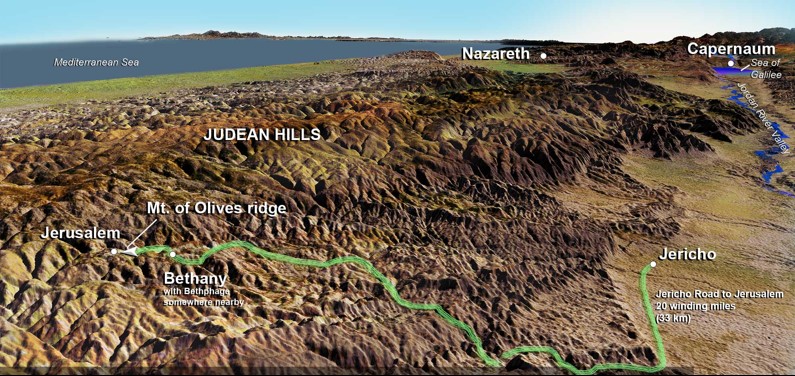
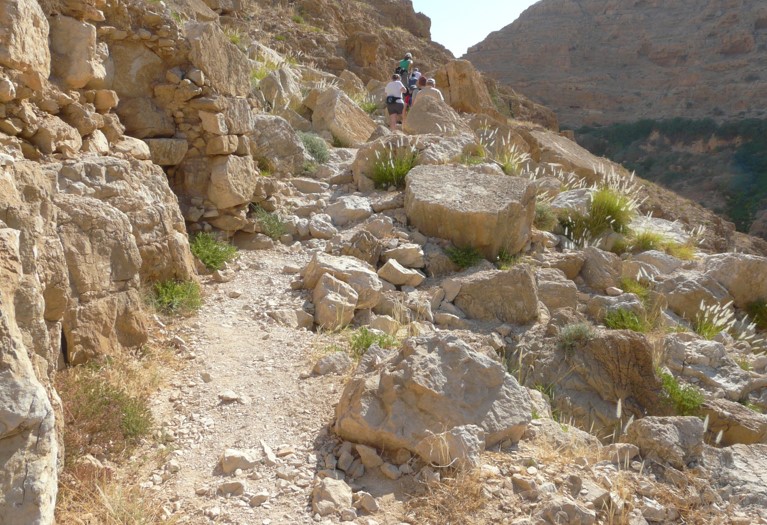
The story is self-explanatory, our neighbours are anyone in need that it is in our power to help, regardless of colour or creed. But there is also within this account the whole of the Gospel message:
- We were (before the fall) in a place of blessing and God’s presence (represented by Jerusalem in this account)
- We ended up descending to a cursed place (represented by Jericho here)
- We were robbed by an enemy and left for dead.
- The Law and religion offered no help.
- The Priest represents all religion.
- There is the hope of help and restoration, but it cannot perform it
- The best religion can do is leave you in the same condition you were found!
- The Levite represents the Law. Note the statement “and looked on him”
- The Law knows our condition……yet “passes by on the other side”
- There is a gulf between the Law and Salvation
- As with religion, it cannot redeem fallen humanity.
- Then One despised and rejected of men came our way.
- He rescued us, bound our wounds took it upon Himself to pay for our restoration.
- Note that the robbed and injured man had nothing to pay for his sojourn, restoration…
- Nor had he anything with which to repay the Samaritan.
- This was entirely the work of Grace.
- He entrusted us to the care and safekeeping of another whilst we remain in this temporary accommodation – all our needs are taken care of!
- He promised to return, our gratitude will be great!
We are not told what the lawyer did. Maybe he humbled himself at the feet of Jesus, and now genuinely sought the salvation he had initially so casually inquired about? Maybe he hardened his heart and walked away, unwilling to acknowledge his own desperate need?
His response is not your concern, for it is your response that matters.
This is what you must do to inherit eternal life: Accept the mercy of the One who was despised and rejected of men, yet Who picked you up when you were without strength, bound your wounds, paid for your restoration in His own blood, has undertaken to provide all you need, and leaves you in the safekeeping of the Holy Spirit until He return.
May you be blessed by this teaching.
The post Luke Ch10 25-42 first appeared on Calvary Chapel Portsmouth.
]]>The post Luke Ch4 1-14 first appeared on Calvary Chapel Portsmouth.
]]>Most will be familiar with the scene:
Jesus is led into the wilderness for 40 days and is tempted by the Devil; yet for many the ‘why’ question is never pondered.
Consider the following verses from the book of James: “Let no man say when he is tempted, I am tempted of God: for God cannot be tempted with evil, neither tempteth he any man: But every man is tempted, when he is drawn away of his own lust, and enticed. Then when lust hath conceived, it bringeth forth sin: and sin, when it is finished, bringeth forth death.” (James 1:13-14)
Here we are clearly told that God is not the source of temptation, that much we probably all know. But surprisingly we are told that neither is Satan the source of temptation! Temptations actually come from within, from our own twisted human nature. The notion that ‘the Devil made me do it‘ is bad theology and simply not true!
There are only two individuals in human history that did not inherit sin from their parents, so did not have a ‘twisted human nature’ to begin with. The First Adam and the Second Adam (1 Cor 15:45 / Romans 5:14-19) – Adam, the son of God and Jesus, The Son of God.
Oswald Chambers notes:
“According to the Bible, there are only two Men: Adam and Jesus Christ, and God deals with them as the representatives of the human race, not as individuals. All the members of the human race are grouped round these two Men. The first Adam is called “the son of God”; the last Adam is the Son of God, and we are made sons of God by the last Adam. The Christian is neither Adam nor Jesus Christ, the Christian is a new man in Christ Jesus. The first Adam and the last Adam are the only two Men according to God’s norm, and they both came into this world direct from the hand of God”. (Oswald Chambers, The Psychology of Redemption)
It is to these two alone that Satan comes directly, bringing his temptations. But why? What was Satan hoping to achieve in tempting Jesus? As Dr Arnold Fruchtenbaum puts it:
“Satan’s aim in these temptations was to cause Messiah to sin. He simply tried to accomplish the impossible. Messiah is impeccable. He simply is not able to sin. However, that did not discourage the fallen one from attempting the impossible”. (Dr Arnold Fruchtenbaum, Yeshua: The Life of Messiah)
The real issue, I believe, goes back to the time of Creation and the fall of Lucifer, and his subsequent distain for mankind.
Firstly, let’s establish some scriptural facts:
- We are not told when angels (including Lucifer) were created, but they must have been created by the time God laid the foundations of the Earth.
- “Where wast thou when I laid the foundations of the earth?
declare, if thou hast understanding.
Who hath laid the measures thereof, if thou knowest?
or who hath stretched the line upon it?
Whereupon are the foundations thereof fastened?
or who laid the corner stone thereof;
When the morning stars sang together,
and all the sons of God shouted for joy?” (Job 38:4-7) - For all the sons of God (angels) to shout for joy as God laid the foundations, it is obvious they had been created and were witnesses to God’s work of Creation.
- “Where wast thou when I laid the foundations of the earth?
- Genesis chapter 1 repeatedly tells us that God’s work of Creation was good, and Ezekiel chapter 28:13-15 tells us that Lucifer was in Eden, the Garden of God in his unfallen state and therefore must also have been amongst the ‘all’ of Job 38:4 that shouted for joy as God created the Earth.
- This places the fall of Lucifer at some time after the 7 days of Creation.
- 1 Timothy 3:6 tells us that it was pride that led to Lucifer’s fall. Isaiah 14 tells us that he wanted to be ‘like the most High’ (Isaiah 14:14)
- Lucifer was not foolish enough to think he could ‘become God’, rather he craved what Adam had been given, namely to be made in the ‘image and likeness of God’ (Gen 1:27), and to be given dominion over this incredible Earth that God had created.
- It must have been a rude awakening to Lucifer’s ambition to discover that the Earth God had created was going to be given over to this ‘man’, and not to him!
- The book of Esther serves as a role play of this very scene.
- In Esther ch 6 we find that king Ahasuerus could not sleep one evening, so decided to read. He read of a failed plot to assassinate him a short while before that had been uncovered by Mordecai. He called in Haman – the archenemy of the Jews – and asked: “What shall be done unto the man whom the king delighteth to honour?” (Est 6:6). We are told that “Haman thought in his heart, To whom would the king delight to do honour more than to myself?” (Est 6:6).
- In the same way, as God created the Earth, Lucifer thought to himself, “To whom would the king delight to do honour more than to myself?” Satan evidently thought that this World would be given to him! Instead, just as ‘Haman’s reward’ was given to Mordecai, so this world was given to the man God had created – Adam.
- The book of Esther serves as a role play of this very scene.
- In rebelling against God, Lucifer (light bearer) became Satan (adversary) and took one third of the angels with him (Rev 12:3)
- Satan then set about to deceive this man God had created and claim the title of the Earth for himself.
- We know from 2 Corinthians 4:4 that, for now, Satan is ‘the god of this world’ and, for now, “the whole world is under the control of the evil one” (John 5:19 NIV).
- Satan was ‘successful’ in taking control of this world.
- However, according to God’s laws, the right of ownership can be reclaimed by a kinsman (family member) – a study of the book of Ruth puts this into context!
- Rather than defeat Jesus at the cross, Satan actually forfeited his right to rule and, in effect, signed his own death warrant on account of the fact he had committed first degree murder and shed ‘innocent blood’ (Matt 27:4 / Gen 9:6).
- Now it is just a matter of time until the full title of the Earth passes back to the Kinsman of Adam, Jesus Christ, as we read in Revelation 11:15 “The kingdoms of this world are become the kingdoms of our Lord, and of his Christ; and he shall reign for ever and ever”.
So, what does all this have to do with the temptation of Jesus in the wilderness?
Quite simply, it was another attempt by Satan to show that Adam, and any descendant thereof, was not worthy to be given the honour of ruling this Earth. Furthermore, if Satan had managed to get Jesus to succumb, it would demonstrate that God’s plan in creating man and giving him this honour was flawed! God would be shown to be wrong, and Satan vindicated in his original ‘objection’ to God’s plan and his assertion the he should have been given this honour!
Incredibly, this is the second time Satan had the audacity to challenge God’s plan, attempting to show that man was unworthy of this honour and that Satan himself was right!
The first time is recorded in the book of Job. There, Satan challenges God that ‘no man can worship God simply because He is God’. The allegation is that man only worships God because of the blessings God gives. Take away the blessings and man will cease to worship God.
As we know from the account in Job, Satan’s argument is destroyed! Job demonstrates that, even with all the blessings stripped away, man can worship God simply because God is God! “Though He slay me, yet will I tust Him” (Job 13:15).
So Satan’s attempt to vindicate himself (and justify his rebellion) is defeated on both counts!
- Man can worship God for who He is apart from any blessings that may come from Him.
- Man can life a life of selfless obedience to God. Although Adam failed in this regard, Jesus Christ, the Second Adam did not succumb to these temptations, and now, through Him, all who receive His nature in them (through being born again) can live a sinless, selfless life in obedience to God the Father (1 John 5:18).
God is justified in His creation and honouring of man and Satan shown to be wrong in his assertions and the basis of his pride completely undermined!
In closing…
…it is worth mentioning that the actual temptations Jesus faced are of the same nature we face, albeit the source is different.
1 John 2:16 tells us: “For all that is in the world, the lust of the flesh, and the lust of the eyes, and the pride of life, is not of the Father, but is of the world”.
This summary of sin (and hence temptation) is shown in both Genesis 3 (Adam/Eve) and Luke 4 (Jesus):
In Genesis we see that:
- Eve saw the fruit was good for food
- the lust of the flesh
- Eve saw it was pleasant to the eyes
- the lust of the eyes
- Eve desired to be wise like God
- the pride of life
In Jesus’ temptations we also see the same pattern:
- “And the devil said unto him, If thou be the Son of God, command this stone that it be made bread.” (Luke 4:4)
- The lust of the flesh
- The appeal to the appetite
- The temptation to satisfy a legitimate need in an illegitimate way
- The lust of the flesh
- “And the devil, taking him up into an high mountain, shewed unto him all the kingdoms of the world in a moment of time. And the devil said unto him, All this power will I give thee, and the glory of them: for that is delivered unto me; and to whomsoever I will I give it. If thou therefore wilt worship me, all shall be thine”. (Luke 4:5-7)
- The lust of the eyes
- The appeal to the desire
- The eyes are the window of the soul
- The lust of the eyes
- “And he brought him to Jerusalem, and set him on a pinnacle of the temple, and said unto him, If thou be the Son of God, cast thyself down from hence: For it is written, He shall give his angels charge over thee, to keep thee: And in their hands they shall bear thee up, lest at any time thou dash thy foot against a stone.” (Luke 4:9-11)
- The pride of life
- The appeal to the ego
- The need for self-worth and acceptance
- The pride of life
The writer to the Hebrews makes the point that “we have not an high priest which cannot be touched with the feeling of our infirmities; but was in all points tempted like as we are, yet without sin”. (Hebrews 4:15)
Our temptations come in the form of the lust of the flesh, the lust of the eyes, or the pride of life. Jesus was tempted in all these points, yet without sin!
For each of the temptations with which Satan tempted Jesus, Jesus’ response was always to quote scripture – to ‘fight back’ with The Sword of the Spirit (Heb 4:12). This is our most sure ally also. David prayed “Order my steps in thy word: and let not any iniquity have dominion over me.” (Psalm 119:133) and “Thy word have I hid in mine heart, that I might not sin against thee.” (Psalm 119:11).
Paul tells us that “There hath no temptation taken you but such as is common to man: but God is faithful, who will not suffer you to be tempted above that ye are able; but will with the temptation also make a way to escape, that ye may be able to bear it” (1 Corinthians 10:13).
God will always give us a way of escape. If we resist the Devil, he will flee from us (James 4:7).
Jesus endured these temptations to 1) defeat Satan’s claim over man, and 2) give us a pattern to follow when we ourselves are tempted. “For in that he himself hath suffered being tempted, he is able to succour them that are tempted.” (Hebrews 2:17-18).
“Blessed is the man that endureth temptation: for when he is tried, he shall receive the crown of life, which the Lord hath promised to them that love him!” (James 1:12)
May you be blessed and encouraged by this study.
The audio recording and PowerPoint slides are available for free download.
The post Luke Ch4 1-14 first appeared on Calvary Chapel Portsmouth.
]]>