The post Ruth – Session 5 first appeared on Calvary Chapel Portsmouth.
]]>Having gone verse-by-verse through the Book of Ruth, in this session we look at the models that God had intentially woven into the naritive of this incredible book.
We will see how the story itself is a model of the gospel; how Naomi is a type of Israel, Ruth a type of the Church, Boaz a type of Christ, Orpha a model of the unbeliever, and even the position of the book is by Diving design!
We also look at the one character that, up to now, has not been mentioned! He plays a major role and yet is never mentiond in the book! But unlocking the mystery of this man who ‘hides in plain sight’ it helps us to see the brethtaking magnitude of God’s plan of Redemption!
May you be blessed and encouraged by this study!

The post Ruth – Session 5 first appeared on Calvary Chapel Portsmouth.
]]>The post Ruth Chapter 1 first appeared on Calvary Chapel Portsmouth.
]]>The book of Ruth is considered one of the most beautiful stories in the Bible. The events recorded took place during the time of the judges, which was a period of national spiritual chaos and darkness where ‘every man did that which was right in his own eyes’ (Judges 21:25) Against this background the book of Ruth stands out like a diamond on a black cloth, a beautiful day in the midst of a season of storms. However this book is far more than just a story of love and commitment. As we will discover, the key theme to the book is ‘redemption’. One dictionary definition of ‘redeem’ is: “to recover possession or ownership of by payment of a price or service; regain” On the surface we see the account of Naomi and her loss and subsequent regaining (redemption) of that which was lost. We also see the redemption of the land that had been sold, and the redemption and purchasing of Ruth by a kinsman-redeemer named Boaz. However, as we will see, the book also has another level. In Hosea 12:10 God says: “I have also spoken by the prophets, and I have multiplied visions, and used similitudes, by the ministry of the prophets.”. The word ‘similitudes’ means a ‘type’ or a ‘model’. A model is simply a representation of something for our insight and instruction.
If the surface story in the book of Ruth is wonderful, then the models that God has given us are nothing short of breath-taking! As we look at the similitudes we will begin to see how this book is a wonderful and powerful model that prefigures God’s work of redemption and plan for mankind. Specifically we see how Naomi, as a type of Israel, through unbelief and rejection of God is expelled from the land, being dispersed among the gentiles, later to be brought home in bitterness before being restored. We also see Ruth, as a type of the Church, being a gentile bride who finds grace in the eyes of Boaz who, as a Kinsman-Redeemer, is a type of Jesus. Then there is the land itself; as in the book of Ruth where the land was lost, only to be redeemed again by Boaz, so Adam lost the ‘title deed’ of this earth to Satan, only to find that the Second Adam, our Kinsman-Redeemer will redeem this earth as we see unfolded in the book of Revelation.
For a book that is only 85 verses long, it is truly amazing!
As we have noted, there are at least 3 levels to the book:
- Firstly, it is an historical account of the events that took place at that time
- Secondly, it serves as a tutor for all who read it in regard to commitment, faithfulness and trust. The lessons we learn here are practical instructions for every day living.
- Thirdly, it is a model laid out in advance of God’s plan of redemption through Jesus.
In the 85 verses:
- God’s name is used 17x (When you see LORD written in capitals it means that in the Hebrew it was written as YAWH, which we pronounce as ‘Yahweh’ or ‘Jehovah’ and was considered by the Jews to be the unpronounceable name of God.) ‘the God who keeps His covenants’
- El hoeim is used x 3 (this is the plural for God and hints at the trinity – Father, Son & Spirit.) – ‘the Creator God’
- El shadai x 2 – God almighty / all powerful
- Redeem / Redeemer / Kinsman over 20 x in just 85 verses.
Hence the theme of the book is established as the ‘redemption by God’.
Timing: – As we have mentioned the events in the book of Ruth occurred during the time of the Judges (Ruth 1:1). Judges itself covers the period around 1400 – 1050 B.C. We know from the genealogy in Matthew 1 that Boaz’s father was Salmon and his mother was Rahab – who was spared in the destruction of Jericho by Joshua. This would place these events fairly early on and probably around the time of chapter 3 – 4 of Judges. It is just a conjecture but we read in Judges 3 that God raised up a man called Ehud to deliver Israel from the hand of the King of Moab. After Ehud’s personal victory, we read in verses 27 – 30, how Ehud blew a trumpet in Ephraim and rallied an army that went and defeated the Moabites. It may have been that Elimelech, being from that area and old enough to fight, was part of the army that went into and conquered Moab. We are told that as a result of this victory: “So Moab was subdued that day under the hand of Israel. And the land had rest fourscore years.” (Judges 3:30) Given this situation, it would make sense that Elimelech, having already been to Moab on a military exercise, and in order to escape the famine now in Israel, chose to take his family to a land that Israel had subdued and was therefore under Israeli control at that time.
If this conjecture is correct, how ironic (and yet familiar in our own circumstances) that whilst being given a victory from God, Elimelech was impressed by the land of Moab, and hence it becomes the place he chooses to go to at this time. The blessing that God had given became the very thing that drove him and his family away from their God. How often have we enjoyed blessings from God’s hand, only to let them become that thing that drives a wedge between us and God? Maybe you have prayed that God will give you a new job, but when you get it you find that now you are too busy to read the Bible or pray anymore, or attend church meetings; maybe you have prayed for a child, only to find that when God answers your prayer, unlike Hannah in 1 Samuel, you don’t always go to church because you want to spend time with your family. The list goes on so fill in the blanks. Blessings that are not given back to God but kept for ourselves are like the manna that was taken and ‘hid under the tent’, they turn to rottenness. (See Exodus 16:14-20)
Author? – Some think that it may have been Samuel and that one of the reasons for writing the book was to show the genealogy of King David as recorded in chapter 4.
Position of the book: It is interesting to note that the book is the eighth book in the Bible. Eight signifies new beginnings – 8th note in an octave is the start of a new octave; 8th day of the week is the start of a new week; 8th colour in the rainbow starts a new spectrum etc. The book records a new beginning for Naomi, Ruth and Boaz and prophetically speaks of a new beginning for Israel, the Church and Jesus who will be united with His bride and begin to rule.
The book is a story of grace and bridges the gap between the darkness and chaos of the times of the Judges and the time when God’s appointed king will be established in Jerusalem as recorded in Samuel. Again, viewed prophetically, the world was in spiritual darkness until Jesus came, who is the light of the world. Since the cross we are now living in a period of God’s grace and are looking forward to God’s appointed King of Kings to establish His throne and rule from Jerusalem.
Importance of the book: All scripture is God-breathed and is profitable for doctrine, reproof, correction and instruction in righteousness so that we might be thoroughly furnished – have all that we need – in order that we might do work of Him who called us. This book is no exception; there is abundant instruction here.
Without this book the reason why the Messiah was born in Bethlehem would not be known, and the field that the shepherds were in when the angel spoke may have been unoccupied if it were not for the events that take place here. Again, as we have noted many times, this book serves to remind us that there are no meaningless details in the Bible. Every number, every word, every name and every place-name are all there by deliberate supernatural design proving once again that the Bible is the work of someone outside of our space-time who can tell the end from the beginning and from ancient times things not yet done!
(2 Timothy 3:16 / Isaiah 46:10)
May you be blessed and ancouraged by this study.
The post Ruth Chapter 1 first appeared on Calvary Chapel Portsmouth.
]]>The post Romans Ch14 first appeared on Calvary Chapel Portsmouth.
]]>It is inevitable that, within the church, there will be practices considered permissible by some but not by others, particularly (using the examples given by Paul) in relation to dietary laws and the observance of specific days. He urges those who are “stronger” in their faith – those who understand the freedom they have in Christ – to welcome and not despise those who are “weaker” and hold more scrupulous views. Similarly, those with stricter convictions should not pass judgment on those who exercise their liberty.
Paul underscores the principle that each believer is ultimately accountable to the Lord. Whether one eats or abstains, whether one regards a certain day as special or considers all days alike, the underlying motivation should be to honour the Lord. For Christians, life and death are both oriented towards Christ.
The Apostle strongly cautions against judging or belittling fellow believers over such disputable matters. He asserts that all will stand before the ‘Bema’ judgment seat of Christ, and therefore, instead of placing stumbling blocks in each other’s way, believers should strive to live in a manner that promotes peace and mutual edification, whilst ‘working out their own salvation with fear and trembling!’.
Paul emphasises that while all food is inherently clean, it becomes wrong for someone to eat if it causes another believer to stumble in their conscience. He concludes by stating that everything that does not come from faith is sin, thereby highlighting the importance of acting in accordance with one’s sincerely held beliefs and showing consideration for the sensitivities of others within the church.
Oswald Chambers comments: “Always keep your life measured by the standards of Jesus. Bow your neck to His yoke alone, and to no other yoke whatever; and be careful to see that you never bind a yoke on others that is not placed by Jesus Christ. It takes God a long time to get us out of the way of thinking that unless everyone sees as we do, they must be wrong. That is never God’s view. There is only one liberty, the liberty of Jesus at work in our conscience enabling us to do what is right. Don’t get impatient, remember how God dealt with you — with patience and with gentleness; but never water down the truth of God. Let it have its way and never apologize for it. Jesus said, “Go…and make disciples” not — make converts to your opinions. – Oswald Chambers
In essence, Romans chapter 14 is a plea for tolerance, mutual respect, and the prioritisation of unity and love over personal preferences in matters of conscience within the church.
May you be blessed and encouraged by this teaching.
The post Romans Ch14 first appeared on Calvary Chapel Portsmouth.
]]>The post Romans Ch12 first appeared on Calvary Chapel Portsmouth.
]]>In chapter 12, Paul urges believers to offer their bodies as living sacrifices, holy and pleasing to God – this is our logic, and reasonable spiritual act of worship. He then emphasises the importance of not conforming (or constantly being confiormed) to the patterns of this world but insted we should be continually transformed by the renewing of our minds, so we can discern God’s will and walk pleasing to Him.
He then urges unity and diversity within the body of Christ, using the analogy of a human body with many members. Each believer has been given unique gifts that should be used humbly and in service to others.
The concluding practical exhortations are focused on how to live in community of beleivers, including:
- Genuine love and abhorrence of evil.
- Devotion and honor towards one another.
- Zeal and serving the Lord.
- Joy in hope, patience in affliction, and perseverance in prayer.
- Sharing with those in need and practicing hospitality.
- Blessing persecutors and living in harmony with everyone.
- Avoiding revenge and overcoming evil with good.
In essence, Romans 12 is a blueprint for Christian living, emphasising transformation, unity, service, and love in action.
May you be encouraged and strengthened in His Word through this study.
The post Romans Ch12 first appeared on Calvary Chapel Portsmouth.
]]>The post Romans 10:1-17 first appeared on Calvary Chapel Portsmouth.
]]>In these verses Paul begins to lay out the fact that Israel had every opportunity to respond in obedience to the Word of God, but instead they ‘would not’, and so their ‘house was left unto them desolate’. (see Matt 23:37-39)
Paul drives home the simple fact, using Abraham and Moses as his witnesses, that righteousness does not come through our works – however well intentioned – but by God grace alone. The Law was given to reveal to us God’s perfect standard, and to show that we can never attain to that standard. But Christ came and fulfilled the Law, offering to exchange our sin for His righteousness, so that we can be declared ‘not guilty’ before a Holy God.
As has been said; He paid a debt He didn’t owe because we owed a price we couldn’t pay.
We conclude by considering just how important the Word of God is to our faith.
May you be blessed and encouraged by this study.
The post Romans 10:1-17 first appeared on Calvary Chapel Portsmouth.
]]>The post Romans 8 18-39 first appeared on Calvary Chapel Portsmouth.
]]>In this study we conclude Romans 8 – one of the most incredible chapters in the Bible!
What does it mean to be saved? How secure is our salvation? Is there anything that can separate us from the love of God?
May you be blessed and encouraged by this study.
The post Romans 8 18-39 first appeared on Calvary Chapel Portsmouth.
]]>The post Romans Ch8 1-6 first appeared on Calvary Chapel Portsmouth.
]]>The Apostle Paul begins the chapter by stating that there is no possibility of condemnation for those who are in Christ, and ends the chapter by asserting that there is no possibility of separation from Him either!
This should fill the hearts of every belliever with unspeakable joy!
In this study, pastor Barry takes just the first 6 verses of the chapter to contemplate the reality and the effect the indwelling Holy Spirit should have on the life and walk of the believer.
May you be blessed and encouaged by this study.
This study was given on the 3rd Novembe 2024.
The post Romans Ch8 1-6 first appeared on Calvary Chapel Portsmouth.
]]>The post Romans Ch7 first appeared on Calvary Chapel Portsmouth.
]]>The Law leaves us defeated and like Paul we find we end up doing the things we know are wrong, and feeling powerless to do the things we know are right. Thus, the Law drives to cry out: “O wretched man that I am! who shall deliver me from the body of this death?” (Rom 7:24)
If that were the end is would be a sad conclusion! But it is not the end of the matter, for Paul declares that there can be deliverance, there can be freedom, there can be the reality of walking in victory of the demands and dictates of the flesh life – and it is though the Person and power of the indwelling Spirit of Christ!
May you be blessed and encouraged by this study.
The post Romans Ch7 first appeared on Calvary Chapel Portsmouth.
]]>The post Romans Ch1 1-7 first appeared on Calvary Chapel Portsmouth.
]]>On their website, Libertly University in America state: “The great apostle Paul authored at least 13 New Testament epistles. If he were here today with us, and was asked which epistle was the most needed for this time in history, I believe he would say without hesitation, the book of Romans. And the reason? Well, 2000 years ago he warned that “in the latter times some will abandon the faith and follow deceiving spirits and things taught by demons” (1 Tim. 4:1). So then, the only real cure for bad doctrine is biblical doctrine; thus, the most theological book ever written – the book of Romans!”
That is quite a statment, but one that will undoubtedly prove to be true as we begin a study through this incredible book.
John Calvin said: “if we understand this epistle we have a passage opened to us to the understanding of the whole of Scripture”.
Indeed, Romans unlocks, expounds and sheds Divine light on many of the key doctrines in Scripture. If all of the Bible were lost except Romans, scarcely any fundamental doctrine would be lacking. As he explained the gospel in Romans, Paul quoted from the Old Testament more often than in all his twelve other letters combined—showing how important the Old Testament is to understanding the gospel. No less than 57 quotes can be found.
Additional study notes from this session:
Author: Paul this is not disputed. – Paul was a Roman citizen (adopted by Sergius Paulus – governor of Cypress (hence for then on taking his family name).
- “Paul” = the least; the little one. Understood grace.
- “I am the chief of sinners” 1 Tim 1:12-15
- Significantly, the most devoutly religious man who ever lived! Phil 3:1ff
- So God has already saved one who is far worse than you or me!…
Addressee: The Saints in Rome (not a single church but the collective body of believers), various congregations, no doubt meeting from home to home.
Paul sent greetings to the church that met in the home of Aquila and Priscilla. Rom 16:5
28 people are named in the letter
- Many of the believers in Rome were Paul’s converts
- He was writing to believers
- Not preaching for them to be converted
- Teaching them what salvation is really all about
Written from Corinth
- Though he never mentions it, he wrote from Corinth.
- Cenchrea being its eastern harbor. 16:1
- Written at the close of his third missionary journey on c. AD 57-58
Time of Writing:
In 1947 a Bedouin boy made one of the greatest archeological discoveries of all time in a cave at Qumran in southern Israel.
Much is said about the discovery of the Dead Sea Scrolls,…
They comprise some 800 documents
…dating from around 250 BC to 68 AD
Among the Scrolls are partial or complete copies of every book in the Hebrew Bible
except the book of Esther
But what is not so widely publicised is that fragments of a number of New Testament books were also discovered in cave 7… including the Book of Romans.
The caves at Qumran are famous for the hoard of Old Testament and other manuscripts that have been found there. But the thing which receives the least publicity (if any publicity at all) is the fact that the caves have also yielded fragments of New Testament books. This absence of publicity – this blanket denial of their identity – is not to be wondered at.
It was really most awkward. In fact, it still is very awkward for them, for it means that the fragments must have been written out – copied from even earlier exemplars – well before A.D. 68, which undermines everything that the critics have been claiming all these years.
The fact of the matter is this, that these manuscripts were deposited in the caves at Qumran by the year A.D. 68 at the very latest, when Qumran and the surrounding area was overrun by the Roman 10th legion, and according to the critics, the New Testament had not been written by that time. – Dr Bill Cooper
This means that Romans – which we know was written by Paul – was written at a time the Christian church in the Roman world was not being persecuted, but was allowed to flourish and thrive!
Construction of the Colosseum began under the Roman emperor Vespasian between 70 and 72,
By that time, Romans, and indeed copies of the Book of Romans were already in circulation among the Christian church!
Theme: The Grace of God Revealed:
- God’s righteousness,
- Our iniquity, and
- God’s remedy through Grace
There are many self-help books on the market today that all tell you to follow your heart!
The Bible tells us in Jeremiah 17:9 that the heart is deceitful and desperately wicked
Self-help books simply give you a new set of rules to follow that all too quickly you break and fail to keep!
The Book of Romans focuses on the Gospel – which does not merely give us a set of rules to follow, it tells us that firstly we cannot keep (any) set of rules, but that Jesus alters the mainspring of our lives, changes our disposition and places withing us something that was never there before, the Person of God’s Holy Spirit and by His power we can live!
- Christ did not come to make bad men good;
but to give dead men life!
The Impact of the Book
- “The most profound of all literature”
Romans became the cornerstone to the Reformation in Europe.
Martin Luther had tried relentlessly to get right with God… but failed. A wise old monk told him to read Habakkuk – a man who like Luther knew a thing or two about struggling!
In Habakkuk Luther read “The Just Shall Live by Faith”
- Habakkuk 2:4 has lead to a Trilogy of epistles by Paul in NT.
- The Just… (Who are they?) Romans Rom 1:17
- …Shall live (How?) Galatians Gal 3:11
- …By Faith! Hebrews Heb 10:39
May you be blessed and encouraged by this study.
The post Romans Ch1 1-7 first appeared on Calvary Chapel Portsmouth.
]]>The post 2 Corinthians Ch1 vs 1-11 first appeared on Calvary Chapel Portsmouth.
]]>Have you ever been discouraged by the constant trials?
In this letter, Paul pours his heart out to the saints in Corinth and teaches them that the sufferings and tribulations we so often experience are used by God to demonstrate His comfort to us that we might then be a comfort to others, and that we might come to the end of our own self-reliance and trust solely in His grace.
Paul speaks of something many of us know too well, that of despairing of life, of coming to the end of our rope and not wanting to keep on fighting. Sometimes life can just seem too hard. But it when we have nothing left that we discover God is there waiting for us, to wrap His arms around us.
Oswald Chambers said:
“No one experiences complete sanctification without going through a “white funeral” — the burial of the old life. If there has never been this crucial moment of change through death, sanctification will never be more than an elusive dream. There must be a “white funeral,” a death with only one resurrection— a resurrection into the life of Jesus Christ. Nothing can defeat a life like this. It has oneness with God for only one purpose— to be a witness for Him.
Have you really come to your last days? You have often come to them in your mind, but have you really experienced them? You cannot die or go to your funeral in a mood of excitement. Death means you stop being. You must agree with God and stop being the intensely striving kind of Christian you have been”.
May you be blessed and encouraged by this study.
The post 2 Corinthians Ch1 vs 1-11 first appeared on Calvary Chapel Portsmouth.
]]>The post 1 Corinthians Ch5 first appeared on Calvary Chapel Portsmouth.
]]>In this chapter Paul addresses two serious problems in the church at Corith. Firstly, there was a man within the fellowship in an immoral relationship, but secondly, the church had failed to do anything about it.
Paul makes it clear that the church must act to ‘purge’ out anything that draws believers’ hearts and affections away from Christ.
There are those in the church today who want to live worldly lives during the week, but think is ok to ‘put on their Sunday best’ when at church. No so. Being a Christian, a follower of Jesus, is a 24/7 lifestyle choice that must impact out thoughts, actions and behaviour. We must be different from the world around us because we have bought at a price so (as Paul will say in the next chapter) we are to honour God in our bodies as well as our spirits.
May you be blessed and encouraged by this study.
The post 1 Corinthians Ch5 first appeared on Calvary Chapel Portsmouth.
]]>The post 1 Corinthians Ch3 first appeared on Calvary Chapel Portsmouth.
]]>In this study, pastor Barry considers how Christians should have a profound sense of self-worth when we consider God’s love for us and the price God paid to purchase and redeem us. Understanding how much we mean to God should help prevent the factions that had developed in the Corinthian church, where we so often try to align ourselves with others we perceive to be successful – in life or ministry – in an attempt to ‘feel good’ about ourselves. We all want to back a winner!
In the Corinthian church, some perceived Paul to be the most learned, others sided with Apollos because of his eloquence and wisdom; still others saw Peter as the leader they wanted to be seen to follow.
Paul argues that we should all simply be followers of Christ, not a man or ministry. Good Bible teachers, ministers and pastors should lead us to Christ, not to themselves.
Rather than producing greater spiritual depth, this attitude had actually stunted their growth. They were like babies that could only handle milk and were not yet ready for solid food.
May you be blessed and encouraged by this study.
The post 1 Corinthians Ch3 first appeared on Calvary Chapel Portsmouth.
]]>The post 1 Corinthians Ch1 first appeared on Calvary Chapel Portsmouth.
]]>In this opening chapter Paul focuses on the centrality of Christ for our salvation, sanctification, enrichment, growing in grace, sustaining and eventually to present us faultless before the throne in Heaven.
Christ is our all in all.
May you be blessed and encouraged by this study.
The post 1 Corinthians Ch1 first appeared on Calvary Chapel Portsmouth.
]]>The post The Judgment Seat of Christ first appeared on Calvary Chapel Portsmouth.
]]>In this concluding session of our 3-part mini-seies on ‘The Inheritance of the Saints’ was given by pastor Barry on 17th September 2023.
In this final part we look at the day that is coming, referred to by the Apostle Paul as ‘The Judgment Seat of Christ‘ and what is means (or should mean!) for us now.
May you be blessed and encouraged by this study.
The post The Judgment Seat of Christ first appeared on Calvary Chapel Portsmouth.
]]>The post Luke Ch12 first appeared on Calvary Chapel Portsmouth.
]]>As we continue our journey through Luke’s gospel Jesus now begins to show clearly the two different ways we can choose to live. We can either live for ourselves, serving the god of materialism and the perceived need to continually strive to have more to have the latest thing, to have financial stability and success… or we can choose to live our lives trusting in God and His word, living our lives based solely on the promises He has given, allowing Him to direct our paths, to provide for us through whatever means He engineers.
Oswald Chambers put’s it succinctly:
“If God so clothe the grass of the field…shall He not much more clothe you?”
A simple statement of Jesus is always a puzzle to us if we are not simple. How are we going to be simple with the simplicity of Jesus? By receiving His Spirit, recognizing and relying on Him, obeying Him as He brings the word of God, and life will become amazingly simple.
“Consider,” says Jesus, “how much more your Father Who clothes the grass of the field will clothe you, if you keep your relationship right with Him.”
Every time we have gone back in spiritual communion it has been because we have impertinently known better than Jesus Christ.
We have allowed the cares of the world to come in, and have forgotten the “much more”of our Heavenly Father.
“Behold the fowls of the air” — their main aim is to obey the principle of life that is in them and God looks after them. Jesus says that if you are rightly related to Him and obey His Spirit that is in you, God will look after your “feathers.”
“Consider the lilies of the field” — they grow where they are put. Many of us refuse to grow where we are put, consequently we take root nowhere. Jesus says that if we obey the life God has given us, He will look after all the other things.
Has Jesus Christ told us a lie? If we are not experiencing the “much more,” it is because we are not obeying the life God has given us, we are taken up with confusing considerations.
How much time have we taken up worrying God with questions when we should have been absolutely free to concentrate on His work
“Take no thought for your life.” “Be careful about one thing only,” says our Lord — “your relationship to Me.” Common sense shouts loud and says — “That is absurd, I must consider how I am going to live, I must consider what I am going to eat and drink.” Jesus says you must not. Beware of allowing the thought that this statement is made by One Who does not understand our particular circumstances. Jesus Christ knows our circumstances better than we do, and He says we must not think about these things so as to make them the one concern of our life. Whenever there is competition, be sure that you put your relationship to God first. – Oswald Chambers (My Utmost For His Highest)
May you be blessed and encouraged by this study.
The PowerPoint slides used in this teaching are available for free download.
The post Luke Ch12 first appeared on Calvary Chapel Portsmouth.
]]>The post The Power of His Resurrection first appeared on Calvary Chapel Portsmouth.
]]>The Power of His Resurrection
In Philippians 3:10-12, the Apostle Paul states the following: “That I may know him, and the power of his resurrection, and the fellowship of his sufferings, being made conformable unto his death; If by any means I might attain unto the resurrection of the dead. Not as though I had already attained, either were already perfect: but I follow after, if that I may apprehend that for which also I am apprehended of Christ Jesus.”
Paul tells us that the historical fact of the Resurrection of Jesus has the power to change us! Firstly, as a result of the Resurrection, we can actually know Jesus personally – if your heart is still beating that should stagger you and become your new no#1 goal in life! Secondly, by understanding what Jesus did for us in laying down His life in obedience to His Father, we can, in the same way, lay down the right to our own lives to God and begin to live… not merely ‘be alive’ but really begin to live the abundant life Jesus spoke of (John 10:10). Paul then tells us the reason Christ ‘took hold’ of us was so that we might ‘take hold’ of Him. By giving ourselves to Him, He gives Himself to us! Jesus loves you and wants an intimate relationship with you… but it has to be on His terms, because only He knows what is best for us.
To try to understand this incredible proposition we are going to look at a model found in the Old Testament book of Joshua – written around 1500 years before the time of the crucifixion and resurrection of Jesus. The model itself is yet further proof of the supernatural origin and design of the Bible; only a God who is outside of time could record events with such precision before they happen. God Himself lays this challenge before any sceptic: “Remember the former things of old: for I am God, and there is none else; I am God, and there is none like me, Declaring the end from the beginning, and from ancient times the things that are not yet done, saying, My counsel shall stand, and I will do all my pleasure” (Isaiah 46:9-10).
Models in Advance
In 1 Corinthians 15, Paul’s definitive chapter on the subject of the resurrection, he makes the point that the death, burial and resurrection of Jesus had been foretold and recorded in advance in the Old Testament scriptures (see 1 Corinthians 15:1-4). We could actually go back to Genesis chapter 3 to get the first hint of Christ’s victory over Satan on the cross; but then in Genesis 22 we have the dramatic acting-out (two thousand years in advance) of the events of the crucifixion and resurrection. Abraham (a type of God the Father) is told to “Take now your son, your only son Isaac, whom you love, and go into the land of Moriah; and offer him there for a burnt offering upon one of the mountains which I will tell you of” (Genesis 22:2). As we consider this, we start to see that, whilst being a real event that occurred in the life of Abraham, It was also a ‘model’ or ‘type’ of God the Father who, 2000 years later, gave up His only son for mankind.
This model becomes even more remarkable when we realise that the place that Abraham was told to offer up Isaac (on top of Mount Moriah), was later to be known as Golgotha, the very spot where Jesus was to be crucified. Abraham renamed the place: “Jehovah-jireh” which means, “In the mount of the LORD it shall be seen” (Gen 22:14). Thus, it would seem that Abraham actually realised he was acting out prophecy, anticipating what was to come. This is confirmed in Hebrews 11:17-19: “By faith Abraham, when he was tried, offered up Isaac: and he that had received the promises offered up his only begotten son; of whom it was said, That in Isaac shall thy seed be called: Accounting that God was able to raise him up, even from the dead; from whence also he received him in a figure.”
From the account in Genesis 22, we know that an innocent ram was eventually sacrificed in the place of Isaac, and again in this we see a model in anticipation of Jesus who, like that innocent ram, was sacrificed in our place so that, like Isaac, we too could go free.
Before we come to our text in the book of Joshua, there is one other model we need to consider, for that will lay an important foundation.
The 7 Feasts of Israel
God, through Moses, led the Children of Israel out of Egypt through the Red sea and gave them seven Feasts (holy festivals) that they were to celebrate each year to continually remind them of what God had done for them, as wells as His continued provision and their obligation to be holy before their God. Various passages of scripture outline the Feasts and their purpose, such as Exodus 12:14-17 / Leviticus 23 :4-44 / Deuteronomy 16:1-16.
The 7 feasts in the order that they were to occur each year are as follows:
- The Feast of Passover (14th of the 1st month Abib – our March/April time)
- The Feast of Unleavened bread (15th of the 1st month Abib)
- The Feast of Firstfruits (celebrated on the Sunday following the Passover)
- The Feast of Harvest (also known as the Festival of Weeks / Pentecost – celebrated 50 days after Firstfruits)
- The Feast of Trumpets (the 1st day of the 7th month)
- The Feast of Atonement (the 10th day of the 7th month)
- The Feast of Tabernacles (also known as the Feast of Ingathering – celebrated on 15th day of the 7th month)
These feasts had a practical / spiritual significance to Israel during their time in the wilderness and later when they entered the promised land; but as we will discover, these feasts were also supernaturally designed to be ‘a shadow of things to come’ (Col 2:17), prophetically looking forward to events that would take place many years in the future.
As compelling evidence of God’s Divine design throughout the Bible, these feasts were intended by God to be models that find their fulfilment in:
- The crucifixion and death of Jesus – Passover
- His burial and victory over sin and death – Feast of Unleavened Bread
- His resurrection – Feast of Firstfruits
- The birth and subsequent rapture of the Church – Pentecost
- God’s judgement during the Tribulation – Feast of Trumpets
- God’s purging of Israel during the tribulation – Feast of Atonement
- and finally: Tabernacles. The regathering of the Jews back to the land of Israel (Feast of Ingathering) when Jesus returns to establish His millennial kingdom and ‘tabernacle’ among us.
Thus, they paint a picture that spans the whole of human history from the birth of the nation of Israel to the beginning of the millennial kingdom of Jesus.
All of these Feasts are really worth studying, but it is the first three that are of significance in this study.
The Feast of Passover
For 400 years the Children of Israel were ‘sojourners’ without a land of their own, a fact that had been prophetically revealed to Abraham in a dream (Genesis 15:13). The last 215 years of this time had been spent in Egypt; firstly in prosperity and blessing during the time of Joseph, but toward the end of this time ‘there arose up a new king over Egypt, which knew not Joseph’ (Exodus 1:8). This new Pharoah treated Israel harshly, eventually prompting them to cry to the LORD for deliverance. Just as God had promised Abraham, when the time was right, his descendants would return to the land of Canaan, leaving Egypt with great wealth. We know from Exodus chapters 3 through 12 that God called Moses and sent him before Pharaoh with the request that Abraham’s descents, the Children of Israel, be allowed to leave the land of Egypt. Pharaoh repeatedly refused despite being sent plagues that all but destroyed the land.
Finally God said to Moses: “Yet will I bring one plague more upon Pharaoh, and upon Egypt; afterwards he will let you go hence: when he shall let you go, he shall surely thrust you out hence altogether……Thus saith the LORD, About midnight will I go out into the midst of Egypt: And all the firstborn in the land of Egypt shall die, from the firstborn of Pharaoh that sitteth upon his throne, even unto the firstborn of the maidservant that is behind the mill; and all the firstborn of beasts. And there shall be a great cry throughout all the land of Egypt, such as there was none like it, nor shall be like it any more” (Exodus 11:1-6).
Thus, as a judgment for the way Egypt had treated God’s ‘firstborn’ (i.e. Israel), the firstborn of all the Egyptians would die (see Exodus 4:22-23). However, as God had done throughout all the other plagues, He made a way for the people of Israel to be protected.
“And the LORD spoke unto Moses and Aaron in the land of Egypt, saying, This month shall be unto you the beginning of months: it shall be the first month of the year to you. Speak ye unto all the congregation of Israel, saying, In the tenth day of this month they shall take to them every man a lamb, according to the house of their fathers, a lamb for an house:” (Exodus 12:1-3).
“Your lamb shall be without blemish, a male of the first year: ye shall take it out from the sheep, or from the goats: And ye shall keep it up until the fourteenth day of the same month: and the whole assembly of the congregation of Israel shall kill it in the evening. And they shall take of the blood, and strike it on the two side posts and on the upper door post of the houses, wherein they shall eat it” (Exodus 12:5-7).
“……it is the LORD’s passover. For I will pass through the land of Egypt this night, and will smite all the firstborn in the land of Egypt, both man and beast; and against all the gods of Egypt I will execute judgment: I am the LORD. And the blood shall be to you for a token upon the houses where ye are: and when I see the blood, I will pass over you, and the plague shall not be upon you to destroy you, when I smite the land of Egypt” (Exodus 12:11b-13).
The Feast of Unleavened Bread
In Leviticus we read: “ the fifteenth day of the same month is the feast of unleavened bread unto the LORD:” (Leviticus 23:6). This Feast of Unleavened Bread, although being part of the seven-day period where unleavened bread was to be eaten, was itself to be a distinct Feast and observed in its own right.
The Feast of Firstfruits
Leviticus 23:10-11 also details the Feast of Firstfruits. This was to occur on the day after the Sabbath. “And the LORD spoke to Moses, saying, “Speak to the children of Israel, and say to them: ‘When you come into the land which I give to you, and reap its harvest, then you shall bring a sheaf of the firstfruits of your harvest to the priest. He shall wave the sheaf before the LORD, to be accepted on your behalf; on the day after the Sabbath the priest shall wave it.” It is clear from the context that this Feast was to be on the day after the Sabbath that followed the Passover, in other words, always on a Sunday.
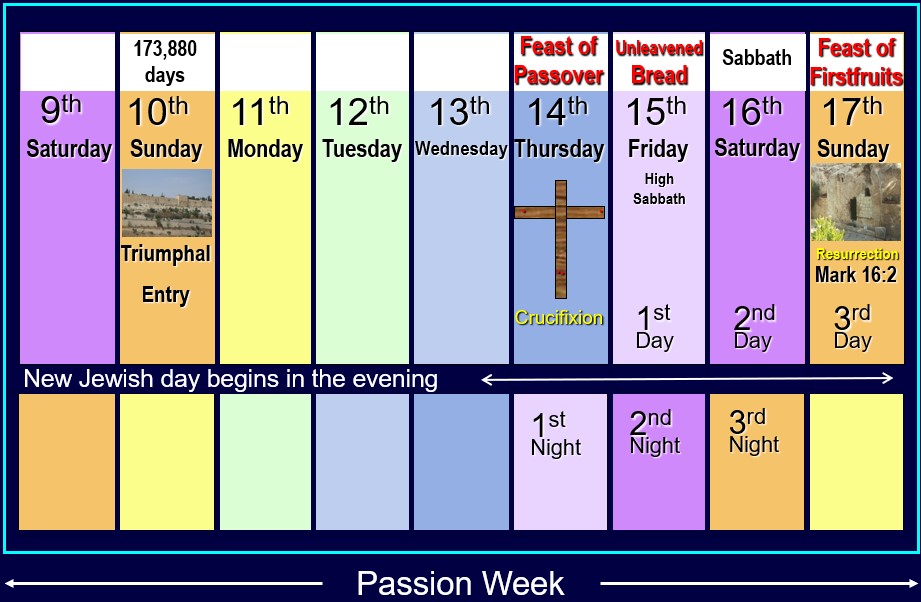
So we see from all of this that we have 4 specific markers:
- The 10th day of the 1st month – when the lamb was to be taken
- The 14th of the 1st month – when the lamb was to be slain
- The 15th of the month – to mark the eating of unleavened bread (leaven is analogous to sin, so it speaks of the removal of sin)
- The Sunday (the first day of the week), following the Passover was to be the Feast of Firstfruits. As this Feast was fixed to a specific day (i.e. Sunday), the actual date would change from year to year (much like Easter does for us). It could occur as early as the 16th (if the Passover fell on a Friday), or as late as the 22nd (if the Passover fell on a Saturday Sabbath), but always on a Sunday. In the year of Jesus’ crucifixion and resurrection the Feast of Firstfruits fell on the 17th of the 1st month.
Incredible Fulfilment!
With a little diligent study we can ascertain that it was on the 10th day of the Jewish month that Jesus rode into Jerusalem on the day we now celebrate as Palm Sunday (in precise fulfilment of Daniel 9:24-25). This was the day the Lamb of God was ‘taken’ by the people as they waived palm branches and hailed Him their king.
It was then on the 14th (the Feast of Passover) that Jesus was crucified as a spotless Lamb, bearing the sins of the world, thus becoming our Passover Lamb, His blood being shed to purchase our freedom from the slavery of sin.
It is important to note that the Jewish day begins in the evening (Genesis 1:5), so as the evening began on the 14th, the next Jewish day – the Feast of Unleavened Bread – started. From the gospels we know that Jesus died at 3pm and His body remined on the cross for a short while before being requested by, and then laid in, Joseph of Arimathea’s tomb; yet because the new day was about to begin, there was not enough time to properly anoint Jesus’ body for burial – which is why the woman planned to return at the earliest opportunity (after the Sabbath’s had passed) to complete the anointing procedure. Just a week before this, Jesus Himself had prophetically said: “Except a corn of wheat fall into the ground and die, it abideth alone: but if it die, it bringeth forth much fruit” (John 12:24), and so on the 15th, as the Feast of Unleavened Bread began, Jesus’ body, which had borne our sin, was being laid in the ground as a grain of wheat (from which bread is made).
Paul declares: “Purge out therefore the old leaven, that ye may be a new lump, as ye are unleavened. For even Christ our passover is sacrificed for us” (1 Corinthians 5:7)
The Feast of Unleavened Bread (15th) – which fell on the Friday – was a ‘high sabbath’ where no work was permitted under the Jewish Law. The next day (Saturday 16th) was the regular Jewish Sabbath, again, where no work was permitted. This meant that the earliest opportunity for the woman to return to the tomb and anoint Jesus’ body did not occur until Sunday 17th, the first day of the week. We know from Mark’s gospel that: “when the sabbath[s were] past, Mary Magdalene, and Mary the mother of James, and Salome, had bought sweet spices, that they might come and anoint him. And very early in the morning the first day of the week, they came unto the sepulchre at the rising of the sun” (Mark 16:1-2). This is of course the day of the resurrection! …and as the first Sunday following the Passover it would also be the Feast of Firstfruits. Thus, on the Feast of Firstfruits “is Christ risen from the dead, and become the firstfruits of them that slept” (1 Corinthians 15:19).
The Model in Joshua
With all the detail we have just seen, you might be wondering what the connection is with the Book of Joshua? Well, it is simple and yet profound!
We begin in Joshua 4:19 where we read: “And the people came up out of Jordan on the tenth day of the first month, and encamped in Gilgal, in the east border of Jericho”.
Yes! The triumphant day the Children of Israel finally crossed over the Jordan and entered the Promised Land, receiving their future kingdom, was the anniversary in advance of the very same day Jesus entered Jerusalem and was received as Israel’s future King! Of course, for Israel the adulation quickly stopped and they crucified their King. But He will return to sit on the throne of David and rule over Israel and the whole earth (Luke 1:32-33).
Next, we move onto Joshua 5:10, and there we read: “And the children of Israel encamped in Gilgal, and kept the passover on the fourteenth day of the month at even in the plains of Jericho”. The fact that they kept the Passover may not come as much of a surprise – they were simply following the Torah, but look at the detail! They celebrated and ate their Passover lamb ‘in Gilgal… in the plains of Jericho’. Their Passover lamb was killed in a place (Gilgal) synonymous with sacrifice and literally right in full view of their enemy. On the future anniversary of the very same day Jesus was offered up as The sacrificial Lamb, also in a place synonymous with sacrifice (Calvary – see again Genesis 22:13-14), and in full view of ‘principalities and powers’, making a public spectacle of them, triumphing over Satan and forever declaring His victory as Christ declared ‘It is finished’! – Literally in the Greek: ‘Paid in full’! (see Colossians 2:15)
As the inhabitants of Jericho looked on, barricaded within their seemingly impenetrable walls, they must have been shaken and somewhat unnerved to see Israel having a celebration and a feast right in front of thier faces! Israel’s first Passover celebration in the Promised Land was itself looking forward to the ultimate Lamb whose blood would be shed to make atonement for sin once and for all!
But there is more!
Joshua 5:11 tells us: “And they did eat of the old corn of the land on the morrow after the passover, unleavened cakes, and parched corn in the selfsame day”. For 40 years the Children of Israel had eaten Manna, the food God had miraculously provided during the wilderness wanderings. Now, on the 15th day of the first month, the very day they were supposed to celebrate the Feast of Unleavened Bread, they were able – for the first time – to do just that, with unleavened bread! Unleavened bread speaks of a life without sin, that is only possible for us because Christ became sin for us (2 Corinthians 5:21). But notice once again the detail here: it was the ‘old corn of the land‘. Through Christ’s death (on the 14th) and burial (on the 15th) ‘old things’ are to pass away, all things are to become new (2 Corinthians 5:17). As Paul asks us: “How shall we, that are dead to sin, live any longer therein?” (Romans 6:2). “Knowing this, that our old man is crucified with him, that the body of sin might be destroyed, that henceforth we should not serve sin. For he that is dead is freed from sin” (Romans 6:6-7).
Paul goes on to say: “Likewise reckon ye also yourselves to be dead indeed unto sin, but alive unto God through Jesus Christ our Lord. Let not sin therefore reign in your mortal body, that ye should obey it in the lusts thereof. Neither yield ye your members as instruments of unrighteousness unto sin: but yield yourselves unto God, as those that are alive from the dead, and your members as instruments of righteousness unto God. For sin shall not have dominion over you: for ye are not under the law, but under grace.” (Romans 6:11-14)
For the Children of Israel with Joshua, after the 14th and 15th came… the 16th! “And the manna ceased on the morrow after they had eaten of the old corn of the land” (Joshua 5:12a). So, they ate the old corn on the 15th, and the last time Manna fell, the day it ceased, was the next day, the 16th. (If it didn’t fall on the 16th it would have been said to have ceased on the 15th). Why is this significant? Because it means that the 16th represented the old order of things; from ‘tomorrow’ everything would be different. The verse continues: “neither had the children of Israel manna any more; but they did eat of the fruit of the land of Canaan that year” (Joshua 5:12b). This is incredible! From the 17th onwards – the exact date of the Feast of Firstfruits in the year of the Resurrection, and the very day of the Resurrection itself, Israel ate the fruit of the Land! This was a new beginning for Israel, they were finally back in the Land God had promised to Abraham, Isaac and Jacob and living off its bounty!
For us, the 17th, the Feast of Firstfruits, the day of the Resurrection of Jesus Christ marks an awesome new beginning! It was also the exact same day that Noah’s Ark finally came rest on the Earth again at the end of the flood – signifying a new beginning for mankind!
Because Christ rose from the dead, we can have certainty that our sins are forgiven (1 Corinthians 15:17), that He will one day come and receive us to Himself (John 14:1-3) and that we will also be resurrected, these mortal, corruptible bodies being changed into glorious incorruptible bodies fit for eternity (see 1 Corinthians 15:35-57).
Just as Israel were able to put behind them the struggle they had endured getting to this place, so we can put behind us the struggle we endured before we came to know the risen Christ. In Christ we are no longer dependant on the old ways; the things we once held dear (Philippians 3:7), the things that once susstained and satisfied us. Old things are gone, all things have become new! “But if the Spirit of him that raised up Jesus from the dead dwell in you, he that raised up Christ from the dead shall also quicken your mortal bodies by his Spirit that dwelleth in you” (Romans 8:11).
The Resurrection of Jesus changes everything! That is why it is so powerfull; but remember again the verse from Philippians we began with: “That I may know him, and the power of his resurrection [the power to forgive our sins He sealed on the 14th as our Passover], and the fellowship of his sufferings, being made conformable unto his death [that we too would be dead to sin, being ‘Unleavened‘, our old life being buried as Christ was on the 15th]; If by any means I might attain unto the resurrection of the dead [just as Christ rose again on the 17th becoming the Firstfruits of those who will rise!]. Not as though I had already attained, either were already perfect: but I follow after, if that I may apprehend that for which also I am apprehended of Christ Jesus.” (Philippians 3:10-12)
There is one final lesson for us from Joshua, and that is how we are to follow:
“And it came to pass, when Joshua was by Jericho, that he lifted up his eyes and looked, and, behold, there stood a man over against him with his sword drawn in his hand: and Joshua went unto him, and said unto him, Art thou for us, or for our adversaries? And he said, Nay; but as captain of the host of the Lord am I now come. And Joshua fell on his face to the earth, and did worship, and said unto him, What saith my lord unto his servant? And the captain of the Lord’s host said unto Joshua, Loose thy shoe from off thy foot; for the place whereon thou standest is holy. And Joshua did so” (Joshua 5:12-15) .
When Joshua meets the Captain of the host of the Lord (this is the 2nd Person of the Trinity whom you and I know as Jesus!), he begins by asking if He is on Joshua’s side. The LORD does not say, “Yes Joshua, I’m here to help you in your quest”. The answer probably took Joshua by surprise. In effect the answer given is, “No Joshua, I’ve come to see if you are on My side!”
The Resurrection is not so that we can have Jesus on our side, it’s so we can now be on His! The battle is His, not ours. His is the victory.
And what is it that Joshua does? He worships! That is the end-game. His death, burial and Resurrection are so that we might worship Him. Worship Him with our thoughts, our actions, our lives. Worship Him in all we say and all we do; in all we hope for and all we hold dear. He will then go before us and fight the battles! He alone is the Risen , Conquering, Son. Endless is the victory He over death has won!
May you be blessed and encouraged by this study to a deeper walk with our Risen Saviour.
The post The Power of His Resurrection first appeared on Calvary Chapel Portsmouth.
]]>The post Luke Ch11 1-2 first appeared on Calvary Chapel Portsmouth.
]]>The Disciples Payer – Part 1
On a number of occasions the disciples observed Jesus in payer. What must have struck them was the manor in which Jesus prayed. It was not the typical religious observance, a formality conducted out of a sense of duty; it was an intimate conversation between a Father and Son. It was not an arduous labour but a delightful exchange; it was not merely His mouth that spoke but His heart.
Shortly after the 70 had returned from their mission (Luke 10:1-24), one of them had the courage to ask the Master what, no doubt, the others had been thinking: “How is it that You pray as You do? Can you please teach us?” The relationship that existed between Jesus and His Father was one of complete trust. It was evident to all who knew Jesus that the incredible peace that characterised His life was as a result of this unflinching devotional submission and obedience to His Father. The disciples craved this kind of relationship. We should crave this kind of relationship – and Jesus came to show us that we can have it!
When Jesus had been up in the Galilee He had given a similar teaching on prayer at the end of His ‘Sermon on the Mount’ (Matt 6:9-13); but many of the 70 may not have been with Him at that time. Now, as they were approaching Jerusalem for the final time the question is asked: “Lord, teach us to pray, as John also taught his disciples”.
The first thing to note is that those with an understanding of what prayer really is, also have a living relationship with the Holy Spirit. Jesus was full of the Holy Spirit (Luke 4:1), John the Baptist was filled with the Holy Spirit (Luke 1:41-44), Elijah was filled with the Holy Spirit (2 Kings 2:9/James 5:17). As good as the multitude of books and teaching on prayer are, a relationship with the Holy Spirit is the only way to experience a real and meaningful prayer life.
The second thing to observe is that when Jesus went to pray, He resorted to a ‘certain place’ (Luke 11:1). It is good to find a place free from distractions. Jesus said: “But thou, when thou prayest, enter into thy closet, and when thou hast shut thy door, pray to thy Father which is in secret” (Matt 6:6).
“And he said unto them, When ye pray, say”:
Our Father
The Jews ‘understood’ prayer, but had never called God Father; Jesus always called God ‘Father’ – except on the cross when He cried out ‘My God, My God…’ (Matt 27:46). Jesus introduces us to this new relationship that we can have with God because of the atonement. By beginning prayer this way there is the acknowledgment that God is a good Father; everything He does is good, and that sets the tone of everything else we pray.
There is also the acknowledgment that we are part of a family (‘Our Father’). We are not alone, we are brothers and sisters united in Christ. We have been adopted into God’s family and are now His beloved children. “For ye have not received the spirit of bondage again to fear; but ye have received the Spirit of adoption, whereby we cry, Abba, Father”. (Romans 8:15).
“But when the fulness of the time was come, God sent forth his Son, made of a woman, made under the law, To redeem them that were under the law, that we might receive the adoption of sons“. (Galatians 4:4-5)
“Having predestinated us unto the adoption of sons by Jesus Christ to himself, according to the good pleasure of his will, To the praise of the glory of his grace, wherein he hath made us accepted in the beloved”. (Ephesians 1:5-6)
[Note: As the NIV translates this verse, “He predestined us for adoption to sonship“, we have all (male or female) been given the position of the firstborn son, the one who had the right to inherit the double portion. We are all equal in Christ, “there is neither Jew nor Greek, there is neither bond nor free, there is neither male nor female: for ye are all one in Christ Jesus”. (Galatians 3:28). “Behold, what manner of love the Father hath bestowed upon us, that we should be called the sons of God“ (1 John 3:1). Don’t be robbed by the ‘gender netural’ proponants that rob us of this great truth! You have not been made a ‘child of God’, but a ‘son of God’ – given the honour and blessing of the firstborn son, regardless of your gender!
With these opening two words we are brought face to face with the relationship that God wants to have with each one of us; not one of a master and slave, or of a king and their subject, but one of a loving, doting, besotted Father and a precious son! Yes, our Father is the Master of all and King of the universe, but we are to approach Him as ‘Daddy’!
Which are in Heaven
Why are we to remind ourselves, when we pray, that God is in Heaven? Because it takes our focus off time and this Earth and onto God who is outside of time. God sees the end from the beginning (Isaiah 46:9-10) and we need to look at (and pray for things) from God’s vantage point, not ours. So many of our troubles evaporate when we understand that we will never think of something that God has forgotten!
To think of Heaven is to be reminded that this earth is temporary. In the words of C.S. Lewis, this is just a ‘shadow land’. Paul said: “For I reckon that the sufferings of this present time are not worthy to be compared with the glory which shall be revealed in us. For the earnest expectation of the creature waiteth for the manifestation of the sons of God”. (Romans 8:18-19)
It is also a reminder that our treasure is laid up in Heaven… awaiting us! (Matt 6:19-22) …not in the things of this world, which is passing. (1 John 2:15-17). We are no longer citizens of Earth, but Heaven (Philippians 3:20), so we should be setting our minds on the things above (Colossians 3:2).
If you went away on business, and stayed in a hotel that was in need of repair, you would not spend your time there trying to fix it up! You would focus on completing your assignment and look forward, even more, to returning home!
It’s funny how our perception changes when our perspective changes! “Unto thee lift I up mine eyes, O thou that dwellest in the heavens. Behold, as the eyes of servants look unto the hand of their masters, and as the eyes of a maiden unto the hand of her mistress; so our eyes wait upon the Lord our God, until that he have mercy upon us.” (Psalm 123:1-2).
Hallowed be Thy Name
Is this a prayer that God’s name would be honoured and respected by the world around us? Unlikely!
It is a prayer that God’s great Name would be hallowed and honoured in our lives; it is a prayer of submission! It an acknowledgment that He is God, and we are not! –“We can only see a part of the picture He is painting!” – Steven Curtis Chapman
Psalm 119:55 states: “I have remembered thy name, O Lord, in the night, and have kept thy law”. To remember His name is to call to mind His reputation, to stop for a moment and think upon who He is and what He’s done. To be reminded that He is the God of Noah, Abraham, Moses, Joshua, Gideon, Samuel, David, Jeremiah, Daniel, Nehemiah, Paul, Peter, John…
He is also the God of Whitfield, Wesley, Spurgeon, Tozer, Husdon Taylor, Finney, Oswald Chambers, Billy Graham, Chuck Smith… He never changes.
He’s dependable, faithful, loving, the “I AM that I AM”, The voice of the burning bush, He is enduringly strong, He is entirely sincere, He is eternally steadfast, He is immortally graceful, He is imperially powerful, He is impartially merciful.
The Heavens declare His glory and the firmament shows His handiwork, He who is, who was and who will always be. He is available to the tempted and the tried; He blesses the young; He cleanses the lepers; He defends the feeble; He delivers the captives; He discharges the debtors; He forgives the sinners; He franchises the meek; He guards the besieged; He heals the sick; He provides strength to the weak; He regards the aged; He rewards the diligent; He serves the unfortunate; He sympathises and He saves!
His offices are manifold; His reign is righteous; His promises are sure; His goodness is limitless; His light is matchless; His grace is sufficient; His love never changes; His mercy is everlasting; His Word is enough; He’s indescribable; He’s incomprehensible; He’s irresistible; He’s invincible!
The Heaven of Heavens cannot contain Him; man cannot explain Him; He has always been and always will be; He had no predecessor and will have no successor; You can’t vote Him out and He isn’t going to resign! His is the Kingdom, the power and the glory… Hallowed be His Name!
There are seven names of God revealed in scripture, each tell us of His character and nature:
- JEHOVAH-JIREH –”The Lord our Provider” (Genesis 22:14).
- JEHOVAH-NISSI –”The Lord our Banner” (Exodus 17:15).
- JEHOVAH-RAPHA –”The Lord our Healer” (Exodus 15:26)
- JEHOVAH-SHALOM – The Lord our Peace (Judges 6:24)
- JEHOVAH-RAAH –“The Lord our Shepherd” (Psalm 23 )
- JEHOVAH-TSID-KENU –”The Lord is our Righteousness” (Jeremiah 33:16).
- JEHOVAH-SHAMMAH –“The Lord is Ever-present” (Isaiah 60:19)
- JEHOVAH-SHUA (JESHUA) –“The Lord is our Salvation” (Luke 1:31)
How can we ever doubt or fail to trust such a wonderful God, who demonstrated His enduring love for us in that, while we were yet sinners, He sent His Son to die for us. (Romans 5:8)
Now, think about your current problem, crisis or niggling doubt, and ask yourself, is there anything bigger than our God? Is there anything He cannot do? “Behold, the Lord’s hand is not shortened, that it cannot save; neither his ear heavy, that it cannot hear” (Isaiah 59:1).
This is the God who states His reputation – His name – on His promises: “When thou passest through the waters, I will be with thee; and through the rivers, they shall not overflow thee: when thou walkest through the fire, thou shalt not be burned; neither shall the flame kindle upon thee. For I am the Lord thy God” (Isaiah 43:2-3).
Our prayer so far…
We have been reminded as we pray, of:
- Our relationship with our loving Father
- Our real home and place of comfort, not this temporary dilapidated accommodation
- How great our God really is by thinking about His faithfulness and reputation – that He never changes!
Most of what we intended to bring before Him has by now evaporated!
But before we get onto our requests / needs, God would have us reminded of something of immense importance… J U S T I C E !
We have all at times been unjustly treated, especially by this sin-sick world. That is why we are to pray:
Thy Kingdom come
In Psalm 119 the psalmist cries out to God, pleading that God will right the wrongs:
“How many are the days of thy servant? when wilt thou execute judgment on them that persecute me? The proud have digged pits for me, which are not after thy law. All thy commandments are faithful: they persecute me wrongfully; help thou me. They had almost consumed me upon earth; but I forsook not thy precepts” (Psalm 119:84-87).
…and in Psalm 73, we see the impassioned prayer of a heart at breaking point as he looks at all the injustice around him: “Behold, these are the ungodly, who prosper in the world; they increase in riches. Verily I have cleansed my heart in vain, and washed my hands in innocency. For all the day long have I been plagued, and chastened every morning. If I say, I will speak thus; behold, I should offend against the generation of thy children. When I thought to know this, it was too painful for me; Until I went into the sanctuary of God; then understood I their end. Surely thou didst set them in slippery places: thou castedst them down into destruction. How are they brought into desolation, as in a moment! they are utterly consumed with terrors. As a dream when one awaketh; so, O Lord, when thou awakest, thou shalt despise their image.” (Psalm 73:12-20)
When we pray ‘Thy Kingdom come’ we are praying in confidence and hope that:
- God is going to right every wrong! (Ps 119:137)
- Every injustice will be brought to light and exposed (1 Cor 4:5)
- God’s wrath will fall on the ‘workers of iniquity’
- The wicked who have laid snares (Ps 119:110)
- dug pits to trip us up (Ps 119:85)
- and waited for us to destroy us (Ps 199:95)
- will themselves be cast down (Ps 119:119).
- Those who have been overlooked by man will be exalted by God (Luke 16)
- We will then know and understand (1 Cor 13:12)
The ‘kingdom’ we are to ‘hasten’ (2 Peter 3:12) by our payers is the Millennial kingdom of Jesus Christ upon this Earth (Rev 20:1-6). Jesus will sit on the Throne of David (Luke 1:32) and rule the whole world from Jerusalem. Our prayer is literally: “to put an end to the works of the Devil that oppress and destroy so many lives here and now!”
Our prayer is for all of the pain and suffering to be over! It is such and intense prayer that we are joined in it by the Holy Spirit: “The Spirit and the Bride say come!” (Rev 22:17)
But until that time, until the kingdom comes, we are to wait… “I had fainted, unless I had believed to see the goodness of the Lord in the land of the living. Wait on the Lord: be of good courage, and he shall strengthen thine heart: wait, I say, on the Lord”. (Psalm 27:13-14).
…and during this season of waiting, we are to pray…
Thy will be done, as in heaven, so in earth.
In a word (actually two words!) this is about Submission and Sanctification!
In this waiting time (before the kingom comes) we are to lay down the right to our own lives and seek for God’s will to be done on Earth – in our lives here and now – just as it is in Heaven by the myriad of angelic beings around the throne. Praying for God’s will to be done on Earth is praying that we will submit to His rulership in our lives and circumstances. Though we may not understand ‘the mind of the Lord’ we are to ‘walk by faith, not by sight’ (2 Cor 5:7). We have to humbly acknowledge that “as the heavens are higher than the earth, so are [God’s] ways higher than [our] ways,and [God’s] thoughts than [our] thoughts” (Isaiah 55:9). We are to ‘trust in the Lord and lean not on our own understanding’ (Proverbs 3:5-6).
It is in this present age the Church is being trained for eternity; the events of our lives are not random or haphazard, they are ordained of God. He leads us by still waters, and through the valley of the shadow of death… But either way we are being taught to ‘fear no evil’. “Thy will be done” is our submission to His work in us.
What is God’s will? It is a question that we may often ask in any given situation or circumstance. It may come as a surprise that the Bible actually gives us the answer, for every situation, trial, problem, disappointment, injustice, hurt… for absolutely everything we have faced, are currently facing, and will face unto the day of His return. The answer is found in 1 Thessalonians 4:3:
“For this is the will of God, even your sanctification”.
That is it! It’s as simple as that! God allows all that happens in your life for one purpose; that you might be sanctified, set apart for Him. Separated from the things of this world (the weak and begerly elements of this world) and be embraced by the heart of a Father who loves you and wants to bless you with His presence, power and purpose.
Oswald Chambers comments: “It is arduous work to keep the master ambition in front. It means holding one’s self to the high ideal year in and year out, not being ambitious to win souls or to establish churches or to have revivals, but being ambitious only to be “accepted of Him.” It is not lack of spiritual experience that leads to failure, but lack of labouring to keep the ideal right. Once a week at least take stock before God, and see whether you are keeping your life up to the standard He wishes. Paul is like a musician who does not heed the approval of the audience if he can catch the look of approval from his Master. Any ambition which is in the tiniest degree away from this central one of being “approved unto God” may end in our being castaways. Learn to discern where the ambition leads, and you will see why it is so necessary to live facing the Lord Jesus Christ. I have to learn to relate everything to the master ambition, and to maintain it without any cessation. My worth to God in public is what I am in private. Is my master ambition to please Him and be acceptable to Him, or is it something less, no matter how noble?”
We are now half-way through this model prayer that Jesus gave us, and we have not yet prayed one word in regard to our own needs, our present problems and difficulties and that which consumes so much of our time and attention! But having spent even just a small amount of time considering 1) our Father, 2) our home and future in Heaven, 3) God’s reputation and faithfulness, 4) the fact that He has promised to right every wrong and judge all injustice when His kingdom comes upon this Earth, 5) that while we are awaiting that, everything He allows in our lives is for the purpose of setting us apart for Himself, that He might truely be our God and we as His adopted and much loved sons… once we consider that, so much of what we were going to prayer about now evaporates! As Oswald Chambers once said: “Suppose God is the God you know Him to be when you are nearest to Him — what an impertinence worry is!”
God already knows the things we have need of before we even ask Him, and He can do exceedingly abundantly above all we ask or think!
If we spend more time focussing upon Him, we’ll have far less concern about ourselves!
To be continued…
May you be blessed and encouraged by this study.
The post Luke Ch11 1-2 first appeared on Calvary Chapel Portsmouth.
]]>The post Luke Ch9 1-17 first appeared on Calvary Chapel Portsmouth.
]]>Having seen Jesus demonstrate His power and authority over sickness and those possessed, Jesus now sends his 12 disciples out to do the same:
“Then he called his twelve disciples together, and gave them power and authority over all devils, and to cure diseases. And he sent them to preach the kingdom of God, and to heal the sick”. (Luke 9:1-2)
On this occasion, this power and authority was given to just the 12, but later Jesus will tell the disciples that this remit is now given to all who follow on and believe in His name: “Go ye into all the world, and preach the gospel to every creature. He that believeth and is baptized shall be saved; but he that believeth not shall be damned. And these signs shall follow them that believe; In my name shall they cast out devils; they shall speak with new tongues; They shall take up serpents; and if they drink any deadly thing, it shall not hurt them; they shall lay hands on the sick, and they shall recover” (Mark 16:15-18)
Paul will later tell us that the ‘healing of the sick’ and ‘working miracles’ are two of the gifts the Holy Spirit will give to the church (see 1 Cor 12:8-11).
Certainly, the early church specifically prayed for this power and authority over sickness and demonic spirits (Acts 4:29-31) and God answered this prayer: “And believers were the more added to the Lord, multitudes both of men and women.) Insomuch that they brought forth the sick into the streets, and laid them on beds and couches, that at the least the shadow of Peter passing by might overshadow some of them. There came also a multitude out of the cities round about unto Jerusalem, bringing sick folks, and them which were vexed with unclean spirits: and they were healed every one.” (Acts 5:14-16).
The South African Bible scholar, author and teacher, Andrew Murray, said: “The Bible does not authorize us, either by the words of the Lord or His apostles, to believe that the gifts of healing were granted only to the early times of the Church; on the contrary, the promises which Jesus made to the apostles when He gave them instructions concerning their mission, shortly before His ascension, appear to us applicable to all times. Paul places the gift of healing among the operations of the Holy Spirit. James gives a precise command on this matter without any restriction of time. The entire Scriptures declare that these graces will be granted according to the measure of the Spirit and of faith.”.
“Oh, that we could learn to believe in the promises of God! God has not gone back from His promises; Jesus is still He who heals both soul and body; salvation offers us even now healing and holiness, and the Holy Spirit is always ready to give us some manifestations of His power. Even when we ask why this divine power is not more often seen, He answers us: ‘Because of your unbelief. The more we give ourselves to experience personally ‘sanctification by faith’, the more we shall also experience healing by faith. These two doctrines walk abreast. The more the Spirit of God lives and acts in the soul of believers, the more will the miracles multiply by which He works in the body. Thereby the world can recognize what redemption means.”.
…and that is the great secret that unlocks this divine power and authority to heal the sick: The Holy Spirit working in the lives of believers! It is not our power, it’s His!
Why do we not see more of this power at work in the Church today?
1) Partly because of unbelief – we have allowed our rational (western) 21st Century mind to tell us it doesn’t / can’t happen today (Satan’s old, regurgitated lie “hath God really said…?”).
2) Because so few Christians today give themselves totally to God to be used by Him as He chooses and not for our own endeavours and plans.
God is still the same. He still wants to see the lost saved. He has paid for our sin and our sickness on the cross (Isaiah 53:4-5). We receive our salvation by faith in His Word, believing it in our hearts and confessing it with our lips. We can receive His healing (that has already been paid for) if we simply ask in faith, believing, not doubting His promise and not doubting His completed work, and then confessing with our lips. (Romans 10:9-10). This is why James boldly states: “Is any among you afflicted? let him pray. Is any merry? let him sing psalms. Is any sick among you? let him call for the elders of the church; and let them pray over him, anointing him with oil in the name of the Lord: And the prayer of faith shall save the sick, and the Lord shall raise him up; and if he have committed sins, they shall be forgiven him” (James 5:13-15).
It is why John, under the inspiration of the Holy Spirit, declares: “Beloved, I wish above all things that thou mayest prosper and be in health, even as thy soul prospereth”. (3 John 1:2).
The LORD is looking today for sanctified vessels (like Stephen – see Acts 6:3-8), ‘full of the Holy Spirit’ that He can use to bring the gospel to the lost. The early church saw multitudes added to the church as the Lord confirmed the Word with signs following (Mark 16:20). We live in a sceptical world that sees no need for God in their busy (desperate) lives.
The power and authority that God gives to His church has not changed because God has not changed.
There is a call, just as in Isaiah’s day, “Whom shall I send, and who will go for us?” (Isaiah 6:8).
Will you be one of the few that answer?
You will either have this word snatched away (Luke 8:12)… Or be one who initially receives this with joy, only for Satan to come and tempt you by saying ‘Has God really said?’ (Luke 8:123) … Or you will simply be too busy with the cares and concerns of this life (Luke 8:14). Or you may be one of those who receive the Word with faith, who produce a wonderful crop unto eternal life! (Luke 8:15).
May you be blessed and encouraged by this study.
The post Luke Ch9 1-17 first appeared on Calvary Chapel Portsmouth.
]]>The post Luke Ch8 26-56 first appeared on Calvary Chapel Portsmouth.
]]>There are three silent, but powerful, ‘enemies’ that hinder the work of God in our lives: Fear, doubt and unbelief. So often, fear leads to doubt and doubt to unbelief. James tells us: “But when you ask, you must believe and not doubt, because the one who doubts is like a wave of the sea, blown and tossed by the wind. That person should not expect to receive anything from the Lord”. (James 1:6-7 NIV). Jesus clearly stated that He was unable to work miracles in Nazareth that He did elsewhere ‘because of their unbelief’ (Matt 13:58). Over 300 times we are told to ‘not be afraid’ / ‘fear not’, clearly showing that we have a choice! The only fear we should have is the fear of the LORD which is the beginning of wisdom! Oswald Chambers said that if you fear God, you’ll fear nothing else!
Sadly, instead of fearing God we fear everything else, for what if God’s promises don’t ‘come true’? What then? That leads to us doubting God’s Word, which then gives way to unbelief.
Thinking back to the four soils at the beginning of Luke chapter 8, we see that the seeds that fell on the wayside were immediately met by unbelief: “the devil comes and takes away the word from their hearts, so that they may not believe” (Luke 8:12). The seed that fell on the rocky soil started well, only for doubt to consume and destroy (v13). The seed that fell among the thorns was choked by ‘life’s worries’ (v14) – in a word, fear.
John Piper once said: “The tap root, out of which sprouts all the weeds of sin, is the tap root of unbelief in the promises of God. When you trust, or believe in a promise of God, you glorify God. In fact, trusting somebody’s promise is the most fundamental honour you can do that person. The reverse is also true: The greatest contempt that you can bring down upon a person, is to say to them, ‘I can’t trust you’. So, when we don’t trust a promise of God, we bring contempt upon Him, we give Him a vote of ‘no confidence’.
In Luke 8:22-25 we see the disciples in a boat on the sea of Galilee. Whilst Jesus was asleep, a storm arose. In a state of fear the disciples awoke Jesus who then calmed the storm and chided the disciples for their lack of faith (v25) – their unbelief. Jesus had already ‘given His word’ and told them they were going to the other side of the lake, but here, overwhelmed by the circumstances’ they fear (demonstrating a lack of trust), doubt Jesus’ word, and their unbelief is exposed.
In the remainder of Luke chapter 8 we see Jesus continuing to preach and actively demonstrate the ‘good news’. In quoting from Isaiah Jesus had said “The Spirit of the Lord is upon me, because he hath anointed me to preach the gospel to the poor; he hath sent me to heal the brokenhearted, to preach deliverance to the captives, and recovering of sight to the blind, to set at liberty them that are bruised, To preach the acceptable year of the Lord” (Luke 4:18-19).
Now Jesus demonstrates that He had come to destroy the works of the devil (1 John 3:8) – both sin and sickness – by delivering a man who had been possessed by a legion of demons, healing a woman who had an issue of blood for 12 years, and then raising from the dead Jairus’ daughter!
Significantly, Jesus tells the woman with the issue of blood “thy faith hath made thee whole” (v48).
To Jairus (upon his hearing that his daughter had died) Jesus said “Fear not: believe only, and she shall be made whole.” (v50).
We cannot get away from the fact that two thirds of Jesus ministry were spent healing the sick and performing miracles by the power of the Holy Spirit – in direct fulfilment of Isaiah 61:1. This is an integral part of the gospel (good news!) He came to proclaim. The good news is that through Christ there can be reconciliation with God and forgiveness of sins, “But that ye may know that the Son of man hath power upon earth to forgive sins“* He also heals the sick! Do you believe this?
*(Luke 5:24)
Are you prepared to take God at His Word? Or do we receive the Word with joy, only to have doubt creep in and tell us that this is not how it is, that God doesn’t heal today?
Andrew Murray stated: “Oh, that we could learn to believe in the promises of God! God has not gone back from His promises; Jesus is still He who heals both soul and body; salvation offers us even now healing and holiness, and the Holy Spirit is always ready to give us some manifestations of His power. Even when we ask why this divine power is not more often seen, He answers us: ‘Because of your unbelief. The more we give ourselves to experience personally ‘sanctification by faith’, the more we shall also experience healing by faith. These two doctrines walk abreast. The more the Spirit of God lives and acts in the soul of believers, the more will the miracles multiply by which He works in the body. Thereby the world can recognize what redemption means.”.
“The Bible does not authorize us, either by the words of the Lord or His apostles, to believe that the gifts of healing were granted only to the early times of the Church; on the contrary, the promises which Jesus made to the apostles when He gave them instructions concerning their mission, shortly before His ascension, appear to us applicable to all times. (cf Mark 16:15-18)”
“Paul places the gift of healing among the operations of the Holy Spirit. James gives a precise command on this matter without any restriction of time. The entire Scriptures declare that these graces will be granted according to the measure of the Spirit and of faith.”.
“In this chapter (Isaiah 53), the expression ‘to bear’ occurs twice, but in relation to two different things. It is said not only that the Lord the righteous Servant bore our sins (v12), but also that He bore our sicknesses (v4). Thus, His bearing our sicknesses as well as our sins forms an integral part of the Redeemer’s work. Although He was without sin, He has borne our sins, and has done the same with our sicknesses. “As soon as a sick believer understands the meaning of the words, ‘Jesus has borne my sins’, he is not afraid to say ‘I no longer need to bear my sins’. In the same way, as soon as he fully believes that Jesus has borne our sicknesses, he is not afraid to say ‘I no longer need to bear my sicknesses.’ “Jesus, in bearing sin, bore sickness also, which is its consequence. He has made payment for both, and He delivers us from both. In Jesus, we have both pardon and healing. They are two sides of His redemptive work.”
Consider the impact on your family, friends, colleagues, if they heard of, or came to church and actually saw miracles of healing… It would be just like it was in the Book of Acts where we read: “and many wonders and signs were done by the apostles… And the Lord added to the church daily such as should be saved” (Acts 2:43-47). “And believers were the more added to the Lord, multitudes both of men and women.)… There came also a multitude out of the cities round about unto Jerusalem, bringing sick folks, and them which were vexed with unclean spirits: and they were healed every one.” (Acts 5:14-16).
It will not and cannot happen except by the work and power of the Holy Spirit among a people who yield themselves to Him, to ‘Walk in the Spirit’ (Gal 5:16), and who are ‘Led by the Spirit’ (Gal 5:18). Not wavering, not doubting, willing to take God at His Word, letting the Seed of His Word sink down into the good soil of faith and belief. Who not only hear, but also do!
The Apostle Paul wrote to the Galatian believers and asked: “He therefore that ministereth to you the Spirit, and worketh miracles among you, doeth he it by the works of the law, or by the hearing of faith?” (Gal 3:5).
May this study challenge and encourage you to a deeper walk with the Holy Spirit.
The post Luke Ch8 26-56 first appeared on Calvary Chapel Portsmouth.
]]>The post Luke Ch8 1-15 first appeared on Calvary Chapel Portsmouth.
]]>Luke chapter 8 begins by reminding us that throughout Jesus ministry He proclaimed the good news, accompanied by signs and wonders, healing multitudes. When Jesus sent the disciples out He said: “And as ye go, preach, saying, The kingdom of heaven is at hand. Heal the sick, cleanse the lepers, raise the dead, cast out devils” (Matthew 10:7-8). When He gave the ‘Great Commission’, He said that those who believe in Him should preach the gospel and make disciples (Matt 28:19), and that they should lay their hands on the sick and they would recover (Mark 16:18). In the book of Acts, Dr Luke records that the early church prayed “with all boldness they may speak Your word, by stretching out Your hand to heal, and that signs and wonders may be done through the name of Your holy Servant Jesus.” (Acts 4:29).
Somehow, we have all heard and responded (to some degree or another) to the call to preach the gospel, but it seems only a handful in today’s church have taken Jesus at His Word and are prepared and willing to pray for healing for the sick.
This is largely the result of a lack of faith in God’s Word. We say we believe and trust His Word, but shy away from actually praying for the sick, just in case it doesn’t work! With such unbelief it’s no surprise we see few healed (see Matt 13:58) , and reaching the lost seems like an almost impossible task in a world where people see no need for an empty religion.
But what if… what if it’s true! What if God still heals people today?
Jesus came to destroy the works of the Devil (1 John 3:8)… and repeatedly Jesus attributes sickness to the work of the Devil. (see Luke 13:11-16 / Luke 8:2 / Luke 4:39).
The very ‘good news’ Jesus went throughout every city proclaiming was the mission He declared He’d been given:
─he hath anointed me to preach the gospel to the poor;
─he hath sent me to heal the brokenhearted,
─to preach deliverance to the captives, and
─recovering of sight to the blind,
─to set at liberty them that are bruised, (Luke 4:18)
The ‘good news’ was that God was breaking the power of the Devil over people’s lives! It included forgiveness of sins (quickening of our souls – see Ephesians 2:1-6), and the quickening of our mortal bodies (Romans 8:11). Our bodies become the Temple of the Holy Spirit when we turn to the cross and put our faith and trust in Jesus for the forgiveness of our sins (1 Cor 3:16). But does the Holy Spirit expect a dilapidated and impaired Temple to dwell in? Most Christians have no doubt that Jesus can quicken our souls; so why do we struggle to believe that the One to Whom all power is given, in Heaven and Earth (Matt 28:18) can and will quicken our mortal bodies if we just look to Him with the same faith for healing that we do for salvation?
In the book of Numbers we read the account of how the Children of Israel murmured against Moses and complained about the Manna God had provided for them. As a result we read that “the Lord sent fiery serpents among the people, and they bit the people; and much people of Israel died” (Num 21:6). When the people acknowledged their sin God told Moses to “make thee a fiery serpent, and set it upon a pole: and it shall come to pass, that every one that is bitten, when he looketh upon it, shall live” (Num 21:8). Anyone that looked upon this serpent on a pole (in faith) was then forgiven for their sin and healed.
In John chapter 3 Jesus Himself explains that this real event for the Children of Israel was a model in advance that spoke of Himself becoming sin for us and being put upon the cross. All who look in faith to Jesus “should not perish, but have eternal life” (John 3:14). Note that here we have the promise that we shall not perish (which applies to the physical life) and the promise of eternal life to come!
Do we really think that the serpent on a pole as a type was more effective than the fulfilment of Christ on the Cross? If the Children of Israel were healed and forgiven by looking at a serpent on a pole, are we who look to the actual Lamb of God, who became sin for us, ‘only’ to expect forgiveness, but somehow cannot expect healing? Is the arm of the Lord somehow shortened? (Isaiah 59:1).
“Bless the Lord, O my soul,
and forget not all his benefits:
Who forgiveth all thine iniquities;
who healeth all thy diseases;
Who redeemeth thy life from destruction;
who crowneth thee with lovingkindness and tender mercies;
Who satisfieth thy mouth with good things;
so that thy youth is renewed like the eagle’s.” (Psalm 103:2-5)
Do we think the blessings under the old covenant with Israel were greater than the New Covenant in the blood of Jesus?
In Luke 8:5-15 we have Luke’s account of the parable of the ‘four soils’, into which the seed is sown. The seed is a picture of the Word of God. Seeds are full of life and can multiply and reproduce once they are put into the right soil and watered. They have found 300o year-old seeds in Egypt that are so dry and brittle they would just shatter if squeezed hard. Yet when put in soil and watered they burst into life!
Such is the Word of God in a believing heart. Unbelief however, chokes out the Word and leaves us unfruitful.
“He saith unto the ruler of the synagogue, Be not afraid, only believe!“ (Mark 5:36)
“Jesus said unto him, If thou canst believe, all things are possible to him that believeth. And straightway the father of the child cried out, and said with tears, Lord, I believe; help thou mine unbelief.” (Mark 9:23)
Will you be like those on the way side, that hear, but then the Devil comes and takes away the Word, replacing it with doubt? (Luke 8:12)
Will you be like those on the rock, that receive the Word with joy – ‘you really want to believe but…’ then succumb to temptation “has God really said?” (Luke 8:13)
Will you be like those among thorns, who have too many interests in this world and can’t really be bothered to find out if this is true? (Luke 8:14)
Or will you be one of the few with an “honest and good heart, having heard the Word, keep it, and bring forth fruit with patience”! (Luke 8:15)
“For the eyes of the Lord run to and fro throughout the whole earth, to shew Himself strong in the behalf of them whose heart is perfect toward him” (2 Chron16:9).
May this study stir up your pure minds as you step out in faith with your eyes upon Jesus!
The post Luke Ch8 1-15 first appeared on Calvary Chapel Portsmouth.
]]>The post Malachi Ch3-4 first appeared on Calvary Chapel Portsmouth.
]]>This also brings us to the end of our study in the Minor Prophets.
Throughout the Minor Prophets we have seen God’s faithfulness to the Nation of Israel, keeping His covenant with the nation that had been given to Abraham; yet God is a just God and Israel, before being restored, must be judged for her sins as a nation.
Malachi draws all of this to a close and calls for a people who will offer sincere offerings from the heart out of a love for the God that has called and chosen them.
Malachi also introduces us to two great voices who will ‘prepare the way of the LORD’. Firstly, John the Baptist, who prepared the way at Christ’s first advent, and then Elijah who will return and prepare the way for Christ’s 2nd Advent!
May you be blessed and encouraged by this study.
(The PowerPoint slides used in this study are available for free download)
The post Malachi Ch3-4 first appeared on Calvary Chapel Portsmouth.
]]>The post Daniel – Introduction first appeared on Calvary Chapel Portsmouth.
]]>Introduction to this study:
The book of Daniel is one of the best-loved books of the Bible; it gives us the story of ‘Shadrach, Meshach and Abed-nego and the fiery furnace’ and ‘Daniel in the lions den’ – stories that many of us learned and loved at Sunday school. However the years have come and gone and we so often tend to just skip over those quaint little stories without them having any real impact on our lives; however, I believe that once we have completed a serious verse-by-verse study of this amazing book we will never be the same. This book gives us real perspective, it helps us to see things the way that God sees them – the way Daniel saw them.
Daniel, whose name means ‘God is my judge’, was just a teenager, probably about 14, when the Babylonian army, led by king Nebuchadnezzar, came and took him and his friends away from all they knew, and carried them away into a distant land. It’s hard for us to imagine the feelings and emotions of a 14-year-old being taken from the security of a family, not knowing if he would ever see them again. Although we are told that there was not a righteous man in Jerusalem at that time (Jer 5:1 / Jer 8:5-6), (hence the reason for God bringing His judgment), it would seem that there were still some God-fearing mums, for Daniel and his friends had been brought up to know and fear God and even their names were a continual reminder of the God of Israel. But would that be enough? After all, how many young people today, after seeing all that Daniel saw, and enduring all that he endured, would make a stand for God in the midst of a pagan culture? How many of our young people leave home and go to the University of ‘Babylon’, where secular humanism rules, and find their once vibrant faith destroyed as they become ‘free’ to do what they want, as the moral constraints and stability of a loving family (church and/or home) become just memories? And how many of us can truly say, as we are thrust out into the world every Monday morning, that we desire purity more than worldly pleasure?
Do we really fear God and shun evil as Job did? (Job 1:8). Do we run from temptation like Joseph? (Gen 39:12). Or do we find ourselves dropping the odd expletive (Col 3:8), telling a ‘funny’ course joke to our colleagues so that we will fit into the crowd (Eph 5:4), maybe telling the odd little ‘white’ lie (Col 3:9). “Out of the same mouth proceedeth blessing and cursing. My brethren, these things ought not so to be. Doth a fountain send forth at the same place sweet water and bitter?” (James 3:10-11). Were you in church praising God last Sunday, and then blending right back into the world on Monday? I heard of a man who went up to a Christian once and asked: ‘You’re a Christian aren’t you?’ The Christian replied ‘That’s for you to tell me’ – i.e. it should be obvious to all around us. Too many Christians act as secret agents, never wanting to blow their cover.
Daniel hadn’t been in Babylon for five minutes before they could tell what the most important thing in his life really was. It is my earnest prayer and desire that by the time we reach the end of this study, we too can say along with Daniel that we have ‘purposed in our hearts that we will not defile ourselves’ – no matter what the cost.
Overview of the book of Daniel
The book of Daniel records the collapse of the nation of Israel and the beginning of the ‘times of the gentiles’ – a period of time that will last until the Messiah returns to set up His kingdom (‘thy kingdom come…’) and sit on the Throne of David (see Luke 1:32) (i.e. the throne of Israel) ruling over all nations from Jerusalem: “And after they had held their peace, James answered, saying, Men and brethren, hearken unto me: Simeon hath declared how God at the first did visit the Gentiles, to take out of them a people for his name. And to this agree the words of the prophets; as it is written, After this I will return, and will build again the tabernacle of David, which is fallen down; and I will build again the ruins thereof, and I will set it up” (Acts 15:13-16)
O Jerusalem, Jerusalem, which killest the prophets, and stonest them that are sent unto thee; how often would I have gathered thy children together, as a hen doth gather her brood under her wings, and ye would not! Behold, your house is left unto you desolate: and verily I say unto you, Ye shall not see me, until the time come when ye shall say, Blessed is he that cometh in the name of the Lord. (Luke 13:34-35)
“And it shall come to pass in the last days, that the mountain of the LORD’s house shall be established in the top of the mountains, and shall be exalted above the hills; and all nations shall flow unto it. And many people shall go and say, Come ye, and let us go up to the mountain of the LORD, to the house of the God of Jacob; and he will teach us of his ways, and we will walk in his paths: for out of Zion shall go forth the law, and the word of the LORD from Jerusalem. And he shall judge among the nations, and shall rebuke many people: and they shall beat their swords into plowshares, and their spears into pruninghooks: nation shall not lift up sword against nation, neither shall they learn war any more.” (Isaiah 2:2-4) (We will deal more fully with this whole idea of ‘Replacement Theology’ – the lie that God has finished with Israel – in part 2 (chapters 7-12) of our study).
As we will see, the book of Daniel is very much a book of prophecy, foretelling the history of the world in advance; from the time of the Babylonian empire of Nebuchadnezzar, to the final world empire of Antichrist, and then ultimately into the Millennial reign of Jesus.
Many of the prophecies in this book have now been fulfilled, however chapters 2, 7 and 9 contain prophecies of vital importance if we are to have a biblical understanding of the times we are living in. This book details what we can expect on the near horizon as world events play out to their ultimate conclusion as we approach the imminent return of Jesus.
We will deal with it in detail when we get there, but the prophecy in chapter 9, known as ‘Daniel’s 70 weeks’, is possibly the most remarkable prophecy in the entire Bible and provides undeniable proof that Jesus of Nazareth is the Jewish Messiah. In fact, so accurate are the prophecies in this book that it has led many critics to claim that it must have been written after the time of Christ – a claim that is easily refuted by the facts! Nevertheless, the book of Daniel has come under great attack from the (self-titled) ‘Higher Critics’ and sceptics and we will deal with some of their claims and objections as we go through our study.
The book can be divided into two main sections, the historical (chapters 1-6), and the visions (chapters 7-12). Also of note is the fact that the section of the book that is dealing with the gentiles is written in Aramaic, as opposed to Hebrew (which makes up the rest of the book).
The Chronology of the Book of Daniel:
606 B.C. Chapter 1 – Israel’s captivity in Babylon begins, Daniel deported
604 B.C. Chapter 2 – King Nebuchadnezzar’s dream
c.588 B.C. Chapter 3 – Nebuchadnezzar’s image & the fiery furnace
571-563 B.C. Chapter 4 – Nebuchadnezzar’s pride and fall
c.552 B.C. Chapter 7 – Daniel’s vision of the four beasts
c.550 B.C. Chapter 8 – Daniel’s vision of the Ram & He-goat
539 B.C. Chapter 5 – Babylon falls to the Persians – the writing on the wall
c.538 B.C. Chapter 6 – Daniel in the lions den
537 B.C. Chapter 9 – Daniel’s vision of the 70 weeks
c.535 B.C. Chapters 10 – The Spiritual War
c.535 B.C. Chapters 11-12 – Closing visions
As we have noted, Daniel was just a teenager when he was deported to Babylon in 606 B.C. Josephus records that he met Cyrus at the gates of Babylon in 539 B.C., and we know that he served under king Darius the Mede (who reigned in the province of Babylon under Cyrus). Therefore, we see that Daniel’s ministry stretched into his late 80’s, and saw him serve as ‘prime minister’ under two successive world empires – a feet unparalleled in history. But as Daniel records at the end of chapter 1, it was God alone who had lifted him up. His is the power, glory might and dominion, He alone rules in the kingdoms of men.
Pre-eminence, Purpose, Purity & Prophecy
The sub title of this study, ‘Pre-eminence, Purpose, Purity & Prophecy’ is an apt summary of the book.
Pre-eminence because the book shows time and again that it is God who rules in the kingdoms of men (Dan 4:17 / 4:25 / 4:32). It is He who orders the steps of a good man (Psalm 37:23), indeed, “Man’s goings are of the LORD; how can a man then understand his own way?” (Prov 20:24). This was the basis of Daniel’s life, a confident assurance that whatever happened on the outside, however desperate things seemed to be, God was still on the throne, the One who is the same, yesterday, today, forever (Heb 13:8).
Purpose for two reasons:
Firstly because this book underlines the fact that God has a purpose for all that happens in our lives, as Daniel and his friends show – who would have thought that these teenagers who were dragged away in shackles would be the ones to bring the most powerful nation to its knees? Paul reminds us: “And we know that all things work together for good to them that love God, to them who are the called according to his purpose.” (Rom 8:28).
Secondly, purpose because “Daniel purposed in his heart that he would not defile himself with the portion of the king’s meat, nor with the wine which he drank: therefore he requested of the prince of the eunuchs that he might not defile himself.” (Dan 1:8). In this context the ‘purpose’ referred to is a determined conscious decision that is made in the heart “For where your treasure is, there will your heart be also.” (Matt 6:21). Daniel’s treasure was to do the will of God regardless of what others thought or said, as we will see in chapter 6: “Now when Daniel knew that the writing was signed,[that everyone should worship king Darius alone or be thrown to the lions] he went into his house; and his windows being open in his chamber toward Jerusalem, he kneeled upon his knees three times a day, and prayed, and gave thanks before his God, as he did aforetime.” (Dan 6:10). Oh for men and women who purpose in their hearts to serve God. In the New Testament Paul purposed in his heart to preach the gospel: “But life is worth nothing unless I use it for doing the work assigned me by the Lord Jesus-the work of telling others the Good News about God’s mighty kindness and love.” (Acts 20:24 TLB) “…woe is unto me, if I preach not the gospel!” (1 Cor 9:16), as a result of this purpose of heart we read: “And Paul, as his manner was, went in unto them, and three sabbath days reasoned with them out of the scriptures” (Acts 17:2). For these people, serving God was a way of life, not just a ‘Sunday thing’. The challenge for us as we go through this book is: are we really living lives worthy of our calling? (Eph 4:1 / Col 1:10 / 1 Thess 2:12).
Purity. Because of Daniel’s purpose of heart, there was a beautiful purity about Daniel (as there was with Joseph). It is so easy for us to get tainted by the world and our surroundings, but when we do, it can so quickly escalate out of control. Chuck Smith sums it up clearly and concisely, “The flesh is never satisfied”. Chuck Missler comments that the more you feed a desire, the more you need to feed that desire; if you give into drink, you will need more drink to be satisfied, but then that will not be enough. If you take drugs, you will soon need more drugs to feed your habit; but that will not be enough. If you lust after the flesh, you will find yourself wanting more and more. If you gossip, one little story is never enough. Sin will always take you further than you want to go, keep you longer than you want to stay, and cost you more than you want to pay. If you have a tin of pure white paint, how many drops of black paint would it take to stop it being pure white? And so it is with our lives. Daniel never gave in; and twice in the book of Ezekiel God points to Daniel as an example of what a righteous man should be like. (Ezekiel 14:14 /20). May God put us through His crucible to remove the dross so that, like pure gold, we become reflections of His glory.
Prophecy. This needs no explanation other than to say that prophecy is one of the infallible and undeniable proofs that God has given us to show that His word is true (see 2 Peter 1:19). Jesus Himself in Matthew 24 pointed to a prophecy in the book of Daniel as the key to understanding the end-times, yet it is astonishing that so many Christians are ignorant regarding the prophecies in the Bible. Job said: “Why, seeing times are not hidden from the Almighty, do they that know him not see his days?” (Job 24:1). Jesus held the Jews accountable for not understanding the prophetic scriptures, and rebuked the Pharisees because, although they could predict the weather, they didn’t understand the signs of the times.
Facts about the book
Author: Daniel – how do we know? Because seven times we read “I Daniel…” and secondly because Jesus said Daniel wrote it (Matt 24:15). “If you don’t believe what Jesus said you’ve got much bigger problems than the authorship of Daniel!” – Chuck Missler
- Daniel uses his own name 75 times.
- When was it written?: About 606-530 B.C.
Statistics:
- 27th book of the Bible;
- 12 chapters,
- 357 verses;
- 11,606 words;
- 16 questions;
- 218 verses of history;
- 79 verses of fulfilled and 60 verses of unfulfilled prophecy;
- 7 commands;
- 4 promises; and
- 6 messages from God.
Scope: From king Nebuchadnezzar’s Babylon in 606BC to the establishment of the Messianic kingdom in the Millennium.
Main characters:
- Daniel and his three friends, Hananiah, Mishael & Azariah.
- Gentile kings: Nebuchadnezzar, Belshazzar, Cyrus, Darius
Daniel is one of only a few people in scripture of whom no sin is recorded, Joseph being another – this doesn’t mean they didn’t sin, Romans 3:23 makes that clear, but in this way they become a type of Christ.
Daniel is called ‘beloved’ (Dan 9:23 / 10:11 / 10:19), the same title is given to John in the NT. Both Daniel and John were given revelations of the climax of world events. It appears that God reserves His most intimate secrets for those who are His beloved. The church is also called His beloved (Rom 9:25) – i.e. these secrets are for us – what a privilege!
It is recorded by Josephus (a Jewish historian) that in 332 B.C. Jeduthan, a Jewish high priest, met Alexander the Great at the gates of Jerusalem and presented to him a copy of the book of Daniel. Upon showing Alexander the prophecies about himself in the book, Alexander was so impressed that he spared the city!
Historical Background:
The book of Daniel begins with an historical statement – something the critics try to obfuscate, yet there is no getting away from the fact that Daniel is a book of history as much as it is a book of prophecy.
Therefore, in preparation for our verse-by-verse study through Daniel is would be profitable to do a crash course in ancient history, to give us some of the background of the times that Daniel lived in and to set the scene.
Israel as a nation became divided during the reign of Solomon’s son, Rehoboam. The northern part of the nation became known as ‘Israel’, the southern part as ‘Judah’. Israel went from bad to worse and God sent prophet after prophet to warn them to repent or face judgment. All of this is recorded in the books of Kings and Chronicles. There was not a good king among the kings of Israel and so eventually God allowed the Assyrians to conquer Israel in around 722 B.C.
Judah was not a great deal better, with many bad kings who did not seek God but indulged in idolatry. However there were a few good kings such as Jehoshaphat (2 Chron 17:1-6), Joash (2 Chron 24:1-4), Hezakiah (2 Chron 29:1-2), and Josiah (2 Chron 34:1-2).
Josiah reigned in Judah from about 641 to 609 B.C. However Josiah’s death was brought about by a strange event that is recorded in 2 Chron 35:19-27.
Assyria had been the dominating world empire, having already conquered the northern kingdom of Israel as mentioned above; but their days were numbered as God had prophesied through Nahum. In 612 B.C. Babylon and Media formed an alliance and conquered Assyria’s capital, Nineveh. Three years later Pharaoh Necho, the king of Egypt attacked Assyria and defeated it at a place called Charchemish.
In 2 Chronicles 35:19-21 we read: “After all this, when Josiah had prepared the temple, Necho king of Egypt came up to fight against Carchemish by Euphrates: and Josiah went out against him. But he sent ambassadors to him, saying, What have I to do with thee, thou king of Judah? I come not against thee this day, but against the house wherewith I have war: for God commanded me to make haste: forbear thee from meddling with God, who is with me, that he destroy thee not.”
Now remember that Assyria had been Israel’s enemy for centuries – remember Jonah’s reluctance to go and preach to them? Consider also king Sennacherib’s taunts against Hezekiah (2 Chron 32). So the question has to be asked, why did king Josiah go out against Necho who was on his way to destroy Israel’s enemies? Surely Josiah should have been fighting with him if anything, not against him. The answer may be found in the opening line of verse 19: “After all this, when Josiah had prepared the temple” – prepared it for what? Reading chapters 34 & 35 of 2 Chronicles we discover that Josiah had been presented with ‘the book of the law’ that had been discovered as they were starting to repair the temple. After reading it, Josiah realised how far away from God the nation had gone – the same is true today, reading God’s word will show how far from God our nation has gone.
Josiah set about restoring everything according to the law of Moses, however in verse 3 of chapter 35 he tells the priests to ‘put the holy ark in the house that Solomon had built’. Now if they were to put it in there, it was obviously not in there at that time. So where was it?
There are various theories about what happened to the Ark of the Covenant, but by far and away the most plausible is that it was taken by the Levites during the reign of king Manasseh who was desecrating everything that was holy, in order to keep it safe. It is believed that it was taken to Ethiopia, and certainly there are many legends of the ark being in Ethiopia. Recent discoveries by Bob Cornuke (Base Institute) have brought to light some compelling evidence to support this belief. What makes all of this interesting is to realise that Pharaoh Necho was not himself Egyptian, but Ethiopian! Could this therefore be the reason that Josiah went out to fight with Necho? Even Necho himself was surprised by Josiah’s actions and told Josiah that he was following God’s instructions and claimed that ‘God is with me’ – a strange comment from a gentile, unless of course he actually had the Ark!
Anyway, Josiah died in the battle and Necho went on to defeat the Assyrians as has been mentioned (and was prophesied by Isaiah in Isaiah 10:5-11). With Josiah now dead, his son, Jehoahaz became king in Jerusalem, that is until Necho, on his way back from the battle, stopped off at Jerusalem, put Judah under tribute, carried Jehoahaz away to Egypt and made Jehoahaz’s brother, Jehoiakim, king instead.
With the Assyrians conquered there was now a ‘power vacuum’ that needed to be filled. Necho was powerful, but there was a ‘new kid on the block’; a young general called Nebuchadnezzar. The king of Babylon at that time was Nabopolassar, but it was his son Nebuchadnezzar who was destined to become one of the most powerful rulers the world has known. Three years after Necho had won at Charchemish he found himself going back again, but this time to fight against Nabopolassar’s Babylon under the command of Nebuchadnezzar. Necho lost the battle and so began the mighty Babylonian Empire.
Eager to make his mark, the young Nebuchadnezzar stopped off at Jerusalem on his way home for some trophies, and here begins the book of Daniel: “In the third year of the reign of Jehoiakim king of Judah…” (Dan 1:1) Jehoiakim was taken to Babylon but then allowed to return as a ‘vassal king’ and he reigned for another eight years. However the last five of these he rebelled against Nebuchadnezzar despite the warnings from Jeremiah who faithfully continued to prophesy in Jerusalem. When Jehoiakim died (at age 36) his son Jehoiachin (also called Jeconiah and sometimes simply Coniah) reigned, but only for three months and ten days (2 Chron 36:9). The Bible says he was evil in the sight of the Lord for which a blood curse was put upon him and his descendants (Jer 22:30). (NB: as he was of the royal line from king David this poses a real problem from the coming Messiah who is to be a descendant of David, of the royal line! Spot the difference between Matthew’s and Luke’s genealogies!). So eight years after his first visit, Nebuchadnezzar came again, laid siege to Jerusalem and took Jehoiachin back to Babylon along with more captives including a certain young priest called Ezekiel. Ezekiel started prophesying from Babylon in what would have been the 5th year of Jehoiachin; by this time Daniel would have been about 27 years old.
King Nebuchadnezzar then made Zedekiah (Jehoiachin’s uncle cf: 2 Kings 24:17) the final king over Judah. Zedekiah reigned for eleven years before he too was carried away to Babylon after once again ignoring the prophecies of Jeremiah. (see Jer 34:2-3, then Ezekiel 12:13 and finally Jer 52:8-11 for a dramatic fulfilment of prophecy – Zedekiah went to Babylon, but he never saw it!)
In Jeremiah we read: “Now in the fifth month, in the tenth day of the month, which was the nineteenth year of Nebuchadrezzar king of Babylon, came Nebuzar-adan, captain of the guard, which served the king of Babylon, into Jerusalem, And burned the house of the LORD, and the king’s house; and all the houses of Jerusalem, and all the houses of the great men, burned he with fire: And all the army of the Chaldeans, that were with the captain of the guard, brake down all the walls of Jerusalem round about.” (Jer 52:12-14)
So Jerusalem was finally destroyed and the people of Judah were led away captive from the land to give the land the rest that it was owed. “…..To fulfil the word of the LORD by the mouth of Jeremiah, until the land had enjoyed her sabbaths: for as long as she lay desolate she kept sabbath, to fulfil threescore and ten years.” (2 Chron 36:21) (See also Lev 25:2-4 & Lev 26:32-35)
Judah had seen themselves as unconquerable, after all they were God’s chosen people, Jerusalem was the city of David. This complacency had led them into idolatry. Idols had been put on the hills and even on the temple mount; sexual immorality was everywhere. All that God had despised about the Canaanites whom God had removed from the land, Israel was now doing and worse. All that God had said would destroy a nation they had embraced – if you sow the wind you will reap the whirlwind. “Righteousness exalteth a nation: but sin is a reproach to any people.” (Prov 14:34)
Nebuchadnezzar laid siege to Jerusalem three times in total; the final time in 587 B.C. he levelled the city and destroyed the temple. With the first siege began the ‘servitude of the nation’, which, as prophesied by Jeremiah (Jer 29:10), lasted exactly seventy years (based on a 360 day year – we will cover this in ch 9). The final siege began a period of time known as the ‘desolations of Jerusalem’(Jer 25:11 / Daniel 9:2), also seventy years to the day. The first period of seventy years (servitude of the nation) was ended by the decree of Cyrus in 537 B.C. Legend has it that Cyrus was met at the gate of Babylon by an aged Daniel who presented Cyrus with a scroll of Isaiah in which there was a detailed prophecy from some 200 years earlier which not only mentioned Cyrus by name, but also recorded how he would take the city, and that he would set the captive Jews free and allow them to return home to Jerusalem (see Isaiah 44:24-45:6). The second seventy-year period (desolations of Jerusalem) was ended by the decree of Darius as recorded in Ezra 6:1.
So that is our historical background for this most incredible of books! Stay with us over the coming weeks as we study verse-by-verse, chapter by chapter through the book of the prophet Daniel.
May you be richly blessed and encouraged by this study.
The post Daniel – Introduction first appeared on Calvary Chapel Portsmouth.
]]>The post Jude vs 20-25 first appeared on Calvary Chapel Portsmouth.
]]>In this closing section of the letter (vs 20-25), Jude now answers the ‘so what?’ question. Having warned us of apostates that have crept into the church, and given a detailed explanation of their ways so that they can be identified, Jude now tells us what we are to do with this information.
Firstly:
We are to keep our eyes firmly fixed on Jesus, making sure we keep ourselves in a place where we can know the love of God and be beneficiaries of His grace and blessings.
- The father of the prodigal son (Luke 15:11-32) never stopped loving his wayward son, however, the prodigal son removed himself from his father’s presence & blessing.
- Israel too, though ‘espoused to God’ (Jeremiah 2:2) and ‘the apple of His eye’ (Deuteronomy 32:10) forsook Him and subsequently removed themselves from His blessings.
- Samson knew the blessing of God on his life, yet when he removed himself, he lost the presence and power of God in his life
Secondly:
We are to reach out and rescue as many as we can from the deception of these apostates. Not all will listen, and we must make sure that in rescuing souls ‘as from a burning fire’ we do not get caught up, entangled and burned ourselves. We must work our our own salvation – pay attention to our own personal walk with the LORD first – but then have compassion on those who otherwise would be deceived by smooth-talking religious charlatans!
Jude concludes his letter by reminding us that God is able to keep us from falling and will give us all the resource of Heaven if we simply resist the world, the flesh and the devil. It is a moment by moment choice. If we abide in Him, He will abide in us.
Finally, He is, and will, present us faultless before His throne in Heaven. This is not based upon us, but upon the completed work of Christ on the cross. Jesus paid it all, Jesus is our advocate with the Father, and we are now clothed with the righteousness of Christ. He has made us accepted in the beloved! (Ephesians 1:6).
May this study encourage you to abide in Christ and stir your hearts to reach out to those who have ears to hear!
The post Jude vs 20-25 first appeared on Calvary Chapel Portsmouth.
]]>The post 1 John ch 3 first appeared on Calvary Chapel Portsmouth.
]]>John gives us 5 key reasons for writing his 1st Epistle:
-
- That which we have seen and heard declare we unto you, that ye also may have fellowship with us 1:3
- And these things write we unto you, that your joy may be full. 1:4
- these things write I unto you, that ye sin not 2:1
- These things have I written unto you concerning them that seduce you. 2:26
- These things have I written unto you that believe on the name of the Son of God; that ye may know that ye have eternal life, and that ye may believe on the name of the Son of God. 5:13
As we move into chapter 3 John builds on all of these and starts by reminding us of the incredible, unconditional love that God has for us, that we have been adopted and given the position of the firstborn son – who would inherit a double blessing. “Behold, what manner of love the Father hath bestowed upon us, that we should be called the sons of God”.
The Greek word for ‘bestowed’ implies that God was obligated to give us what was due to us! This is incredible! For we did not earn or merit God’s love, Christ did; and in return for our sin (which Jesus took upon Himself), we were given His position and so the Father gives us what was earned by Christ!
John want’s us to be assured of this position we now have in Christ, so 7x reminds us of things we should by now know:
- We know when He appears, we shall be like Him v2
- We know He was manifested to take away our sins v5
- We know we have passed from death to life because we love the brethren v14
- We know that one who hates (or does not love his brother) does not have eternal life within him v15
- We know that He loves us because He laid down His life for us v16
- We know that are of the truth if our love is shown by our deeds v18-19
- We know that He abides in us though His Spirit if we keep His commandments v24
Along with this assurance John tells us of 5 ‘actions’ that elicit a response:
- If we have hope that He will appear again:
- we will purify ourselves (live a pure life in heart & mind) v3
- If we abide in Him:
- we will not sin v6
- If we are born of God
- we will not (habitually) sin v9
- Because He laid down His life for us:
- we should be willing to lay down our lives for the brethren v16
- If our heart is clean:
- we will not fear God’s gaze v21
May you be blessed and encouraged by this study.
The post 1 John ch 3 first appeared on Calvary Chapel Portsmouth.
]]>The post Hebrews – Chapter 6 vs10 – 7 vs28 first appeared on Calvary Chapel Portsmouth.
]]>In this study, we see the writer to the Hebrews build on what he has been saying in the preceding verses, encouraging his hearers to go on to maturity in their Christian faith, and then concludes his argument (that he began in chapter 5), that Jesus is better than Aaron and the Levitical priesthood.
The Levitical priesthood could never make one perfect, it could only condemn. Aaron’s priesthood was bassed on succession in Levi’s family line, but the priesthood of Jesus was just like that of Melchizedek in the Old Testament, not dependant on an earthly father or mother, or particular line, but appointed by God Himself.
When we realise just how great a Salvation we have in Christ, how He is so much better than angels, so much better than the Law (that can only condemn), so much better a deliverer than Moses, so much greater a champion than Joshua, and so much better a high priest than Aaron, how can we fail to grow in His amazing grace?
If you can read and study these things and remain unmoved, check you pulse! You might already be dead!
May you be blessed, encouraged and challenged by this study.
The post Hebrews – Chapter 6 vs10 – 7 vs28 first appeared on Calvary Chapel Portsmouth.
]]>The post Hebrews – Introduction & The 5 Warnings first appeared on Calvary Chapel Portsmouth.
]]>In this study, we look at 5 warnings the writer to the Hebrews gives them (and us) as a warning against complacency, that instead we might grow as believers into spiritual maturity.
Overview of the Book of Hebrews
-
Jesus: The New and Better Deliverer 1-7
–The God-man: better than the Angels – 1, 2
–Warning #1 (of 5) – 2:1-4
–An Apostle better than Moses – 3
–Warning #2 (of 5) – 3:17-4:13
–A Leader better than Joshua – 4:1-13
–A Priest better than Aaron – 4:14 – 5:10
–Warning #3 (of 5) – 5:11-6:20
–A Priest after the order of Melchizedek – 7
-
Calvary: A New and Better Covenant 8 – 10:17
–A Better Sanctuary – 9
–A Better Sacrifice – 10:17
-
Practical Applications 10:18 -13
–Warning #4 (of 5) – 10:18-31
–Hall of Faith – 11
–Exhortation to Endurance – 12 – 13
–Warning #5 (of 5) – 12:25-29
The underlying theme of this book is ‘bringing sons unto glory’. Wherever you are right now in your walk with the LORD, it’s not too late to turn around and seek Him with a whole heart, to know the power of His resurrection in your life. If you feel you need help or support, join us for this journey through Hebrews which, as we will see, is a practical guide to living a holy life for His glory.
May you be blessed and encouraged by this study.
The post Hebrews – Introduction & The 5 Warnings first appeared on Calvary Chapel Portsmouth.
]]>