The post Romans 10:1-17 first appeared on Calvary Chapel Portsmouth.
]]>In these verses Paul begins to lay out the fact that Israel had every opportunity to respond in obedience to the Word of God, but instead they ‘would not’, and so their ‘house was left unto them desolate’. (see Matt 23:37-39)
Paul drives home the simple fact, using Abraham and Moses as his witnesses, that righteousness does not come through our works – however well intentioned – but by God grace alone. The Law was given to reveal to us God’s perfect standard, and to show that we can never attain to that standard. But Christ came and fulfilled the Law, offering to exchange our sin for His righteousness, so that we can be declared ‘not guilty’ before a Holy God.
As has been said; He paid a debt He didn’t owe because we owed a price we couldn’t pay.
We conclude by considering just how important the Word of God is to our faith.
May you be blessed and encouraged by this study.

The post Romans 10:1-17 first appeared on Calvary Chapel Portsmouth.
]]>The post Romans 10 – Introduction first appeared on Calvary Chapel Portsmouth.
]]>In Matthew 23:37-39 Jesus outlines Israel’s past, present & future.
O Jerusalem, Jerusalem, thou that killest the prophets, and stonest them which are sent unto thee, how often would I have gathered thy children together, even as a hen gathereth her chickens under her wings…
This tells us the purpose of all history: that God might gather His children together. (Jerusalem is a synecdoche for all of Israel). The image of the mother bird gathering and covering her brood is a familiar one. Moses used it in his farewell sermon (Deut. 32:11). It is a picture of love, tender care, and a willingness to die to protect others. Jesus did die for the sins of the world, including the nation of Israel: but “His own received Him not” (John 1:11).
Israel’s past is the underlying theme of Romans chapter 9.
and ye would not! Behold, your house is left unto you desolate.
As Chuck Missler says: The purpose of all history was that God might gather His children together. The tragedy of all history is that through disobedience and rejecting their Messiah, Israel ‘would not’, and consequently ‘her house has been left desolate’, with the Jews scattered around the world.
This sums up Israel’s present condition and is the underlying theme of Romans chapter 10.
For I say unto you, Ye shall not see me henceforth, till ye shall say, Blessed is he that cometh in the name of the Lord.
Jesus left the nation with a promise: He would one day return, the nation would see Him and say, “Blessed be He that cometh in the name of the Lord!” This is a quotation from Psalm 118:26, that great messianic psalm that was quoted so many times in His last week of ministry. The crowds had used those very words (Matt. 21:9). This is a statement of the hope Israel has, and that Paul alludes to, that the Nation of Israel will be regathered and restored, albeit a remnant.
This future hope is the theme of Romans chapter 11.
May you be blessed and encouraged by this study.
The PowerPoint slides used in the study are available for free download.
The post Romans 10 – Introduction first appeared on Calvary Chapel Portsmouth.
]]>The post 1 Corinthians Ch10:13-33 first appeared on Calvary Chapel Portsmouth.
]]>In this study, we continue Paul’s admonition to the Corinthian believers to consider others before ouselves. Our lives should show forth the love and compassion we have recieved from God. Our freedom and liberty should never become a stumbling block for another believer.
May you be blessed and encouraged by this study.
The post 1 Corinthians Ch10:13-33 first appeared on Calvary Chapel Portsmouth.
]]>The post Luke Ch21 first appeared on Calvary Chapel Portsmouth.
]]>The PowerPoint slides and notes used in this study are available for free download.
May you be blessed and encouraged by this study.
The post Luke Ch21 first appeared on Calvary Chapel Portsmouth.
]]>The post Luke Ch19:45-48 first appeared on Calvary Chapel Portsmouth.
]]>In this study we look at the incredible events of Palm Sunday. Why was this day so important? Why did Jesus hold Israel accountable for not knowing the significance of this day, and why did Jesus pronounce national blindness on Israel for ‘missing the day of their visitation’?
The answer is found in a prophecy recorded over 500 years beforehand in the book of Daniel chapter 9 – one of the most astonishing prophicies in the Bible!
May you be blessed and encouraged by this study.
The PowerPoint slides used in this study are available for free download.
The post Luke Ch19:45-48 first appeared on Calvary Chapel Portsmouth.
]]>The post Luke Ch16 first appeared on Calvary Chapel Portsmouth.
]]>In this chapter, Jesus warns the disciples about the deceitfulness of riches. As Bible commentator Adam Clarke put’s it, “Riches promise MUCH, and perform NOTHING: they excite hope and confidence, and deceive both: in making a man depend on them for happiness, they rob him of the salvation of God and of eternal glory. For these reasons, they are represented as unjust and deceitful”.
The chapter begins with the parable of the unjust steward – a man who had acted deceitfully toward his boss, and as a result loses his job. But before he is dismissed, he calls all those who owe his boss. Using the authority of his position (while it lasts) he writes off much of the outstanding debt of these people – reducing the amount they individually owe to his boss, in the hope that his act of kindness toward them will be reciprocated to him when he is shortly to be looking for work!
Jesus uses this example to make the point that “the children of this world are in their generation wiser than the children of light”. v8
“[Jesus] was not commending his unrighteous action or his sin, but only his wisdom in that, knowing the limited amount of time he had left he used his position to prepare for his future” – Arnold Fruchtenbaum
How much thought and care do those in the world give to their (earthly) future, their inheritance, and to maximizing their opportunities? In contrast, how much do the Children of God give time to their inheritance and maximizing their opportunities now? Is it not a sad reflection on the Church, in general, that it does not have the same zeal for Godly things, laying up treasure in Heaven, that the world has for material things and the acquisition of the world’s riches?
The lesson Jesus is teaching is twofold: Firstly, trusting in riches is a great deception. Secondly, his disciples should be as focussed on using our time, money and gifts for His glory and the coming kingdom as the children of this world are in their pursuit of worldly gain.
Psalm 119 gives us a number of insights into how our attitude should be toward riches:
- I have rejoiced in the way of thy testimonies, as much as in all riches. v14
- Deal bountifully with thy servant, that I may live, and keep thy word. v17
- Incline my heart unto thy testimonies, and not to covetousness. v36
- The bands of the wicked have robbed me: but I have not forgotten thy law. v61
- The law of thy mouth is better unto me than thousands of gold and silver. v72
- Thy testimonies have I taken as an heritage for ever: for they are the rejoicing of my heart. v111
- I love thy commandments above gold; yea, above fine gold. v127
We cannot serve (or pursue) money and God. Only one can be the overruling passion of our lives.
We then come to one of the most well-known parables in the New Testament – the parable of the Rich man and Lazarus!
The key point of the parable, in keeping with all that Jesus had been saying, was that you can live for the pursuit of wealth, gain the world, and lose your soul! – Mark 8:36
However, the parable also gives us a glimpse into the unseen world and what happens after death. Jesus taught that there were two eternal destinations for all mankind.
–Heaven or Hell
However, ‘Hell’ is a word that can refer to two different and distinct locations.
- Firstly, the ‘Eternal abode of the wicked’
- Also referred to as the ‘Lake of Fire’
- Rev 19:20 / Rev 20:13
- Also referred to as the ‘Lake of Fire’
We know from Matthew 25:41 that Hell (the eternal Lake of Fire) was not originally intended for man, but for the devil and his angels. God did everything possible to prevent any man ever having to go there; He sent His only Son that whosoever believes on Him should not perish, but instead, have everlasting life! However, those who reject this offer of Salvation in Jesus will ultimately end up in this place of eternal punishment. According to Revelation 19:20 / 20:13, the first souls to enter Hell will be ‘Antichrist’ & the ‘False Prophet’ – at the time of the Second Coming. No other being will be confined to this place until the Great White Throne judgment as recorded in Revelation 20:11-15.
So, this begs the question, what happens to unbelievers when they die, until then? Throughout the Old and New Testament allusion is made to a ‘temporary holding place’ – seemingly at the centre of the earth – were all the departed souls will await the final judgment.
This place is also referred to as ‘Hell’, but is also referred to as:
- Hell
- Ps 139:8 / 2 Sam 22:6 / Ps 16:10 / Prov 9:18
- Sheol (OT Hebrew)
- Ps 16:10 / Is 14:15
- Hades (NT Greek)
- Acts 2:27 / 1 Cor 15:55
- The Pit
- Num 16:33 / Isaiah 14:15 / Ezek 26:20
- The ‘low parts of the earth’
- Ezek 26:20
It is the place were all souls went upon death. It is the bottomless it of Revelation 17:8, and it is the place where Satan will be bound for 1000 years during Christ’s reign on Earth.
However, until the Cross, this ‘holding place’ was split into two distinct areas – as alluded to in this parable.
–The righteous section: Paradise / Abraham’s bosom
–The wicked section: Hell / Sheol / Hades / The Pit etc.
At the time of the Crucifixion Jesus descended into hell – but not the ‘bad’ part! – Acts 2:27 / Eph 4:9. He told the thief on the cross ‘today you will be WITH ME in Paradise’
But why did Jesus need to go to this place? –Certainly not to suffer!
From scripture we know that there is salvation in no other name! Only by accepting Jesus as Lord can you go to Heaven! But this is also true for Adam, Noah, David, Elijah & Daniel et al. They all had to put their faith in Jesus, which is why Jesus presented Himself to them following His crucifixion so they could believe on Him!
Then Jesus literally shifted ‘Paradise’ from being ‘captive’ within the Earth, to Heaven. We read in Ephesians 4:7-10: “But unto every one of us is given grace according to the measure of the gift of Christ. Wherefore he saith, When he ascended up on high, he led captivity captive, and gave gifts unto men. (Now that he ascended, what is it but that he also descended first into the lower parts of the earth? He that descended is the same also that ascended up far above all heavens, that he might fill all things.)”
When Jesus ascended, He took that which had been help captive in the lower parts of the Earth and moved it to Heaven. Now when a believer dies they immediately go to Heaven to be ‘with the Lord’ – Phil 1:23 / 2 Cor 5:8.
What Christ has done for us is truly amazing grace! …and just as with Lazarus, though we may have endured hardship here on Earth, in Heaven we will be comforted and honoured.
“When we shall come home and enter to the possession of our Brother’s fair kingdom, and when our heads shall find the weight of the eternal crown of glory, and when we shall look back to pains and sufferings; then shall we see life and sorrow to be less than one step or stride from a prison to glory; and that our little inch of time-suffering is not worthy of our first night’s welcome home to heaven.” – Samuel Rutherford
May you be blessed and encouraged by this study.
The post Luke Ch16 first appeared on Calvary Chapel Portsmouth.
]]>The post Zechariah Ch13-14 first appeared on Calvary Chapel Portsmouth.
]]>In this concluding study in our verse-by-verse journey though Zechariah we see Zechariah reiterate the LORD’s promises to His people, Israel.
They will be blessed and one day dwell in peace and safety in their land, but first there must come a time of testing – the time of Jacob’s troubles (Jer 30:7), but though two-thirds of the Jews remaining in Jerusalem will be killed by the armies of Antichrist, Israel will emerge from this fire victorious because the LORD will fight for them.
These chapters allude to some huge geographical and meteorological changes to come and we get a glimpse of just how unlike anything the world has yet seen the ‘Day of the LORD’ will be.
This incredible prophetic book leaves us in no doubt that the kingdom Jesus told us to pray for really is coming! He will soon rule and reign over the whole earth from Jerusalem; the nations of this world will become subject to Him, and the unconditional promises made to Abraham, Isaac and Jacob will be fulfilled.
May you be blessed and encouraged by this book and this study.
The post Zechariah Ch13-14 first appeared on Calvary Chapel Portsmouth.
]]>The post Zechariah Ch6 first appeared on Calvary Chapel Portsmouth.
]]>In this study we look at the last of a series of eight visions that the prophet Zechariah had in one night. Each vision unveiled a little more of God’s plan to restore and rebuild the nation of Israel following the Babylonian captivity. The scope of these visions takes us from 518 B.C. when Zechariah had these visions, to the time ahead of us when Jesus will return to establish His kingdom on Earth.
In this eighth vision Zechariah sees two ‘mountains’ in juxtaposition, as if squaring up for battle. These may well represent the kingdom of Jesus Christ and the kingdom of this world, for we see that in the midst of them come riding four horsemen and chariots that bear a striking resemblance to the four horsemen we see in Revelation chapter 6. These are angelic beings that are ushering in a time of judgment, after which Israel’s enemies will be silenced and our King & high priest will be crowned.
May you be blessed and encouraged by this teaching.
The post Zechariah Ch6 first appeared on Calvary Chapel Portsmouth.
]]>The post Zechariah Ch 4-5 first appeared on Calvary Chapel Portsmouth.
]]>Zechariah had a series of visions, all apparently in one night. These visions not only gave comfort to Zechariah and the remnant that had returned from captivity in Babylon at that time, but also prophetically outline significant events that will take place as God restores His people Israel and readies the earth for the Millennial reign of Christ.
In the 4th vision Zechariah sees a menorah – the 7-branched lampstand that God gave Moses the instructions to build for the Tabernacle in Exodus 37.
In Revelation chapter 1, Jesus tells us that this lampstand, that was made from one solid piece of pure gold and hammered into shape, is an idiom of the Church. The Church also is one body in Christ, hammered into shape by our Master craftsman’s tender love and moulding. We are purified through the testing of our faith (see James 1: 2-3). As with the menorah we are to be filled with the oil of His Holy Spirit and bear His light to all around us.
Either side of this (that is, either side of the Church), Zechariah sees two olive trees, representative of the Nation of Israel. It is no coincidence that following the return from Babylon, God dealt with Israel up until the time they rejected their Messiah (see Luke 19:41-44). Whilst the early Church was indeed entirely Jewish, it soon became clear that the Gospel was to now go to the gentiles (see Acts ch10). Though many Jews believed, as a Nation, Israel’s eyes will remain blinded ‘until the fulness of the gentiles has come in’ (See Romans 11: 25-26).
God gives Zechariah comfort, declaring that the Temple will be rebuilt, that all the problems then facing the Nation of Israel, that seemed like a mountain to overcome, would be levelled. God’s promises to Israel would be fulfilled, not by might, nor by power, but by His Spirit. It would be God’s Spirit that would be breathed upon and indwell the Church. The Church would be a work of Divine grace for Jew and gentile alike.
From what we read in scripture, following the Church-age, God’s attention will be once again wholly turned to Israel. Zechariah’s attention in then focused upon the two olive branches (seemingly as distinct yet part of one of the olive trees). Zechariah is told that these are two anointed individuals that will (one day) stand before God, to serve Him.
We see these two individuals appear again in Revelation ch 11, as two witnesses whom God will raise up to preach to the world after the Church has been removed at the time of the Rapture.
They will perform miraculous signs and wonders as a witness and demonstration of God’s omnipotence and sovereignty during the first three-and-a-half-years of the coming time of Tribulation.
Zechariah Chapter 5 also seems to foretell an event that will occur during this time.
All false religion began in Babylon at the time of Nimrod and the Tower of Babel, shortly after the time of the Flood (see Genesis 10). Throughout the ages, false religion has taken many forms and faces, but Revelation 17 & 18 reveal that a One World religion is on our horizon, that will come under the umbrella of the Roman Catholic Church. This religious system has and will exert incredible pressure and influence over the kings of the earth, and Zechariah sees that it will eventually return to the plain of Shinar (modern Day Iraq) where Babel was located. There God will use the kings of the earth to pour out His wrath and judgment on this ‘abomination’ that has kept so many from the truth. Isaiah 13/14, Jeremiah 50/51 and Revelation 17/18 all foretell this coming judgment that was birthed and will be consumed in Babylon.
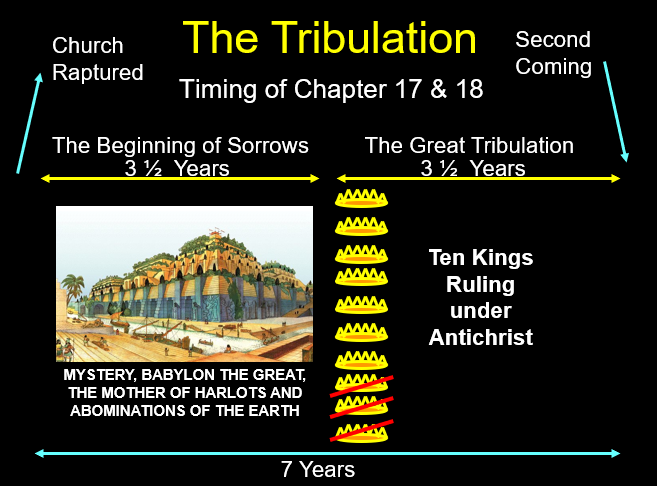
May you be blessed and encouraged to study God’s Word more as we see these day’s approaching!
The post Zechariah Ch 4-5 first appeared on Calvary Chapel Portsmouth.
]]>The post Zechariah – Intro & Ch1 1-2 first appeared on Calvary Chapel Portsmouth.
]]>Israel had returned from Babylon in 537 B.C. following the decree of Cyrus to allow them to return home. 19 years later the prophet Haggai stepped onto the scene and declared “Consider your ways”! In just a few months the heart of the people had changed from one of fear to one of boldness and the foundation of the Temple, that by then had lain in ruins for 89 years, was started.
Two months after Haggai started to preach, another young jewish man, in his mid to late teens, part of the new generation of Jews born in the land, stood up to reveal a series of 8 visions God had given him in one night. These visions were so profound they challenge world governments and the religious establishment even to this day.
As we begin a journey though this incredible book, we will have unveiled, the history and future of the nation of Israel from their return from Babylon, to the first coming of Messiah, and then to the second coming of Messiah. We will see God’s verdict pronounced on the gentile nations of this world for their mistreatment of Israel, and God’s ultimate plan to bless the family of Abraham, Isaac and Jacob when the LORD God Himself will rule over the whole earth from Jerusalem.
In the opening verse of chapter 1 we are given a brief genealogy of Zechariah: “the word of the LORD unto Zechariah, the son of Berechiah, the son of Iddo the prophet”.
There are no meaningless details in the Bible, and this opening statement is an example of that fact, for in this list of names are a statement that sets the tone for the whole of this book.
- Zechariah = “Whom Yahweh Remembers.”
- Son of Berechiah = “Yahweh Blesses.”
- Son of Iddo = “The Appointed Time.”
This book of Zechariah is the account of a God who remembers, and who blesses His people at the appointed time!
May you be blessed and encouraged as we journey through this book.
The post Zechariah – Intro & Ch1 1-2 first appeared on Calvary Chapel Portsmouth.
]]>The post Joel 3 vs3-21 first appeared on Calvary Chapel Portsmouth.
]]>This incredible 3-chapter book of Joel lays out the history of Israel and it’s climatic future at the end of this age, during a period of time to come which the Bible calls ‘the Day of the Lord’.
Joel tells us that God will gather all the nations of this world together in the Jezreel Valley in Israel, also known as the valley of Megiddo. The coming world leader (whom we typically refer to as Antichrist), will launch an attack on Israel, who by that time will be in hiding in the Jordanian desert (the area previously known as Edom).
Just it looks as if there is no hope for Israel against this massive combined military threat, they will petition their Messiah – Jesus Christ – who will return to destroy their enemies, and then proceed to claim Jerusalem as His own, fulfilling countless prophecies and sitting on the Throne of David, from where He will rule the whole Earth!
In this study we look at John’s vision of these events recorded in the book of Revelation, as well as Isaiah, Jeremiah, Zechariah and others whom the Lord used to expound on the framework given to us in Joel.
Joel’s almost 3000 year-old prophecies are now approaching their climactic fulfilment in our lifetime. The schemes and plans of this world will soon give way to the KING OF KINGS AND LORD OF LORDS!
The countdown is almost over; it is time to decide ‘who is on the LORD’s side! There will only be one Victor!
May you be stirred and encouraged to walk with Jesus in these days!
The post Joel 3 vs3-21 first appeared on Calvary Chapel Portsmouth.
]]>The post Joel Ch3 vs1-2 first appeared on Calvary Chapel Portsmouth.
]]>In our previous studies we have seen how the book of Joel seems to prophetically outline the history of the Nation of Israel, up to and including the climactic conclusion as depicted in the last three feasts of Israel.
From the forthcoming ‘time of Jacob’s trouble’ that will commence with the Feast of Trumpets / Trumpet judgments of Revelation 8-9, the subsequent flight of Israel into the wilderness, her repentance and acknowledgement of Jesus as her Messiah, fulfilling the Feast of Atonement; concluding with the return of Jesus to deliver Israel, subdue the nations and establish His throne on Earth, marking the Feast of Atonement.
It is incredible to consider that Joel, arguably the 1st of all the writing prophets, gives us, in this 3 chapter book, such an incredible framework of the key prophetic events surrounding Israel, from the Birth of the nation to the ‘completion’ when she will walk in harmony with her Messiah.
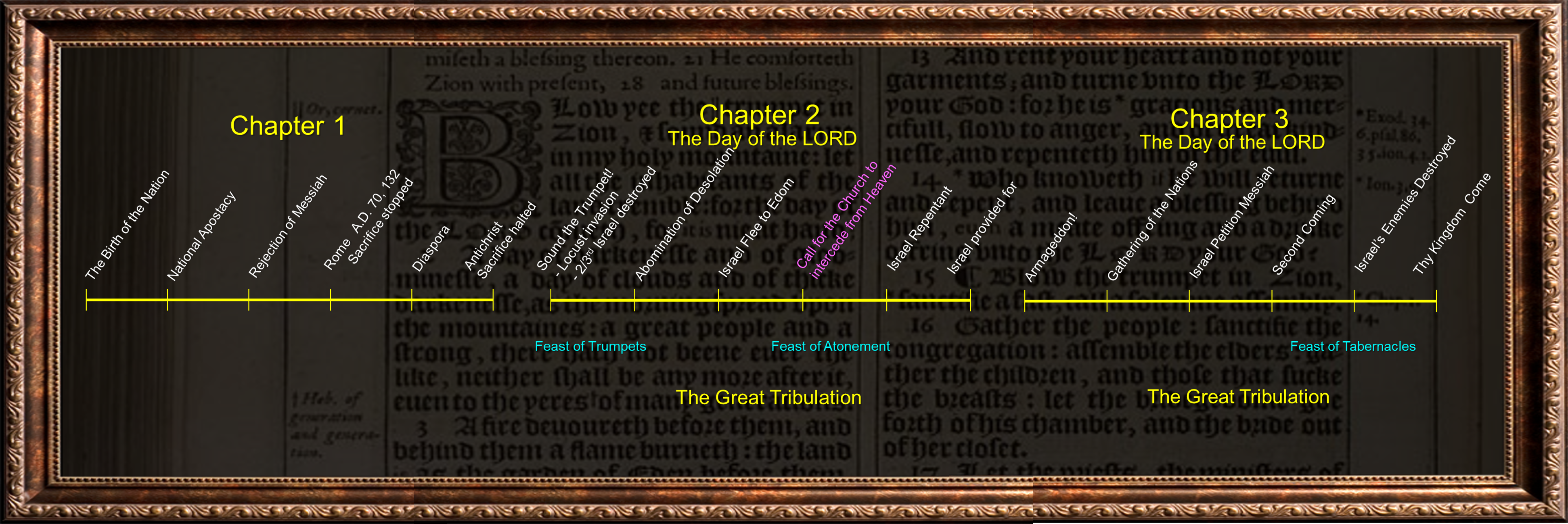
The Framework of Israel’s past, present and future, Genesis 12 to Revelation 20, is prophetically outlined in the incredible 3-chapter book of Joel!
In this session we focused on the first two incredible verses of Chapter 3:
V1. “For, behold, in those days, and in that time, when I shall bring again the captivity of Judah and Jerusalem”,
Joel gives the outline, Ezekiel gives the detail:
“Thus saith the Lord God; Behold, I will take the children of Israel from among the heathen, whither they be gone, and will gather them on every side, and bring them into their own land: And I will make them one nation in the land upon the mountains of Israel; and one king shall be king to them all: and they shall be no more two nations, neither shall they be divided into two kingdoms any more at all: Neither shall they defile themselves any more with their idols, nor with their detestable things, nor with any of their transgressions: but I will save them out of all their dwellingplaces, wherein they have sinned, and will cleanse them: so shall they be my people, and I will be their God. And David my servant shall be king over them; and they all shall have one shepherd: they shall also walk in my judgments, and observe my statutes, and do them. And they shall dwell in the land that I have given unto Jacob my servant, wherein your fathers have dwelt; and they shall dwell therein, even they, and their children, and their children’s children for ever: and my servant David shall be their prince for ever. Moreover I will make a covenant of peace with them; it shall be an everlasting covenant with them: and I will place them, and multiply them, and will set my sanctuary in the midst of them for evermore. My tabernacle also shall be with them: yea, I will be their God, and they shall be my people. And the heathen shall know that I the Lord do sanctify Israel, when my sanctuary shall be in the midst of them for evermore.” (Ezekiel 37:21-28)
As an aside, these 7 verses should put an end forever to the nonsense of ‘Replacement Theology’ – the idea that God has finished with Israel, and that (somehow) all the blessings promised to Israel are now to fall upon the church. This heretical teaching was promoted by the likes of Augustine, embraced by the Roman Catholic church (for political reasons) and subsequently never addressed by the churches that came out of Rome at the time of the Reformation in Europe, such as the Church of England, Baptists, Lutherans and subsequently the Methodists, United Reformed, etc. Sadly tradition has made the Word of no effect for many!
However, Joel was not the first to declare that God would one-day bring Israel back into their own land. Way back in the Torah, Moses listed the blessings God would pour upon Israel for their obedience (Deut 28:1-14), but this was followed by the consequences of disobedience (Deut 28:15-68), including these chilling words: “And it shall come to pass, that as the Lord rejoiced over you to do you good, and to multiply you; so the Lord will rejoice over you to destroy you, and to bring you to nought; and ye shall be plucked from off the land whither thou goest to possess it. And the Lord shall scatter thee among all people, from the one end of the earth even unto the other; and there thou shalt serve other gods, which neither thou nor thy fathers have known, even wood and stone” (Deut 28:63-64).
However, as we read on in Deuteronomy, we come to a pivotal declaration:
“And it shall come to pass, when all these things are come upon thee, the blessing and the curse, which I have set before thee, and thou shalt call them to mind among all the nations, whither the Lord thy God hath driven thee, And shalt return unto the Lord thy God, and shalt obey his voice according to all that I command thee this day, thou and thy children, with all thine heart, and with all thy soul; That then the Lord thy God will turn thy captivity, and have compassion upon thee, and will return and gather thee from all the nations, whither the Lord thy God hath scattered thee. If any of thine be driven out unto the outmost parts of heaven, from thence will the Lord thy God gather thee, and from thence will he fetch thee: And the Lord thy God will bring thee into the land which thy fathers possessed, and thou shalt possess it; and he will do thee good, and multiply thee above thy fathers” (Deut 30:1-5).
Not only does this tell us that God, who is outside of time, knew Israel would be unfaithful and therefore scattered among the nations, but that whilst there, at some far distant point in time, they would turn to Him, and that would be enough for their compassionate God start the reversal, to undo all that had been done, to bring into effect the principle of the Jubilee, where everyone would return to their own Land, their own possession. “In the year of this Jubilee ye shall return every man unto his possession.” (Lev 25:13). The law of the Jubilee also states that the land must be transferred back to its original owner, those inhabiting the Land must relinquish it and the original connection between the owner and the land must be renewed!
In the first century, in the days of the Book of Acts, a gathering took place of Messianic Jewish believers, disciples, apostles, and leaders in Jerusalem. Peter specifically links this gathering to the words of Joel 2:31-32. It was from that gathering that the door of faith would be opened to the nations, the gospel would go forth beyond the land of Israel to the nations, and the Gentiles would now come in.
But as the first century neared its end and the days of the Book of Acts drew to a close, such gatherings of Jewish believers disappeared from the world. But in-line with the ‘Jubilee principle’, in the ‘days of return’ that which had disappeared must reappear! In essence there would be a reversal. Just as that first gathering had changed the course of the world, so would another gathering, the first such gathering in two thousand years, the first such council of Messianic Jewish believers since the days of the disciples!
They came from the nations, teachers, leaders, and emissaries, to the city of London. There they worshipped, prayed, shared, declared their identity, agreed on their purpose and mission, and arrived at a resolution that the Jews needed a homeland.
1867: The Year It All Began to Change
The timing of the gathering was significant. It took place in the year 1867, in fact, to be precise, on the 14th May!
Within 2 days, the Ottoman Land Code became law, allowing ‘foreigners’ to buy Ottoman land to try to recover the debts amassed as a result of the Crimean War. Without realising what they had done, the Ottoman Empire had opened the door for Jews to buy land in Israel!
30 days after the gathering a ship set sail from New York heading for the Promised Land. On board was sceptic and author, Mark Twain (real name Samuel Clemens – Samuel meaning ‘God hears’ and Clemens meaning ‘Merciful’. Mark Twain proved that God does hear and is indeed merciful! – for Twain unwittingly fulfilled the prophecy of ‘the stranger’ in Deuteronomy 29:22-23:
“So that the generation to come of your children that shall rise up after you, and the stranger that shall come from a far land, shall say, when they see the plagues of that land, and the sicknesses which the Lord hath laid upon it; And that the whole land thereof is brimstone, and salt, and burning, that it is not sown, nor beareth, nor any grass groweth therein, like the overthrow of Sodom, and Gomorrah, Admah, and Zeboim, which the Lord overthrew in his anger, and in his wrath”:
In what he would write, Twain almost quoted these words verbatim, then published them for the world to see.
Whilst Twain was in disbelief at what had become of the Land of Israel, another visitor arrived in Jerusalem, and ‘coincidentally’ ended up saying at the same place. It was Charles Warren who, in the coming months, would literally rediscover the old city of Jerusalem!
Jonathan Cahn, in his book ‘The Oracle’ states: “In the Jubilee the connection between the land and its original owner is restored. And so the consequences of Warren’s work were to restore and strengthen the long-lost connection of the Jewish people to the land. And with every restored connection, the idea that the Jewish people, after almost two thousand years, might somehow return to their homeland began to move one more step out of the realm of fantasy.”
After nearly two thousand years of exile, the man with the measuring line reappeared in Jerusalem as a sign that God was about to bring about a restoration. A measuring line is used when one is about to build something. So then the reappearance of the man with the measuring line in the person of Charles Warren was a sign that God was about to act, to move again, to build something . . . to rebuild that which once was and had fallen . . . the nation of Israel!”
“And when else do you use a measuring line?” When there’s about to be a transference of land. So when the man with the measuring line appeared in Jerusalem, it was a sign that the land was going to be transferred … back to the original owner. The land was being prepared for the return. So it was in ancient times when the prophet Zechariah revealed the meaning of the measuring line: “A measuring line will be stretched over Jerusalem . . . And the LORD will again comfort Zion and again choose Jerusalem”
This incredible sequence of events actually began in the year 1517, when the last ‘transference’ of ownership of the Land of Israel took place. Selim I the Ottoman prince took control of the Land, defeating the Mamluks at the Battle of Raydaniyah. The Land stayed under Ottoman rule for the next 350 years, that is 7 x 50 – 7 signifying complete, 50 being the number of Jubilee! God’s time to return the Land to His people was at hand!
1867 was the year of the gathering in London. It was immediately followed (2 days later ) by the Ottoman Land Code. That was subsequently followed by Mark Twain’s visit to Jerusalem (fulfilling Deuteronomy 29), which ‘coincided’ with Charles Warren’s visit where he rediscovered the historic Jerusalem – all this took place in 1867!
In December 1916 the government of the then British prime minister H. H. Asquith unexpectedly collapsed. The man who succeeded him was David Lloyd George. As foreign secretary, Lloyd George appointed Arthur Balfour. Both George and Balfour were Bible believing Christians and in favor of a Jewish homeland and were suddenly lifted to the heights of world power at that critical moment. Cahn comments: “If Asquith’s government had not collapsed just when it did, what was about to happen would never have taken place. You see, Asquith was against the idea of a Jewish homeland. And it was only in that small window of time that these things could have come about. So his government had to crumble, and had to crumble just at that moment. Because it was the very end of 1916. 1917 was coming. And 1917 was the year of Jubilee. And it just happened to be the same year that the British Empire would be placed in the position of determining the future of the land of Israel. And as the Jubilee concerns the return of one’s ancestral land, so world history would now turn to the Middle East and to the land of the ancient inheritance”
As the year of Jubilee began, members of the British government held a conference concerning the future of the Land of Israel. By the middle of the year Balfour called for a draft to be made for a public declaration concerning the land. By autumn the British Cabinet was in discussion over the form the declaration would take, but it was determined that the plan wouldn’t proceed unless it had the support of the American president. On October 16, 1917, the British government was informed that the president, Woodrow Wilson, was in favor of the declaration. On October 31 the declaration was approved by the British War Cabinet. Two days later, on November 2, it went forth in the form of a letter penned by the foreign secretary.

Thus, after almost 2000 years in exile, the way was finally open for Israel to return to the Promised Land. As we know from history, that finally occurred on 14th May 1948! The city of Jerusalem was restored to Israel in the next Jubilee year in 1967!
What Joel prophesied is now unfolding before our eyes!
V2. “I will also gather all nations, and will bring them down into the valley of Jehoshaphat, and will plead with them there for my people and for my heritage Israel, whom they have scattered among the nations, and parted my land”.
God’s controversy with the nations is that they have acted with complete disregard to the fact ‘the Land of Israel’ belongs to God! In fact, it is the only piece of real estate on planet Earth that God actually lays claim to, and the Bible unequivocally states that God has entrusted this piece of land to the physical descendants of Abraham ‘for an everlasting possession’! (Genesis 13:15 / Genesis 17:8 / Genesis 48:4).
Throughout the centuries nations and empires have tried to lay claim to this land, the Canaanites, the Assyrians, Babylonians, Medo-Persians, Greeks, Romans, Byzantine Empire, Ottoman Empire, the British & French, and more recently, the United Nations. The Vatican has tried to claim Jerusalem as its own; Islam too, claim’s Jerusalem as it’s third most holy site! (despite Jerusalem never being mentioned by name in the Quran!). All have had denied the Biblical mandate, all have taken, divided, partitioned and otherwise done to this land whatever they will. Yet is it a land with no significant natural resource. It is not rich in oil, it’s capital is not an international sea port, in fact, for the best part of 2000 years it has been a barren wasteland. There is no intrinsic value, no gold mines like Africa or Cedar’s like Lebanon. Yet this land and the city of Jerusalem have been the most fought over land and city in the word!
Significantly, of all places on the Earth, it will be the place the coming world leader will choose to place a statue of himself!
The Valley of Megiddo (a.k.a. the Jezreel Valley / Valley of Jehoshaphat) will also serve as the staging ground for the coming world-leaders’ ill fated attempt to annihilate Israel and claim this land as his own.
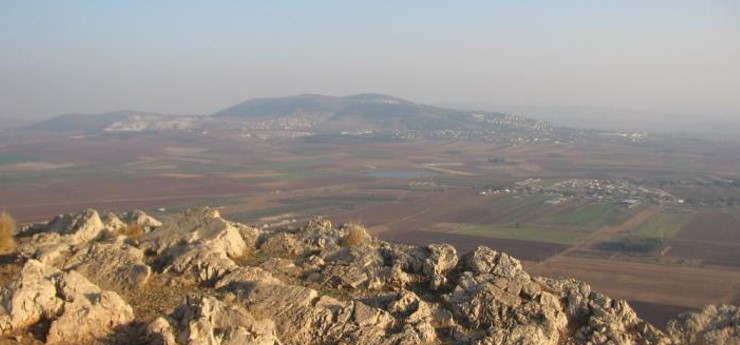
The Jezreel Valley – a.k.a. Armageddon
But God calls Israel ‘my heritage‘ and the land ‘my land‘.
At the time of the Second Coming Jesus will return to fight for Israel against the combined armies of the World under the control of Antichrist. Jesus will win!
We will conclude our study of Joel next week!
May you be blessed and encouraged to study God’s word more!
The post Joel Ch3 vs1-2 first appeared on Calvary Chapel Portsmouth.
]]>The post Joel Ch2 first appeared on Calvary Chapel Portsmouth.
]]>Last week we saw how God used the real plague of locusts in Joel’s time to warn the nation of Israel, and ‘all who have ears to hear’, that another devastating judgment is coming on Israel, and indeed upon the whole earth.
Hosea tells us that God uses similitudes (models or types) to speak to us. We know that the Feasts of Israel, as well as being literal, historical events, were also given as anticipatory models of things that would come later. Last week we noted that the first four feasts of Israel find their prophetic fulfilment in the death, burial and resurrection of Jesus and the birth (and possibly the subsequent rapture) of the Church.
This leaves us with the last three feasts, the Feast of Trumpets, the Feast of Atonement and the Feast of Tabernacles for which no prophetic fulfilment has yet taken place. It would seem from scripture that these last three feasts are specifically linked to events that will befall the nation of Israel; moreover it appears that the book of Joel becomes a model of the prophetic fulfilment of these feasts.
Remember that Joel seems to have been the first of the ‘writing’ prophets; before Isaiah, Hosea or any of the prophets who would come later and add more ‘colour’ to the outline Joel gives us.
Montague S. Mills said: “Joel, … was probably the first of the so called writing prophets; so this book provides a valuable insight into the history of prophecy, particularly as it furnishes a framework for the end times which is faithfully followed by all subsequent Scripture. God started a new work with the writing of Joel, that of preparing the human race for the end of this temporal era, and thus gave an outline of His total plan. Later prophets, including even our Lord, would only flesh out this outline, but in keeping with the divine nature of true Scripture, never found it necessary to deviate from this, the initial revelation.”
The first chapter of Joel, as we studied last week, seems to give the prophetic summery of the nations history from the time of the Exodus (the Birth of the Nation of Israel), to the time of the Tribulation (still yet future).
Prophetically, chapter 1 seems to unveil:
- Verse 1: Introduction: God speaks! – who will listen?
- Verse 2-3: Riches to rags! – How Israel went from being betrothed & blessed by God to being cast out of their land and made to wander throughout the world.
- Verse 4: Utter destruction – the literal Locust plague the Joel witnessed as a forerunner of a far more deadly and destructive plague that is yet to come.
- Verse 5: Israel’s wake-up call! – Israel we given countless chances to return and walk with God and avoid judgment….
- Verse 6-7: Rome! – but alas, because of the Israel’s disobedience, God allowed nations to conquer and subdue them, most notably Rome!
- Verse 8: Israel’s rejection of Messiah – rather than Israel’s betrothal leading to bliss, Israel rejected and killed their Messiah.
- Verse 9: AD 70 – Sacrifice stopped – consequently, what Jesus warned in Like 19 came upon them.
- Verse 10: AD 132 – Jerusalem ploughed – by Emperor Hadrian who wanted the Jews expelled from the Land of Israel.
- Verse 11-12: Worldwide diaspora & shame – history is our record.
- Verse 13: Abomination of Desolation! Sacrifice ‘withholden’ Time to flee! Jesus spoke of this in Matthew 24 etc. and warned this time would come
- Verse 14: The ‘Elders’ gathered into the house of the LORD & called to pray! ‒A picture of the Rapture of the Church and our subsequent obligation?
- Verse 15: The Day of The LORD The Great Tribulation begins!
- Verse 16-18: Israel forced to flee
- Verse 19-20: Desperate Israel seeks refuge in the wilderness of Edom – these last 3 points will now be expounded in chapter 2
In chapter 2 we start to see the prophetic fulfilment of the Feast of Trumpets and the Feast of Atonement:
The Feast of Trumpets (Joel 1:1 – 2:11)
Having already laboured the point that every detail is in the Bible for a reason, it is very likely that the Feast of Trumpets will have its fulfilment during the trumpet judgments of Revelation 8-9. According to Joel 1:1-2:11 these judgments will have a specific impact on the nation of Israel and must occur during the first half of the 7 year Tribulation period while Israel are still in their land and before they flee into the wilderness to escape Antichrist at the 3 1/2 year point. The two key elements of the Feast of Trumpets as detailed in Leviticus 23 are a blowing of trumpets and an ‘offering made by fire’. In Revelation 8-9 and Joel 1:1 – 2:11 we have trumpets blown, and we know that fire is emblematic of judgment, exactly what is happening to Israel during the Tribulation.
The Feast of Atonement (Joel 2:12 – 32)
In verse 12 of Joel chapter 2 the mood changes and Israel are called to repentance. In verses 15-17 a trumpet is blown in Zion. Could this be heaven with the elders (the Bride) and the great multitude serving before the alter (see Rev 6: 9 / Rev 7:15) being called to intercede for Israel so that she be not overwhelmed by her enemies? In verses 18-19 God answers and promises to provide ‘oil and wine’ for them. Clearly this is dealing with the time that Jesus spoke about in Matthew 24:15-22 when Antichrist will erect his statue (the Abomination of Desolation) in the temple in Jerusalem and Israel will flee for her life into the wilderness to ‘a place prepared for her by God’ (Rev 12:6) for the last 3 1/2 years of Daniel’s 70th week. During this time, she will be supernaturally provided for by God (Rev 12:14).
The Feast of Atonement as recorded in Leviticus 23 is a time of reconciliation to God and Joel 2:20-32 again details this time when Israel will return to the Lord their God. This is also prophesied in Hosea 5:15-6:2.
It is interesting that, as we saw in Luke 19, blindness was pronounced upon Israel because they did not know the ‘time of their visitation’. Paul explains in Romans 11:25 that this blindness will last ‘until the fullness of the Gentiles are gathered in’. Many scholars have wondered when this will occur, but surely it will be at this point during the Tribulation when significantly, the last of the martyrs (Gentiles) from the tribulation are killed for not receiving the mark of the beast. Thus ‘the fullness of the Gentiles will be gathered in’ and Israel’s blindness will be removed.
One final observation that suggests a link with this period of time and the Feast of Atonement is found in Leviticus 16, which gives the specific instructions for the Day of Atonement. What is significant is that there are two goats that are to be presented, one is sacrificed: “Then shall he kill the goat of the sin offering, that is for the people, and bring his blood within the veil, and do with that blood as he did with the blood of the bullock, and sprinkle it upon the mercy seat, and before the mercy seat” (Lev 16:15) – this is symbolic of Christ’s death when the veil separating man from God was torn in two (Matt 27:51 / Heb10:20). The other goat is the scapegoat which three times (v10, v21 & v22) we are told is to escape into the wilderness and specifically “unto a land not inhabited: and he shall let go the goat in the wilderness”. (Lev 16:22).
Finally, commenting on the verse in Leviticus 23:27, bible scholar C.I. Scofield says: “…here the stress is laid upon the sorrow and repentance of Israel. That is, the prophetic feature is made prominent, looking forward to the repentance of Israel after their regathering under the Palestinian covenant (Deut 30:1-10) preparatory to the second advent of Messiah and the establishment of the kingdom. See the connection between the trumpet in Joel 2:1 and the mourning which follows in verse 11-15.”
Next week we will conclude this study and consider Joel ch3: Armageddon, the Return of Jesus Christ and The Feast of Tabernacles
May you be encouraged to study and walk in the Word of God!
The post Joel Ch2 first appeared on Calvary Chapel Portsmouth.
]]>The post Daniel Ch12 first appeared on Calvary Chapel Portsmouth.
]]>Daniel 12:1
And at that time shall Michael stand up, the great prince which standeth for the children of thy people: and there shall be a time of trouble, such as never was since there was a nation even to that same time: and at that time thy people shall be delivered, every one that shall be found written in the book.
In the closing verses of chapter 11 we witnessed a coming world ruler, a coming world religion, and a coming world war. Now we told of the forthcoming Great Tribulation as spoken of by Jesus in Matthew 24: “When ye therefore shall see the abomination of desolation, spoken of by Daniel the prophet, stand in the holy place, (whoso readeth, let him understand:)[this will be half way through Daniel’s 70th week] Then let them which be in Judaea [this must therefore apply specifically to the Jews] flee into the mountains: Let him which is on the housetop [again, this applies to the Jews who have their patios on their rooftops] not come down to take any thing out of his house: Neither let him which is in the field return back to take his clothes. And woe unto them that are with child, and to them that give suck in those days! But pray ye that your flight be not in the winter [because the travelling conditions in Israel are very difficult in the winter], neither on the sabbath day [this is only applicable to the Jews, who still keep the Sabbath to this day]: For then shall be great tribulation, such as was not since the beginning of the world to this time, no, nor ever shall be [Jeremiah called this ‘the time of Jacob’s trouble’ (Jer 30:7)] And except those days should be shortened, there should no flesh be saved: but for the elect’s sake [this has to refer to the Jews because the Church will be with the Lord in heaven by now] those days shall be shortened. Then if any man shall say unto you, Lo, here is Christ, or there; believe it not. For there shall arise false Christs, and false prophets, and shall shew great signs and wonders; insomuch that, if it were possible, they shall deceive the very elect.” [Jesus concludes by warning of coming false Christs and coming false prophets, cf. Rev 13] (Matt 24:15-24)
As Gabriel is always seen bringing a Messianic announcement, so Michael is always seen in conflict regarding Israel.
Daniel 12:2
And many of them that sleep in the dust of the earth shall awake, some to everlasting life, and some to shame and everlasting contempt.
Daniel is now told of the coming resurrections; Jesus spoke of the resurrection of the just (Luke 14:14), and the resurrection of damnation: Marvel not at this: for the hour is coming, in the which all that are in the graves shall hear his voice, And shall come forth; they that have done good, unto the resurrection of life; and they that have done evil, unto the resurrection of damnation. (John 5:28-29)
According to the Apostle Paul, the resurrection of the just is not a single event, but rather a category comprised of various separate events: “But now is Christ risen from the dead, and become the firstfruits of them that slept. For since by man came death, by man came also the resurrection of the dead. For as in Adam all die, even so in Christ shall all be made alive. But every man in his own order: Christ the firstfruits; afterward they that are Christ’s at his coming. Then cometh the end…(1 Cor 15:20-24)
In Revelation 19, we find that the resurrection of the just is complete: “And I saw thrones, and they sat upon them [this is the Church – see Rev ch 4], and judgment was given unto them: and I saw the souls of them that were beheaded for the witness of Jesus, and for the word of God, and which had not worshipped the beast, neither his image, neither had received his mark upon their foreheads, or in their hands; [notice that these martyrs don’t yet have resurrection bodies – thus they cannot be the Church because the Church receive their new resurrection bodies at the time of the Rapture cf. 1 Cor 15] and they [i.e. both the church and the martyrs] lived and reigned with Christ a thousand years. But the rest of the dead lived not again until the thousand years were finished. This is the first resurrection.”
“Blessed and holy is he that hath part in the first resurrection: on such the second death hath no power, but they shall be priests of God and of Christ, and shall reign with him a thousand years.” (Rev 20:4-6). Thus the completion of the first resurrection and the ‘resurrection unto damnation’ are separated by a period of 1000 years during which time Christ will reign on the earth on the throne of David (Luke 1:32).
Daniel 12:3
And they that be wise shall shine as the brightness of the firmament; and they that turn many to righteousness as the stars for ever and ever.
“Do all things without murmurings and disputings: That ye may be blameless and harmless, the sons of God, without rebuke, in the midst of a crooked and perverse nation, among whom ye shine as lights in the world” (Phil 2:14-15)
“Let your light so shine before men, that they may see your good works, and glorify your Father which is in heaven.” (Matt 5:16)
“…Then shall the righteous shine forth as the sun in the kingdom of their Father. Who hath ears to hear, let him hear.” (Matt 13:43)
Daniel 12:4
But thou, O Daniel, shut up the words, and seal the book, even to the time of the end: many shall run to and fro, and knowledge shall be increased.
Many have understood this to mean, that in the last time, general knowledge and understanding will be increased – and certainly we have seen a technological explosion in the last 100 years unlike anything the world has previously seen. However, in the context of this verse, it is the book that Daniel is to seal, until the time of the end, at which time, knowledge of the book will be increased.
Never before in the history of the Church has the Church had access to such a wide range of Bible study aids as we do today; from computer programmes to commentaries; from teaching videos to Bible conferences. And what is the result? God has raised up people who have dedicated their lives to the ministry of the word, and in so doing have ‘stumbled’ upon prophecies being fulfilled in our time, scriptures that have confused generations past, now being understood. Knowledge of the Word is indeed increasing in these days. And the most incredible part of it is that the Holy Spirit may choose to show you something that no one else has yet seen. It is however important to remember that anything we may ‘discover’, as we read through God’s Word, will never contradict the rest of scripture.
Daniel 12:5-6
5 Then I Daniel looked, and, behold, there stood other two, the one on this side of the bank of the river, and the other on that side of the bank of the river.
6 And one said to the man clothed in linen, which was upon the waters of the river, How long shall it be to the end of these wonders?
The angel has now finished talking to Daniel, and as Daniel looks up he now sees two angels, one on each side of the river. Yet in the midst of the river, ‘walking on the water’ Daniel sees the ‘man clothed in linen’ whom he had previously seen in a vision at the beginning of chapter 10. We have already put forward the case that this is a pre-incarnate appearance of Jesus (see notes on Dan 10:5-9); and here we not only see Him walking on the water, but also being asked a question – by an angel – that only God could possibly know- the future.
It is interesting, that the angel started, back in chapter 11, by telling Daniel that what he was about to reveal was all recorded in the scripture of truth. Now the angel himself wants to find out more, thus showing that the angel knew only what had been revealed to him up to this point.
What I find provocative is that, even though this angel had access to the scripture of truth, he had to go to, what I believe is Jesus, to really understand. It is the same for us; we have the scripture of truth, yet only by going to Jesus and through His Spirit can we understand – for the things of God are spiritually discerned (1 Cor 2:14).
Daniel 12:7
And I heard the man clothed in linen, which was upon the waters of the river, when he held up his right hand and his left hand unto heaven, and sware by him that liveth for ever that it shall be for a time, times, and an half; and when he shall have accomplished to scatter the power of the holy people, all these things shall be finished.
This man clothed in linen tells the angel, and Daniel overhears, that this period of time will last for three and a half years, i.e. the Great Tribulation as we have already noted. The angel is also told that Antichrist will be allowed to continue in order to break the power of the Jews. This is one of the main purposes of the ‘time of Jacob’s trouble’, to bring God’s judgment on the Jews until the seek Him and repent. “I will go and return to my place, till they acknowledge their offence, and seek my face: in their affliction they will seek me early.” (Hosea 5:15)
Daniel 12:8
And I heard, but I understood not: then said I, O my Lord, what shall be the end of these things?
It is not clear whether Daniel is addressing the man clothed in linen, or the angel who had been speaking to him; I suspect that it is the man clothed in linen, for the answer in the following verses would seem to have been more that the angel would have known (based on verse 6).
Daniel 12:9-10
9 And he said, Go thy way, Daniel: for the words are closed up and sealed till the time of the end.
10 Many shall be purified, and made white, and tried; but the wicked shall do wickedly: and none of the wicked shall understand; but the wise shall understand.
Once again Daniel is told that these words are ‘closed up’ until the time of the end. That clearly implies that at the time of the end they will be understood. We however are now living in the time spoken of, and as we read God’s Word, those of us who have been purified by the blood of the Lamb and our sins made as white as snow, are seeing the pieces of the jigsaw falling into place at an incredible pace.
There really is no excuse for any who call themselves Christians to not have at least a basic grasp of these things as we head toward the finishing line.
Daniel 12:11-12
11 And from the time that the daily sacrifice shall be taken away, and the abomination that maketh desolate set up, there shall be a thousand two hundred and ninety days.
12 Blessed is he that waiteth, and cometh to the thousand three hundred and five and thirty days.
We are now introduced to a seventy-five-day period that separates the end of the Great Tribulation and the beginning of the Millennium. During this interval various events are to occur:
- The removal of the Abomination of Desolation
- Antichrist is resurrected (firstfruits of the second resurrection)
- Antichrist & False Prophet cast alive into the Lake of Fire
- Satan bound for the Millennium
- The resurrection of the tribulation saints
- The setting in place of the thrones for the saints (to rule with Christ)
- The judgement of the living Gentiles (pro-Semitic sheep & anti-Semitic goats)
The Seventy-Five-Day Interval
The removal of the Abomination of Desolation:
As we have already seen, the event that marks the start of the second half of Daniel’s 70th week (i.e. the Great Tribulation) is Antichrist’s breaking of the covenant with Israel and his placing of the Abomination of Desolation in the holy of holies. From this point, we are told that the Great Tribulation will last exactly 1260 days (Rev 13:5 / Rev 12:6 / Dan 7:25 / Dan 12:7). However in verse 11 we are told that, after Antichrist has been destroyed at the end of the 1260 days, there will be an additional 30 days (taking us to the 1290th day) where the Abomination of Desolation will be allowed to remain in the Temple. Quite why this is we are not told, however, it will serve to underline the incredible contrast between the now lifeless image that people have worshipped for three and a half years, and the King of kings, the Creator of all things, who is without beginning or end, whom the people dwelling on the earth had willing rejected in favour of their useless idol.
This again shows the utter foolishness of mankind and the futility of worshipping and serving the creature rather than the Creator – who is blessed forever –Amen! (See Rom 1:25).
Antichrist is resurrected (firstfruits of the second resurrection):
During the Great Tribulation, Satan will have succeeded in establishing a counterfeit trinity, with Satan as the father, Antichrist as a psudo-son, and the False Prophet as a type of the Holy Spirit. God will allow this charade to play out to its conclusion where Antichrist will be resurrected, as the firstfruits of the second resurrection (the resurrection of damnation), only then to be thrown alive into the Lake of Fire along with the False Prophet. We have already see in Daniel 7:11 (cf 2 Thes 2:8), Antichrist will be killed by Christ at the battle of Armageddon; however, just as Christ descended into Hell (Sheol) for a short time (Eph 4:8-10 / Psalm 16:10), so will Antichrist be killed and his soul go down into Hell for a brief time. This is prophesied in Isaiah 14:1-11: “For the LORD will have mercy on Jacob, and will yet choose Israel, and set them in their own land: and the strangers shall be joined with them, and they shall cleave to the house of Jacob. And the people shall take them, and bring them to their place: and the house of Israel shall possess them in the land of the LORD for servants and handmaids: and they shall take them captives, whose captives they were; and they shall rule over their oppressors. And it shall come to pass in the day that the LORD shall give thee rest from thy sorrow, and from thy fear, and from the hard bondage wherein thou wast made to serve, That thou shalt take up this proverb against the king of Babylon, and say, How hath the oppressor ceased! the golden city ceased! The LORD hath broken the staff of the wicked, and the sceptre of the rulers. He who smote the people in wrath with a continual stroke, he that ruled the nations in anger, is persecuted, and none hindereth. The whole earth is at rest, and is quiet: they break forth into singing. Yea, the fir trees rejoice at thee, and the cedars of Lebanon, saying, Since thou art laid down, no feller is come up against us. Hell from beneath is moved for thee to meet thee at thy coming: it stirreth up the dead for thee, even all the chief ones of the earth; it hath raised up from their thrones all the kings of the nations. All they shall speak and say unto thee, Art thou also become weak as we? art thou become like unto us? Thy pomp is brought down to the grave, and the noise of thy viols: the worm is spread under thee, and the worms cover thee.”
Thus those in Hell will marvel that this mighty world ruler, who deceived the world with his miracles, has become like they are, helpless and weak.
Antichrist & False Prophet cast alive into the Lake of Fire:
As the above passage in Isaiah continues we read in verse 19-20 “But thou art cast out of thy grave like an abominable branch, and as the raiment of those that are slain, thrust through with a sword, that go down to the stones of the pit; as a carcase trodden under feet. Thou shalt not be joined with them in burial, because thou hast destroyed thy land, and slain thy people: the seed of evildoers shall never be renowned.” (Isaiah 14:19-20). Whilst Antichrist’s soul will go down into Hell, his body will not be buried but, presumably, will lay dead for the world to wonder, only then to be raised again and cast alive into the Lake of Fire (Rev 19:20).
Satan bound for the Millennium:
“And I saw an angel come down from heaven, having the key of the bottomless pit and a great chain in his hand. And he laid hold on the dragon, that old serpent, which is the Devil, and Satan, and bound him a thousand years, And cast him into the bottomless pit, and shut him up, and set a seal upon him, that he should deceive the nations no more, till the thousand years should be fulfilled: and after that he must be loosed a little season.” (Rev 20:1-4)
The resurrection of the tribulation saints / The setting in place of the thrones for the saints:
“And I saw thrones, and they sat upon them, and judgment was given unto them: and I saw the souls of them that were beheaded for the witness of Jesus, and for the word of God, and which had not worshipped the beast, neither his image, neither had received his mark upon their foreheads, or in their hands; and they lived and reigned with Christ a thousand years…this [completes] the first resurrection.” (Rev 20:5)
“I beheld till the thrones were [set in place]” – see notes on Dan 7:9
The judgement of the living Gentiles (pro-Semitic sheep & anti-Semitic goats):
There are two clear passages that detail the judgment of the living nations who survive the Great Tribulation; the first is in the book of Joel: “For, behold, in those days, and in that time, when I shall bring again the captivity of Judah and Jerusalem, I will also gather all nations, and will bring them down into the valley of Jehoshaphat, and will plead with them there for my people and for my heritage Israel, whom they have scattered among the nations, and parted my land. And they have cast lots for my people; and have given a boy for an harlot, and sold a girl for wine, that they might drink.” (Joel 3:1-3)
The second passage is well know, although it is often overlooked that the basis of the following is how the nations have treated Israel – Jesus brethren, according to the flesh.
“When the Son of man shall come in his glory, and all the holy angels with him, then shall he sit upon the throne of his glory: And before him shall be gathered all nations: and he shall separate them one from another, as a shepherd divideth his sheep from the goats: And he shall set the sheep on his right hand, but the goats on the left. Then shall the King say unto them on his right hand, Come, ye blessed of my Father, inherit the kingdom prepared for you from the foundation of the world: For I was an hungred, and ye gave me meat: I was thirsty, and ye gave me drink: I was a stranger, and ye took me in: Naked, and ye clothed me: I was sick, and ye visited me: I was in prison, and ye came unto me. Then shall the righteous answer him, saying, Lord, when saw we thee an hungred, and fed thee? or thirsty, and gave thee drink? When saw we thee a stranger, and took thee in? or naked, and clothed thee? Or when saw we thee sick, or in prison, and came unto thee? And the King shall answer and say unto them, Verily I say unto you, Inasmuch as ye have done it unto one of the least of these my brethren, ye have done it unto me. Then shall he say also unto them on the left hand, Depart from me, ye cursed, into everlasting fire, prepared for the devil and his angels: For I was an hungred, and ye gave me no meat: I was thirsty, and ye gave me no drink: I was a stranger, and ye took me not in: naked, and ye clothed me not: sick, and in prison, and ye visited me not. Then shall they also answer him, saying, Lord, when saw we thee an hungred, or athirst, or a stranger, or naked, or sick, or in prison, and did not minister unto thee? Then shall he answer them, saying, Verily I say unto you, Inasmuch as ye did it not to one of the least of these, ye did it not to me. And these shall go away into everlasting punishment: but the righteous into life eternal.” (Matt 25:31-46)
All of the above events will therefore occur after the 1260 days of the Great Tribulation, but before the commencement of the Millennium, which itself will begin after the 1335th day; hence blessed indeed will be those who come to the 1335th day as they will then enter into Jesus’ Millennial kingdom. We should be mindful of these things the next time we pray ‘Thy kingdom come, Thy will be done, on earth as it is in Heaven’!
Daniel 12:13
But go thou thy way till the end be: for thou shalt rest, and stand in thy lot at the end of the days.
In other words: ‘keep on going in the way you have known; don’t give up and you will receive your reward in the end’.
What was Daniel’s way?
From the time as a young teenager, when he was carried away from all he had known to the awe and splendour and sensual pleasures of Babylon, Daniel had just one way of living: “But Daniel purposed in his heart that he would not defile himself with the portion of the king’s meat, nor with the wine which he drank: therefore he requested of the prince of the eunuchs that he might not defile himself.” (Dan 1:8). This incredible man serves as a challenge and an inspiration to all of us; a man who “went into his house; and his windows being open in his chamber toward Jerusalem, he kneeled upon his knees three times a day, and prayed, and gave thanks before his God, as he did aforetime.” (Dan 6:10)
Daniel did not just ‘talk the talk’, he really ‘walked the walk’, even though it could have cost him his job, and more importantly, his life. Yet where now are those who tried to take his life in chapter six? We don’t even have a record of their names; yet of Daniel we are told he was a man ‘greatly beloved of God’ – and that is recorded in the Word of God for eternity!
Jesus said:“If the world hate you, ye know that it hated me before it hated you. If ye were of the world, the world would love his own: but because ye are not of the world, but I have chosen you out of the world, therefore the world hateth you”. (John 15:18-19) “For whosoever shall be ashamed of me and of my words, of him shall the Son of man be ashamed, when he shall come in his own glory, and in his Father’s, and of the holy angels.” (Luke 9:26)
“Whosoever therefore shall confess me before men, him will I confess also before my Father which is in heaven.” (Matt 10:32)
Therefore, may we ‘walk worthy of the Lord unto all pleasing, being fruitful in every good work, and increasing in the knowledge of God’; and may we live lives walking ‘worthy of the calling wherein we are called’. For we were bought at such a high price: ‘therefore let us glorify God in our bodies, and in our spirit, which are God’s’. Let us purpose in our hearts to be like Daniel, who, as we have seen, knew the scriptures and lived his life according to them, rejecting the fleeting pleasures of sin so as to not be entangled in them, that we may please the One who has enlisted us as a soldier in His army. And ‘let us not be weary in well doing: for in due season we shall reap, if we faint not.’ (Col 1:10 / Eph 4:1 /1 Cor 6:20 / Heb 11:25 / 2 Tim 2:4 / Gal 6:9).
“Wherefore seeing we also are compassed about with so great a cloud of witnesses, let us lay aside every weight, and the sin which doth so easily beset us, and let us run with patience the race that is set before us, Looking unto Jesus the author and finisher of our faith…” (Heb 12:1-2)
May you be blessed and encouraged by this study.
The post Daniel Ch12 first appeared on Calvary Chapel Portsmouth.
]]>The post Daniel Ch9 vs24-27 first appeared on Calvary Chapel Portsmouth.
]]>As we noted in the last session, Daniel chapter 9 is, without doubt, one of the most important chapters in the Bible. Now, that is an audacious statement, but this chapter contains one of the most remarkable prophecies in the Bible that provides irrefutable evidence that Jesus Christ is the Messiah. On its own that sets it apart, but it also lays out God’s plan for the nation of Israel from the time of the Babylonian captivity unto the Second Coming of Jesus. It give us important prophetic details of the events on our near horizon, when a world leader, who will emerge from within the nations that made up the old Roman Empire, will step onto the world scene and become famous for doing what presidents and kings have unsuccessfully tried to accomplish, bringing peace in the middle east! It is also a chapter the confirms, once again, what we have already seen in the book of Daniel a number of times, that it is God who rules in the kingdoms of man, and He will ultimately give control of the whole earth to His Son, Jesus Christ!
The 70 Weeks Prophecy
As we now look at the prophecy that Gabriel gives to Daniel, we find that it is broken down into four sections:
Firstly, verse 24 gives us the whole scope of the prophecy; it tells us to whom the prophecy referrers and what is to be accomplished during the time of the prophecy.
Verse 25 gives us the first section of the prophecy, namely the 69 weeks.
We then find an interval between the 69 weeks and the 70th week that is dealt with in verse 26.
Finally, verse 27 explains the starting point for, and some specific details of the 70th week.
Daniel 9:24 – The Scope of the Prophecy
Seventy weeks are determined upon thy people and upon thy holy city, to finish the transgression, and to make an end of sins, and to make reconciliation for iniquity, and to bring in everlasting righteousness, and to seal up the vision and prophecy, and to anoint the most Holy.
Seventy weeks
The first thing we need to understand is the term, translated in our Bible’s as, ‘seventy weeks’. In the Hebrew, the word for ‘weeks’ used here is ‘shabuwa’ (shaw-boo’-ah), which means ‘a week of years’. So what we have is ‘seventy weeks o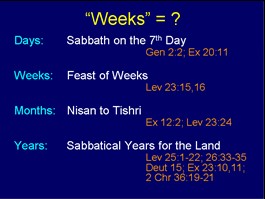 f years’. Whilst this may seem strange to us it was not unusual to the Jews, who not only had a week of days, but also a week of weeks, a week of months and, as is the case here, a week of years. Various examples of these ‘weeks’ can be found in the Bible: We are all familiar with a week of days, as outlined in Genesis 2:2 / Exodus 20:11. We find reference to a week of weeks (i.e. seven weeks) in Leviticus 23. From the Feast of Firstfruits, the Jews were told to count forward seven weeks (7 x 7 = 49 days), after which, the next day was to be the Feast of Weeks (also known as Pentecost – ‘pent’ meaning 50 as it was 50 days from the Feast of Firstfruits). The same idea applied to the Mosaic feasts which were all to occur in a week of months (i.e. a 7 month period). Finally we have the week of years (seven years = one ‘shabuwa’). This can be seen in various places in the Old Testament such as Leviticus 25 where God told the Jews that they were to work the land for six years, but in the seventh year they were to let the land rest. This was to be a Sabbath for the land. It was precisely because Israel failed to observe this law that God then told them in effect ‘you owe me 70 years’, and thus we have the 70 years in
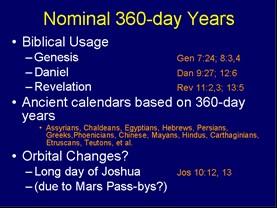 Babylon so that, as 2 Chron 36:19-21 explains, the land could enjoy her Sabbaths. In Genesis 29:27 we read that Jacob served for a ‘week’ for Rachel, which we are told was seven years. So returning to our text, the duration of this prophecy was to last for seventy seven-year periods, which is 490 years.
Another important thing to understand is that, when dealing with prophetic years in the Bible, they are always reckoned to be 360 days in length. There is compelling evidence to suggest that the earth used to be on a 360-day orbit of the Sun (we are currently on a 3651/4 day orbit). All the ancient calendars seem to have been based on a 360-day year that, for some reason, changed in 701 B.C. What caused this change is a matter of scholastic debate, however one of the most credible theories revolves (if you pardon the pun) around the planet Mars.
Mars has long been associated with war (we still use the term ‘marital arts’). For some unknown reason the ancient cultures seemed to be terrified of Mars, yet today very few of us could pick it out at nigh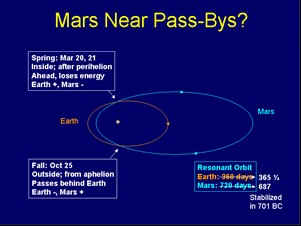 t if we look up in the sky. There are also records of ‘freak’ natural disasters that seemed to occur at regular 104-year intervals. It has been observed that many of the unusual Biblical events recorded in the Old Testament coincided with these dates, including the flood of Noah, the long day of Joshua, Hezekiah’s sundial etc. It has been conjectured that Earth and Mars used to be on resonant orbits, Earth being 360 days and Mars being twice that at 720 days. If this is correct, then at two points in the year, March 20/21 and October 25th, Mars and the Earth would pass by far closer than they do today causing massive tidal waves and earthquakes etc. Such an event would strike fear into those living at that time and would easily explain the paranoia. For those wanting to explore this in more detail, see Chuck Missler’s ‘Signs in the Heavens’ or commentary on Joshua – available from K-House: www.khouse.org
In regard to the 360-day year, Sir Isaac Newton said the following:
“…all nations, before the just length of the solar year was known, reckoned months by the course of the moon, and years by the return of winter and summer, spring and autumn; and in making calendars for their festivals, they reckoned thirty days to a lunar month, and twelve lunar months to a year, taking the nearest round numbers, whence came the division of the ecliptic into 360 degrees.”
In other words, the reason that we have 360 degrees in a circle, is because of this 360-day year that the ancient cultures worked to.
Seventy weeks…. are determined upon thy people and upon thy holy city
Now we are told to whom the prophecy refers: the Jews and Jerusalem. As we have seen throughout this chapter, Daniel has been praying for his people and Jerusalem, therefore it comes as no surprise that Gabriel now gives him a prophecy concerning the same.
….to finish the transgression, and to make an end of sins, and to make reconciliation for iniquity, and to bring in everlasting righteousness, and to seal up the vision and prophecy, and to anoint the most Holy.
Here we are told what will be accomplished by the end of the 490 prophetic years. Whilst it could be said that ‘reconciliation for iniquity’ was accomplished by Jesus on the cross, the other criteria have certainly not been met yet; for we have not witnessed and end of sins, or the ushering in of everlasting righteousness; nor have we seen all prophecies fulfilled or the anointing of the most Holy [place] – which in this context’s referrers to the Sanctuary in the Jewish Temple.
Therefore we have just two options: either this prophecy did not come true (unlikely!), or, the seventy weeks are not continuous and part of the prophecy is yet to be fulfilled.
As we will see clearly in a moment, it is the latter.
Daniel 9:25 – The 69 Weeks unto Messiah
Know therefore and understand, that from the going forth of the commandment to restore and to build Jerusalem unto the Messiah the Prince shall be seven weeks, and threescore and two weeks: the street shall be built again, and the wall, even in troublous times.
Know therefore and understand…
Once again Gabriel tells Daniel ‘listen up ‘cos this is important!’ – see notes on v22.
…from the going forth of the commandment to restore and to build Jerusalem…
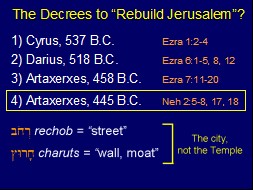
Now we are given the starting point for the 490 years – the ‘commandment to restore and to build Jerusalem’. There were actually four commands given pertaining to the Jews (see slide), however only one of these – the decree by Artaxerxes Longimanus in 445 B.C. – was regarding the rebuilding of the city. All the other decrees were specifically in regard to the Temple only.
Thanks to the work of Sir Robert Anderson, who published his book ‘ The Coming Prince’ back in 1885, and who confirmed his findings with the Royal Greenwich Observatory, we know that the decree was signed on the 14th March 445 B.C. This is recorded in Nehemiah chapter 2 when Nehemiah, the king’s cupbearer, went before the king and was granted his request to return and rebuild the city of Jerusalem.
…unto the Messiah the Prince
Having been given the beginning, Daniel is now told what will bring this first period to an end, namely the arrival of the Messiah! NB: The word translated ‘Prince’ is the Hebrew word ‘nagiyd’ which means ‘chief ruler’, i.e. king.
..shall be seven weeks, and threescore and two weeks…
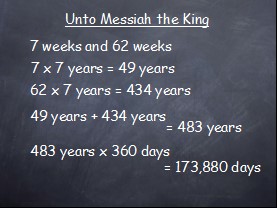
Therefore, from the command of Artaxerxes unto the Messiah there is to be seven weeks of years (49 years), followed by sixty-two weeks of years (434 years), making a total of 483 years. As we have mentioned, these years are each 360 days in length, thus it is possible for us to calculate the exact number of days that Gabriel says will expire between the command being given and Messiah the King. (See calculation below)
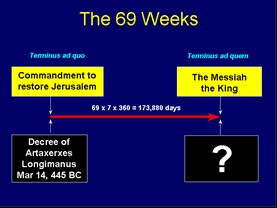
….the street shall be built again, and the wall, even in troublous times.
Gabriel states that during this time Jerusalem will be rebuilt, although it will be during troubled times; this is itself confirmed in the book of Nehemiah.
The question we should now ask is: Did anything of significance occur after 173,880 days had been completed?
In order to answer that question we need to turn our attention to a strange phenomenon that occurred throughout Jesus’ ministry, one that it is easy to miss by casually reading the gospels; however once it is noticed it is perplexing indeed. It stars at the wedding in Cana as recorded in John’s gospel: “And the third day there was a marriage in Cana of Galilee; and the mother of Jesus was there: And both Jesus was called, and his disciples, to the marriage. And when they wanted wine, the mother of Jesus saith unto him, They have no wine. Jesus saith unto her, Woman, what have I to do with thee? mine hour is not yet come.” (John 2:1-4) Surely this would have been a great way to announce that He was the Messiah, at such a public gathering? Yet it was only His disciples who were aware of what had happened. And what did Jesus mean by ‘mine hour is not yet come’?
As we read on in John’s gospel we come to the feeding of the five thousand (chapter 6). Surely this would be the time, in front of so many, to declare Himself the Messiah? However we read: “Then those men, when they had seen the miracle that Jesus did, said, This is of a truth that prophet that should come into the world. When Jesus therefore perceived that they would come and take him by force, to make him a king, he departed again into a mountain himself alone.” (John 6:14-15)
A short while after this, at the time of the Feast of Tabernacles when all Jewish males were required by the Law of Moses to go up to Jerusalem, His disciples asked Him if He was going up with them; He replied: “ My time is not yet come: but your time is aIways ready. The world cannot hate you; but me it hateth, because I testify of it, that the works thereof are evil. Go ye up unto this feast: I go not up yet unto this feast; for my time is not yet full come.” (John 7:6-8)
After a while Jesus did go up, but amazingly we read “But when his brethren were gone up, then went he also up unto the feast, not openly, but as it were in secret.” (John 7:10) This is the Son of God, sneaking around so as not to be noticed!
Eventually the Jews found Him but an even more bizarre thing happens: “Then they sought to take him: but no man laid hands on him, because his hour was not yet come.” (John 7:30)
Just stop and consider this: the Jews want to take Him, but inexplicably they can’t touch Him, and He just walks away.
In John 8:20 we read: “These words spake Jesus in the treasury, as he taught in the temple: and no man laid hands on him; for his hour was not yet come.”
We find exactly the same perplexing situation recorded by the other gospel writers. Luke records: “And all they in the synagogue, when they heard these things, were filled with wrath, And rose up, and thrust him out of the city, and led him unto the brow of the hill whereon their city was built, that they might cast him down headlong. But he passing through the midst of them went his way,” (Luke 4:28-30)
In Matthew we read: “And, behold, there came a leper and worshipped him, saying, Lord, if thou wilt, thou canst make me clean. And Jesus put forth his hand, and touched him, saying, I will; be thou clean. And immediately his leprosy was cleansed. And Jesus saith unto him, See thou tell no man; but go thy way, shew thyself to the priest, and offer the gift that Moses commanded, for a testimony unto them.” (Matt 8:2-4)
So Jesus heals him and says in effect ‘keep it quiet’!???
And again: “And when Jesus departed thence, two blind men followed him, crying, and saying, Thou Son of David, have mercy on us. And when he was come into the house, the blind men came to him: and Jesus saith unto them, Believe ye that I am able to do this? They said unto him, Yea, Lord. Then touched he their eyes, saying, According to your faith be it unto you. And their eyes were opened; and Jesus straitly charged them, saying, See that no man know it.” (Matt 9:27-30)
Now it’s ‘keep it quiet – or else!’
“When Jesus came into the coasts of Caesarea Philippi, he asked his disciples, saying, Whom do men say that I the Son of man am? And they said, Some say that thou art John the Baptist: some, Elias; and others, Jeremias, or one of the prophets. He saith unto them, But whom say ye that I am? And Simon Peter answered and said, Thou art the Christ, the Son of the living God.….Then charged he his disciples that they should tell no man that he was Jesus the Christ.” (Matt 16:13-21)
“And he charged them that they should tell no man” – Mark 7:36
“And he sent him away to his house, saying, Neither go into the town, nor tell it to any in the town.” – Mark 8:26
And so it continued throughout Jesus’ ministry. Continually Jesus played down who He was and the miracles He had done. He refused to be taken as the people’s king or even allow His own disciples to tell people that He was the Christ – the Messiah.
Except that is, until one particular day.
In John 12 we read: “And Jesus answered them, saying, The hour is come, that the Son of man should be glorified. …..Now is my soul troubled; and what shall I say? Father, save me from this hour: but for this cause came I unto this hour.” (John 12:23-28)
What hour, what day was it? If we back up in John’s gospel we find that Jesus said this on what we know as Palm Sunday. Earlier that day Jesus had staged the most incredible spectacle imaginable. He had deliberately sent His disciples to go and get a colt and bring it back to Him so that He could ride it into Jerusalem, intentionally fulfilling the prophesy of Zechariah 9:9: “Rejoice greatly, O daughter of Zion; shout, O daughter of Jerusalem: behold, thy King cometh unto thee: he is just, and having salvation; lowly, and riding upon an ass, and upon a colt the foal of an ass.” We pick it up in Luke’s account: “And when he was come nigh, even now at the descent of the mount of Olives, the whole multitude of the disciples began to rejoice and praise God with a loud voice for all the mighty works that they had seen; Saying, Blessed be the King that cometh in the name of the Lord: peace in heaven, and glory in the highest.” (Luke 19:37-38)
So not only did Jesus set this whole event up in the first place, He is now, for the first time in His ministry, allowing people to worship Him as their king. In addition to this the ‘song’ that the people were singing was Psalm 118 – the very Psalm that was to be sung when the Messiah came!!
The Pharisees were livid! “And some of the Pharisees from among the multitude said unto him, Master, rebuke thy disciples.” To them this was blasphemy; but what was Jesus’ response?…..“And he answered and said unto them, I tell you that, if these should hold their peace, the stones would immediately cry out.” Not what the Pharisees wanted to hear!
Luke continues:
“And when he was come near, he beheld the city, and wept over it, Saying, If thou hadst known, even thou, at least in this thy day, the things which belong unto thy peace! but now they are hid from thine eyes.” (Luke 19:41-42)
So what was this day? Why did Jesus suddenly allow the people to worship Him? Why on this day of all days did Jesus publicly and intentionally present Himself to Jerusalem as their Messiah?
Because this was exactly 173,880 days after the command was given by Artaxerxes Longimanus to restore and build Jerusalem; This was the day – the only day – that the Messiah of Israel would come. And He did!!
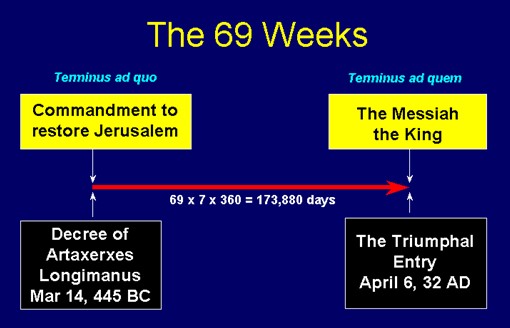 This is undoubtedly one of the most amazing prophecies in the entire Bible, and absolute proof that Jesus Christ is the Messiah of Israel, and that the Bible is the infallible Word of a God who is outside time and therefore able to declare the end from the beginning.
What however is sobering, is to realise that Jesus held the Jews accountable to know Daniel’s prophecy; and because they ‘missed it’, Jesus pronounced national blindness on them and then prophesied the destruction of Jerusalem – which occurred in 70AD – all because they ‘knewest not the time of thy visitation’
“And when he was come near, he beheld the city, and wept over it, Saying, If thou hadst known, even thou, at least in this thy day, the things which belong unto thy peace! but now they are hid from thine eyes. For the days shall come upon thee, that thine enemies shall cast a trench about thee, and compass thee round, and keep thee in on every side, And shall lay thee even with the ground, and thy children within thee; and they shall not leave in thee one stone upon another; because thou knewest not the time of thy visitation.” (Luke 19:42-43)
After a siege lasting almost a year, the Roman forces under Titus Vespasian took and destroyed Jerusalem. Titus had wanted to preserve the Temple but in the fighting, a burning torch was thrown through a window of the Temple starting a fire that was so intense that it melted all the gold on the walls inside. Consequently, Titus ordered the Temple to be taken apart stone by stone to recover all the gold. It was reported that over a million Jews died in the siege.
As a result of this, Jews were scattered around the world; their lives literally ‘hung in doubt’ (See Deut 28). This led some to conclude that God had finished with Israel, and that the promises given to Israel would now be fulfilled by the church. However as Paul made clear in Romans 9,10 & 11, God is not through with Israel: “For I would not, brethren, that ye should be ignorant of this mystery, lest ye should be wise in your own conceits; that blindness in part is happened to Israel, until the fullness of the Gentiles be come in.” (Rom 11:25)
The same message was given by the church at Jerusalem in Acts 15. It had become clear that gentiles were to be included in God’s plan of salvation, but the question was then asked: ‘what about Israel?’ We read: “And after they had held their peace, James answered, saying, Men and brethren, hearken unto me: Simeon hath declared how God at the first did visit the Gentiles, to take out of them a people for his name. And to this agree the words of the prophets; as it is written, After this I will return, and will build again the tabernacle of David, which is fallen down; and I will build again the ruins thereof, and I will set it up” (Acts 15:13-16)
Throughout the Old Testament there are countless prophecies regarding Israel’s ultimate restoration; indeed as we will see, the 70th week of Daniel’s prophecy has yet to be fulfilled, and as the whole of the prophecy was concerning ‘thy people and thy holy city’, Israel and Jerusalem still have a major part to play in God’s overall plan.
Daniel 9:26 – The Interval
And after threescore and two weeks shall Messiah be cut off, but not for himself: and the people of the prince that shall come shall destroy the city and the sanctuary; and the end thereof shall be with a flood, and unto the end of the war desolations are determined.
With the 69 weeks now dealt with, we find two specific events in this verse that will occur after the 69 weeks, but before the 70th. Firstly the ‘cutting off’ of the Messiah, but not for Himself; and then the destruction of Jerusalem by a people from whom another price is said to come.
As we know, less than a week after Jesus rode into Jerusalem completing the 69 weeks, He was crucified – but not for Himself: “And he is the propitiation for our sins: and not for ours only, but also for the sins of the whole world.” (1 John 2:2) And then, just as Jesus had foretold, 38 years later, Jerusalem was destroyed by the Romans.
What this should immediately make us realise is that there is an interval between the 69th and 70th week of this prophecy.
Some ‘scholars’ have objected to placing a gap between the 69th and 70th week, but as is clear from the text, the 70th week could not begin until after the Messiah had been cut of and Jerusalem had been destroyed by the Romans. Therefore, from what we know of history, this interval had to have lasted at least 38 years; however we find that it has now lasted almost two thousand years.
It is clear from the next verse that the event that will trigger the 70th week is the confirming of a covenant with Israel for the last ‘week’ (seven years) of this prophecy. One simple way of knowing that this ‘week’ has not yet (nor could have) occurred is that for any covenant to be signed with Israel, Israel have to exist as a nation, and yet from AD70 right up until May 14th 1948, Israel were not a nation, nor in their land. Thus if one stops and thinks about what this implies, we will see that this prophecy demands that all the prophecies about a future restoration and regathering of the Nation of Israel, after God has scattered them among all the nations of the earth, have to be taken literally. There is no way that this can be made to apply to the church. Two clear and unambiguous prophecies that underline this are found in Deuteronomy as follows:
Scattering
“If thou wilt not observe to do all the words of this law that are written in this book….
…the LORD will rejoice over you to destroy you, and to bring you to nought; and ye shall be plucked from off the land whither thou goest to possess it. And the LORD shall scatter thee among all people, from the one end of the earth even unto the other; and there thou shalt serve other gods, which neither thou nor thy fathers have known, even wood and stone. And among these nations shalt thou find no ease, neither shall the sole of thy foot have rest: but the LORD shall give thee there a trembling heart, and failing of eyes, and sorrow of mind: And thy life shall hang in doubt before thee; and thou shalt fear day and night, and shalt have none assurance of thy life” (Deut 28:58, 63-66)
Regathering
“And it shall come to pass, when all these things are come upon thee, the blessing and the curse, which I have set before thee, and thou shalt call them to mind among all the nations, whither the LORD thy God hath driven thee, And shalt return unto the LORD thy God, and shalt obey his voice according to all that I command thee this day, thou and thy children, with all thine heart, and with all thy soul; That then the LORD thy God will turn thy captivity, and have compassion upon thee, and will return and gather thee from all the nations, whither the LORD thy God hath scattered thee. If any of thine be driven out unto the outmost parts of heaven, from thence will the LORD thy God gather thee, and from thence will he fetch thee: And the LORD thy God will bring thee into the land which thy fathers possessed, and thou shalt possess it; and he will do thee good, and multiply thee above thy fathers.” (Deut 30:1-5)
Some critics would try and say that the prophecies regarding the regathering refer to the regathering of the Jews to the land of Israel after the Babylonian captivity; however Deuteronomy 28:36-58 clearly deals with the Assyrian and Babylonian captivity, whereas verses 63-66 warn of a far greater scattering ‘from the one end of the earth even unto the other’ and consistent with this, the regathering prophesied above is from ‘all the nations, whither the LORD thy God hath scattered thee’.
Another prophecy that confirms this is found in Isaiah 11:11-12 “And it shall come to pass in that day, that the Lord shall set his hand again the second time to recover the remnant of his people, which shall be left, from Assyria, and from Egypt, and from Pathros, and from Cush, and from Elam, and from Shinar, and from Hamath, and from the islands of the sea. And he shall set up an ensign for the nations, and shall assemble the outcasts of Israel, and gather together the dispersed of Judah from the four corners of the earth.”
From the context, this 2nd regathering of the Jews from around the world will occur at the time of the Second Coming when “He [Jesus] shall send his angels with a great sound of a trumpet, and they shall gather together his elect from the four winds, from one end of heaven to the other.” (Matt 24:31) In this verse from Matthew, Jesus was actually quoting from Isaiah 27: “And it shall come to pass in that day, that the great trumpet shall be blown, and they shall come which were ready to perish in the land of Assyria, and the outcasts in the land of Egypt, and shall worship the LORD in the holy mount at Jerusalem.” (Isa 27:13)
If this is the second regathering from around the world, when did the first regathering take place? Answer: In 1948, when, just as Isaiah prophesied (Isaiah 66:8) a nation was born in a day, and countless Jews returned home for the first time since AD70.
Thus (getting back on track!), the 70th week could not have occurred until 1948 when Israel were back in the land that God had given them.
It is worth noting that this is not the only time this ‘gap’ appears in scripture. There are in fact 24 occasions where we jump from the time of Christ to the Tribulation, omitting what has become know as the ‘church-age’. One of the obvious reasons for this is that the church was a mystery hidden in the Old Testament (cf Matt 13 / Eph 3:1-12). One of the other examples of this ‘gap’ is found in Luke 4:17-21
“And there was delivered unto him [Jesus} the book of the prophet Isaiah. And when he had opened the book, he found the place where it was written, The Spirit of the Lord is upon me, because he hath anointed me to preach the gospel to the poor; he hath sent me to heal the brokenhearted, to preach deliverance to the captives, and recovering of sight to the blind, to set at liberty them that are bruised, To preach the acceptable year of the Lord. And he closed the book, and he gave it again to the minister, and sat down. And the eyes of all them that were in the synagogue were fastened on him. And he began to say unto them, This day is this scripture fulfilled in your ears.”
Why were all eyes fastened upon Him? Because Jesus stopped mid-way through a sentence. The Jews would have been familiar with this prophecy from Isaiah, but when Jesus reads it to them, rather than complete the verse, He simply stops. When we compare this to Isaiah’s prophecy, found in Isaiah 61, we discover the following: “The Spirit of the Lord GOD is upon me; because the LORD hath anointed me to preach good tidings unto the meek; he hath sent me to bind up the brokenhearted, to proclaim liberty to the captives, and the opening of the prison to them that are bound; To proclaim the acceptable year of the LORD, and the day of vengeance of our God; to comfort all that mourn” (Isa 61:1-2)
Why did Jesus stop at the comer? Because, just as Jesus said, the first part of the prophecy was indeed being fulfilled in their ears; Jesus had come to preach good tidings, heal the brokenhearted, preach deliverance etc. but between this time and the day of vengeance of our God there has been a period of almost two thousand years. Thus, just as with our prophecy in Daniel, the last part will not be fulfilled until after the church-age.
Daniel 9:27 – The 70th Week
And he shall confirm the covenant with many for one week: and in the midst of the week he shall cause the sacrifice and the oblation to cease, and for the overspreading of abominations he shall make it desolate, even until the consummation, and that determined shall be poured upon the desolate.
In the last verse we were introduced to ‘the prince that shall come’ (a.k.a. Antichrist). There we were told that he will be of the people that destroyed the city (of Jerusalem). From history we know that these ‘people’ were the Romans; therefore this prince who is to come must also be ‘of the Romans’, or from the Roman Empire. It is important to realise that the Roman Empire was divided into two legs (remember the stature in Daniel 2); the western leg is what we are most familiar with from our history lessons, but the eastern leg that covered Turkey, Assyria, Iraq etc survived the western leg by about a thousand years. The reason this is of importance is that one of the other titles of the ‘prince who shall come’ is the ‘Assyrian’. (Is 10:24 / Is 14:24 / Mic 5:5-6), suggesting a strong link with the eastern part of the Roman Empire. Many Bible commentators have made the assumption that the final world empire that will be ruled by Antichrist, will come from the European Union / EEC etc. Whilst this may be the case, we should not ignore the possibility that it could be much broader than this, and there are those who see the 10 horns/ 10 toes / 10 kings, who will make up Antichrist’s government, as ten regions of the world, not just Europe.
As we noted in the last verse, the ‘prince that shall come’ will confirm a covenant for one ‘shabuwa’ – a week of years. This will be the 70th and final week of the prophecy that Gabriel gave Daniel. We have already seen that all seventy weeks were concerning the Jews and Jerusalem, so it is no surprise that this covenant is centred on the Jews. This is confirmed by the fact that in the middle of the week (i.e. after three and a half years) the ‘prince who shall come’ will cause the sacrifice and oblation to cease. It is of course the Jews that will be doing the sacrificing as commanded in the Law of Moses. Who the ‘many’ are is a matter of scholastic debate; some feel it is the ‘many’ Jews who will by now be living in Israel; others feel that it will be the surrounding Arab nations, and thus this will be some sort of peace treaty. Whatever the situation, the result will be that Israel will be granted permission to start sacrificing once again. However in order for this to happen, the Jewish Temple will have to be rebuilt again. It is no secret that that the Temple Institute in Jerusalem are already planning for such a time. They have for some years now been making the tools required for the ceremonies as well as the priest’s clothing as required in the Law of Moses. It is apparently possible for the Temple to be rebuild on the Temple Mount alongside the Dome of The Rock . Whether this will be the case, or whether the Done of the Rock will be destroyed by an earthquake or act of war remains to be seen; but the Jewish Temple will be rebuilt one way or another.
A menorah, already made and ready for use in the rebuilt temple.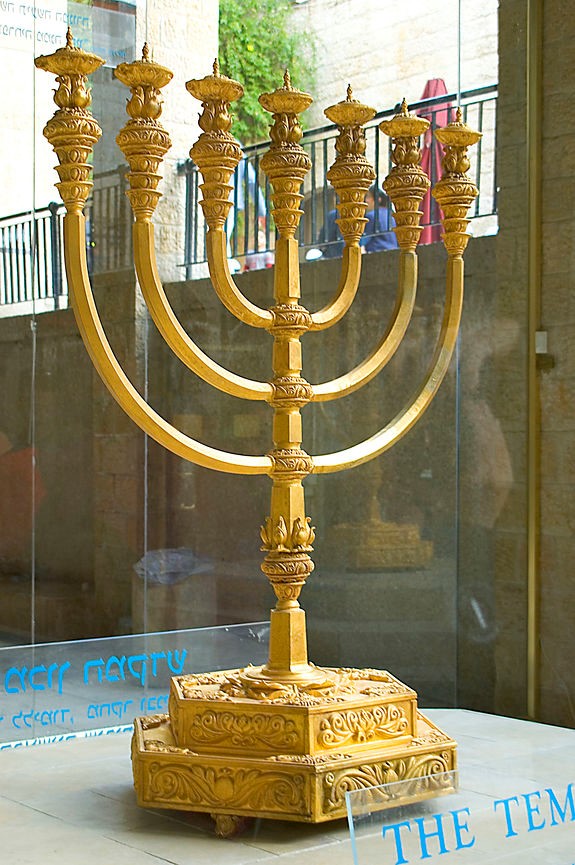
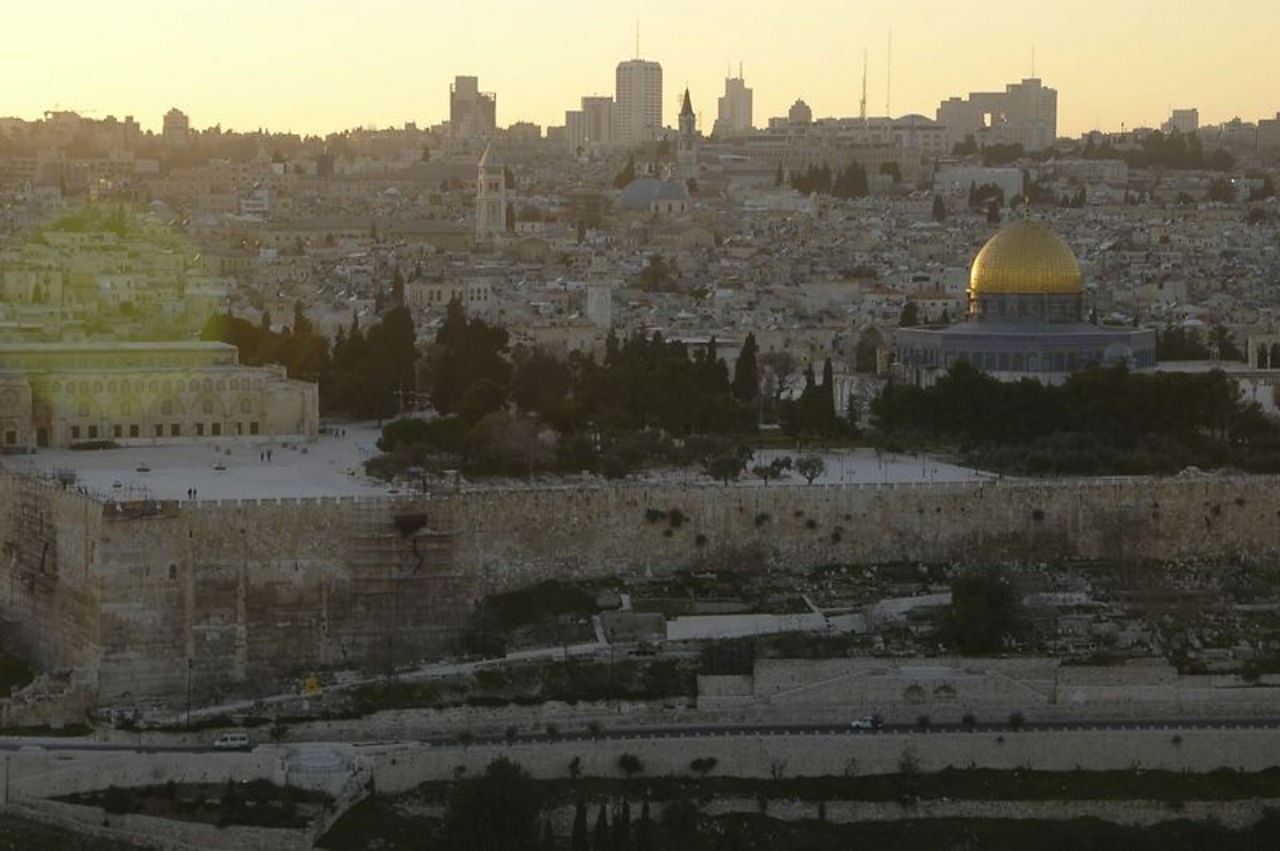
The Temple Mount in Jerusalem
In an act modelling that which was done by Antiochus Epiphanies (cf Daniel 8), this ‘prince who shall come’ (a.k.a. Antichrist) will stop the Jewish Sacrifices and, according to Revelation 13, erect an idol (image of himself) in the holy of holies. This will be an abomination to God, and will thus mark the beginning of the Great Tribulation (last three and a half years of the seven) as spoken of by Jesus: “When ye therefore shall see the abomination of desolation, spoken of by Daniel the prophet, stand in the holy place, (whoso readeth, let him understand:) Then let them which be in Judaea flee into the mountains: Let him which is on the housetop not come down to take any thing out of his house: Neither let him which is in the field return back to take his clothes. And woe unto them that are with child, and to them that give suck in those days! But pray ye that your flight be not in the winter, neither on the sabbath day: For then shall be great tribulation, such as was not since the beginning of the world to this time, no, nor ever shall be. And except those days should be shortened, there should no flesh be saved: but for the elect’s sake those days shall be shortened.” (Matt 24:15-22)
In these few verses, Jesus points to Daniel chapter 9 as the key to understand these things (all of this chapter in Matthew was in response to the disciples asking Jesus ‘when will these things be and what will be the sign of your coming?’). Jesus also makes it clear that this abomination will stand in the holy place. Furthermore, it is clear that Jesus’ warning is not to the church or Christians, but to Jews living in Judea, who will still be under the law and therefore will not be able to travel far if this event occurs on a Sabbath day; not will it be easy for them to escape if it occurs in the winter because many of the roads become impassable.
From Revelation 12 we find out that, at this point, Israel will flee into the wilderness (Bozrah or Petra) for the last three and a half years of the ‘week’. This will be a terrible time for the Jews as prophesied by many of the Old Testament Prophets:
“Ask ye now, and see whether a man doth travail with child? wherefore do I see every man with his hands on his loins, as a woman in travail, and all faces are turned into paleness? Alas! for that day is great, so that none is like it: it is even the time of Jacob’s trouble; but he shall be saved out of it.” (Jer 30:6-7)
“Awake, O sword, against my shepherd, and against the man that is my fellow, saith the LORD of hosts: smite the shepherd, and the sheep shall be scattered: and I will turn mine hand upon the little ones. And it shall come to pass, that in all the land, saith the LORD, two parts therein shall be cut off and die; but the third shall be left therein. And I will bring the third part through the fire, and will refine them as silver is refined, and will try them as gold is tried: they shall call on my name, and I will hear them: I will say, It is my people: and they shall say, The LORD is my God.” (Zech 13:7-9)
In the Nazi Holocaust, one in every three Jews were killed. In the Great Tribulation two out of every three Jews will be killed. Why does God allow this? Firstly to punish Israel for their iniquity; and secondly to cause them to repent and seek their Messiah. In Hosea we read: “I will go and return to my place, till they acknowledge their offence, and seek my face: in their affliction they will seek me early.” (Hos 5:15) This is an incredible prophecy! God is speaking and says ‘I will go and return to my place’. In order to return to His place, He must of left it! Q. So when did God leave His place?
- When He came to earth as a baby and lived and died to pay for the sins of the whole world.
Thus it will be during this time of immense persecution that Israel will repent and realise that Jesus is their Messiah: “And I will pour upon the house of David, and upon the inhabitants of Jerusalem, the spirit of grace and of supplications: and they shall look upon me whom they have pierced, and they shall mourn for him, as one mourneth for his only son, and shall be in bitterness for him, as one that is in bitterness for his firstborn.” (Zech 12:10)
At the end of this period Jesus will return to fight for His people against the armies of ‘the prince who shall come’ (read Zechariah 14), and will consume him with the brightness of His coming (2 Thes 2:8), thus bringing to an end the 70 weeks and bringing in everlasting righteousness.
Finally, not only will God reign in the kingdoms of man, Jesus Christ will rule over them!
Daniel 9:24-27 Overview
24 “Seventy weeks [490 years] are determined upon thy people and upon thy holy city, to finish the transgression, and to make an end of sins, and to make reconciliation for iniquity, and to bring in everlasting righteousness, and to seal up the vision and prophecy, and to anoint the most Holy.
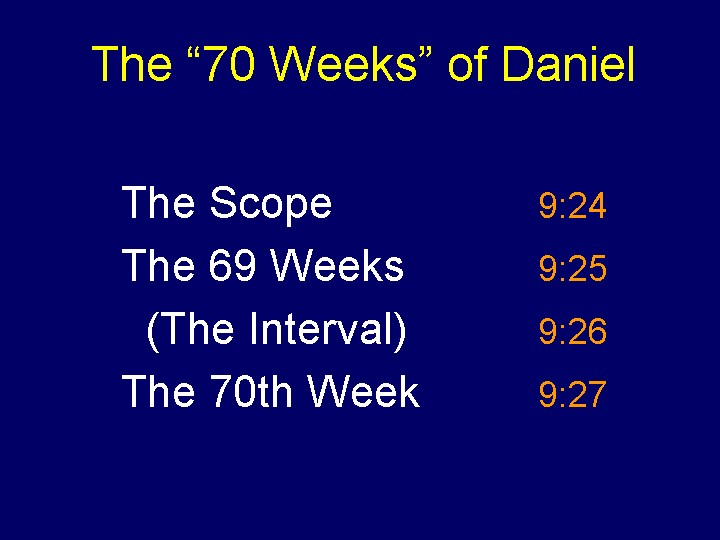
25 Know therefore and understand, that from the going forth of the commandment to restore and to build Jerusalem unto the Messiah the Prince shall be seven weeks, and threescore and two weeks: the street shall be built again, and the wall, even in troublous times.
26 And after threescore and two weeks shall Messiah be cut off, but not for himself: and the people of the prince that shall come shall destroy the city and the sanctuary; and the end thereof shall be with a flood, and unto the end of the war desolations are determined.
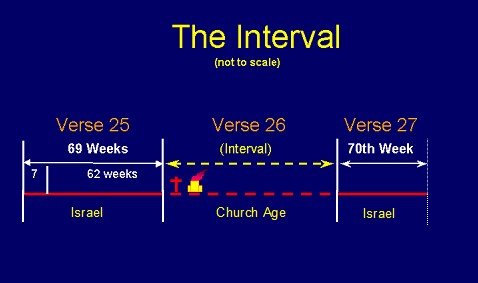
27 And he shall confirm the covenant with many for one week: and in the midst of the week he shall cause the sacrifice and the oblation to cease, and for the overspreading of abominations he shall make it desolate, even until the consummation, and that determined shall be poured upon the desolate.
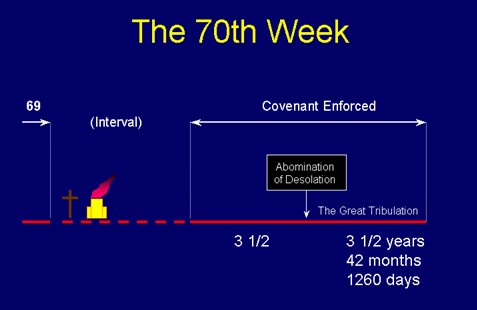
May you be blessed and encouraged by this study.
The post Daniel Ch9 vs24-27 first appeared on Calvary Chapel Portsmouth.
]]>The post Daniel Ch8 first appeared on Calvary Chapel Portsmouth.
]]>DANIEL CHAPTER 8
Daniel 8:1
In the third year of the reign of king Belshazzar a vision appeared unto me, even unto me Daniel, after that which appeared unto me at the first.
It has been about two years since Daniel’s first vision that we looked at in the previous chapter. The year is around 550 B.C. and Daniel is about 69 years old.
Daniel 8:2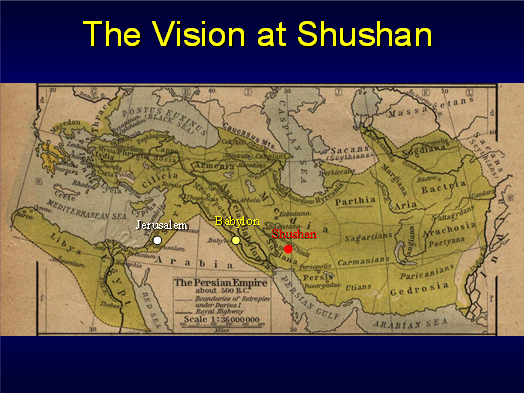
And I saw in a vision; and it came to pass, when I saw, that I was at Shushan in the palace, which is in the province of Elam; and I saw in a vision, and I was by the river of Ulai.
Shushan (also called Susa) was at this time a province of Babylon in the area we would call Iran today. It was about 230 miles east of Babylon, 150 miles north of the top of the Persian Gulf. It had been the capital city of the Elamites, and would later become the capital and main residence of the Persian kings. It is where the action of the book of Esther takes place, and also where Nehemiah was serving as a cupbearer to king Artaxerxes. Because it was not a place of great importance at this time, some commentators have felt that Daniel was actually in Babylon and merely ‘transported’ to Shushan in his vision. However, I believe that Daniel was actually there for the following reasons: Firstly the grammar would seem to imply that Daniel was at Shushan when he saw the vision, not that in the vision he saw Shushan. The simple fact that Daniel identifies the place as Shushan strongly suggests that he was familiar with it, and therefore must at some time have visited not only the city, but also the palace. If he did visit it at some point then why not here and now?
Secondly, as we saw in chapter 5, Belshazzar doesn’t immediately think of Daniel when he sees the writing on the wall; yet at the end of this chapter we find that Daniel was still working for the king. An obvious solution to this ‘problem’ is that whilst Daniel was still in the service of the king, he was conducting his duties elsewhere, and hence ‘out of sight, out of mind’ as the old adage goes.
Elam was one of the sons of Shem (Gen 10:22) who had settled in this area after the flood.
Daniel 8:3
Then I lifted up mine eyes, and saw, and, behold, there stood before the river a ram which had two horns: and the two horns were high; but one was higher than the other, and the higher came up last.
In verse 20 we will be told that this ram with two horns represents the kings of Media and Persia. The fact that one horn is higher than the other speaks of the fact that Persia was stronger than Media, and Persia started its rise to power after Media. We saw a similar idiom in the previous chapter with the bear being raised up on one side (Dan 7:5). Interestingly enough, the ram had long been associated with the Persian kingdom, both in mythology and practice. The Persian kings would take off their royal crown and wear a ram’s head when they went into battle. In ancient cultures, Persia was associated with Aries in the Zodiac, the Ram.
Daniel 8:4
I saw the ram pushing westward, and northward, and southward; so that no beasts might stand before him, neither was there any that could deliver out of his hand; but he did according to his will, and became great.
As Daniel looks on, he sees this ram pushing in three directions, west, north and south. History confirms that these were the directions the Medo-Persian army went in. East of Persia was India, which remained untouched by the Persian kings. At the height of the Persian empire, Xerxes fielded two and a half million men in his army and ‘none could deliver out of his hand’.
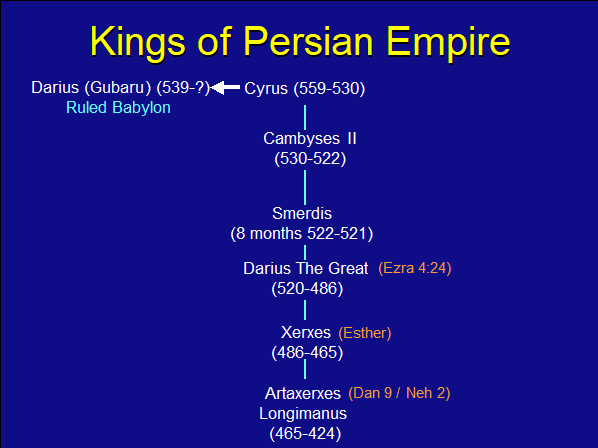
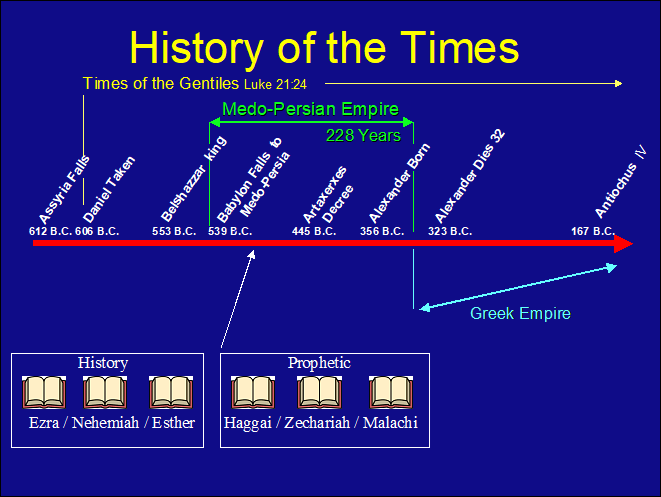
Daniel 8:5
And as I was considering, behold, an he goat came from the west on the face of the whole earth, and touched not the ground: and the goat had a notable horn between his eyes.
As Daniel was watching and thinking this through (remember the Meads and Persians were subservient to the king of Babylon at this time, and had been all of Daniel’s life; it must have been hard to grasp that Babylon would loose its dominance) suddenly, a male goat comes flying from the west and has an impressive horn between its eyes.
Daniel 8:6-7
6 And he came to the ram that had two horns, which I had there seen standing before the river, and ran unto him in the fury of his power.
7 And I saw him come close unto the ram, and he was moved with choler against him, and smote the ram, and brake his two horns: and there was no power in the ram to stand before him, but he cast him down to the ground, and stamped upon him: and there was none that could deliver the ram out of his hand.
Verse 21 will tell us that this male goat is representative of the kingdom of Greece and verse 22 confirms that the ‘notable horn’ is the first king, who from history we know was Alexander the Great. This corresponds with the ‘belly and thighs of brass’ of the dream in chapter two and the leopard of the vision in chapter 7.
There had long bee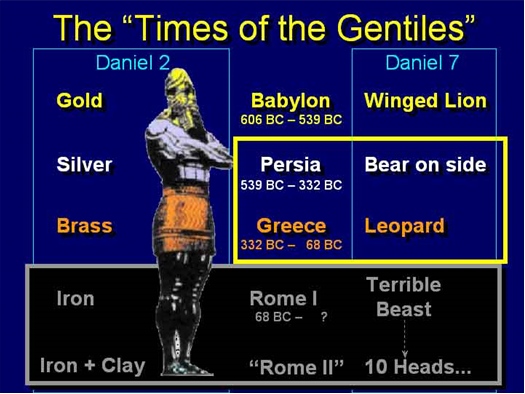 n rivalry between Medo-Persia and Macedonia (the area just to the north of Greece). Philip of Macedon, Alexander’s father, was murdered by a conspiracy, said to have been masterminded by Darius of Persia. Thus when Alexander came to the throne as a young 19/20 year old, he needed little encouragement in going after Darius and the Persians; whom he duly defeated after a few decisive battles. Alexander’s kingdom surpassed anything that had existed up to this time, and in just 6 years it stretched all the way from Greece to India. If Persia was associated with a ram, then Greece was certainly associated with a goat. Various stories in their folklore were centred around a goat, and Alexander’s son was named `Alexander Aegus’, the `son of the goat’. In addition, some of Alexander’s successors are represented on their coins with goat horns. For us this is history; but we should keep in mind how incredible this was for Daniel 200 years before any of this happened. It would be like someone telling us Iceland will rule the world!
Daniel 8:8
Therefore the he goat waxed very great: and when he was strong, the great horn was broken; and for it came up four notable ones toward the four winds of heaven.
Greece got stronger and stronger under Alexander and he even succeeded in uniting the Macedonians and the Persians, enlisting many foreigners into his army. However, at just 32 years old, Alexander died. It is famously reported that on his deathbed he was asked: ‘to whom shall the empire be given’, he answered: ‘give it to the strong’. As we mentioned in the notes on Daniel 7:6, within a year of Alexander’s death, the empire was divided up between his four generals, Antigonus took Babylon (later to be conquered by Seleucus), Ptolemy took Egypt, Cassandra took Macedonia and Lysimachus took Asia Minor. (see map below).
Daniel 8:9
And out of one of them came forth a little horn, which waxed exceeding great, toward the south, and toward the east, and toward the pleasant land.
We are now introduced to a little horn, but it should not be confused with the little horn of the previous chapter. In chapter 7 the little horn was seen to come from among the 10 horns, which were identified as being the 10 kings of the revived Roman Empire that are yet to come. Here the little horn comes out of one of the 4 horns that arose after the death of Alexander the Great. So this horn is to come out of the remains of the Greek Empire; and we are told that he ‘waxed exceeding great’ toward the south, east and the pleasant land – Israel.
Daniel 8:10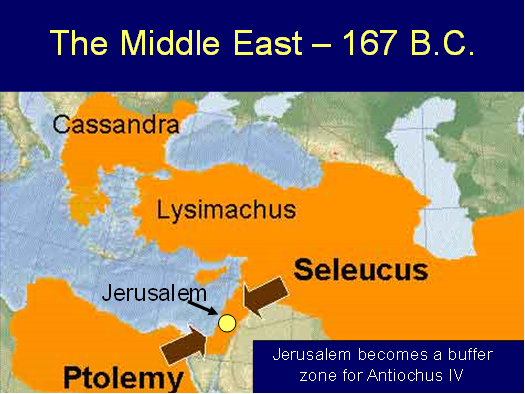
And it waxed great, even to the host of heaven; and it cast down some of the host and of the stars to the ground, and stamped upon them.
As we continue in the remainder of this chapter, we will have described (prophesied) for us an event that occurred in 167 B.C. Yet some of the language seems to go beyond what we know happened historically and points to a future fulfilling, of which this then becomes a model. This is not uncommon in prophetic scripture and is given the label ‘The Law of Double Reference’: This law observes the fact that often a passage or a block of Scripture is speaking of two different persons or two different events that are separated by a long period of time. Thus we have in clear view the little horn, who we will discover was Antiochus Epiphanies, yet a shadow is cast into the distant future as Antiochus Epiphanies becomes a model or type of Antichrist.
Those familiar with the book of Revelation may have already recognised this verse as being remarkably similar to Revelation 12:3-4:“And there appeared another wonder in heaven; and behold a great red dragon, having seven heads and ten horns, and seven crowns upon his heads. And his tail drew the third part of the stars of heaven, and did cast them to the earth” (Rev 12:3-4). In our study on Revelation we noted that at the mid-point of the Tribulation (just prior to the commencement of the Great Tribulation) Satan will be thrown out of Heaven once and for all, but in so doing, he will ‘drag’ one third of the ‘stars’ (angels in this context) with him. Thus prophetically, this verse (Daniel 8:10) can be seen to be looking forward to that yet-future event; but that leaves the question of how it is to be understood in regard to Antiochus Epiphanies.
Finis Jennings Dake, in his reference Bible comments that the word ‘host’ is translated from the Hebrew word ‘tsaba’ which means ‘a mass of persons or things, especially organised for war’. Dake adds: “The words host and hosts are used 475 times of various armies of earth and heaven, as well as the mass of stars.” “The term host of heaven is used of the sun, moon, and stars; and here [i.e. in this verse] of the high priest, the priests and Levites. It is a technical term for the ministers of the temple. The host may also include the worshippers. They are pictured under the figure of stars of heaven. The fact that the host will be trodden under the foot of men proves it refers to the Jewish people on earth, and not literal stars of heaven”.
Therefore, if this is the case, this verse is prophesying that this little horn will stand up against the priests of the temple and attack the Levites and worshippers – something that we know from history (i.e. Josephus / 1 Maccabees), actually happened.
Daniel 8:11-12
11 Yea, he magnified himself even to the prince of the host, and by him the daily sacrifice was taken away, and the place of his sanctuary was cast down.
12 And an host was given him against the daily sacrifice by reason of transgression, and it cast down the truth to the ground; and it practised, and prospered.
Antiochus was a part of the Seleucid Empire that had come to power following the death of Alexander the Great. According to the book of 1 Maccabees in the Apocrypha, and other historical records, Antiochus IV was the 8th king of the Syrian dynasty, reigning from 175 – 164 B.C. He ascended to the throne after the death of his father and imprisonment (by Rome) of his elder brother, Seleucus Philopator. Yet Antiochus was not the rightful heir, for Seleucus had a son. However, by flattery and bribery Antiochus succeeded in becoming king. He invaded Egypt and defeated Ptolemy VI, but on his way back he stopped of at Jerusalem. Jerusalem was situated right in between the Seleucid and Ptolemaic empires, and acted as a ‘buffer zone’ in between the two rival kingdoms. As you can imagine, the Jews were not very enamoured by this and tried to resist. (For more, see notes on ch.11).
In response, Antiochus plundered and desecrated the temple and even went as far as sacrificing a pig on the alter. He tried to do everything he possibly could to offend the Jews as can be seen from the following record from 1 Maccabees:
“And the king sent letters by messengers to Jerusalem and the cities of Judah: he directed them:
– to follow customs strange to the land,
- to forbid burnt offerings and sacrifices and drink offerings in the sanctuary,
- to profane Sabbaths and feasts,
- to defile the sanctuary and the priests,
- to build alters in sacred precincts and shrines for idols,
- to sacrifice swine and unclean animals, and
- to leave their sons uncircumcised,
They were to make themselves abominable by everything unclean and profane, so that they [the Jews] should forget the law and change the ordinances. And whoever does not obey the command of the king shall die”
Antiochus put an idol in the temple and stopped the daily sacrifices. Once again we see here a model of what Antichrist will do. Jesus himself referred to this event as the ‘abomination of desolation’ and foretold it happening again (see Matthew 24). The fact that the ‘model’ happened just as Daniel had prophesied, and with such incredible detail, we can be absolutely certain that the ‘fulfilment of the model’ will happen just as Jesus said.
Daniel 8:13
Then I heard one saint speaking, and another saint said unto that certain saint which spake, How long shall be the vision concerning the daily sacrifice, and the transgression of desolation, to give both the sanctuary and the host to be trodden under foot?
The question that Daniel overhears being asked is ‘how long will this be allowed to go on for’?
Daniel 8:14
And he said unto me, Unto two thousand and three hundred days; then shall the sanctuary be cleansed.
In the previous verse Daniel overheard a question being asked. It is reasonable to assume that the answer given in this verse would be the response to that question. It is amazing therefore, as one browses the various commentaries on this verse, that not only do we have various ‘interpretations’ of what the ‘two thousand and three hundred days’ actually mean, but also what they are referring to! Probably the most incredible of these interpretations was by a man named William Miller. Miller, an American Baptist preacher and active Freemason, proposed that the days actually meant years, and that the sanctuary actually referred to the earth. Therefore, he concluded, after 2300 years the earth would be cleansed and Jesus would return. Miller became convinced that the 2,300 day/year period started in 457 B.C. with the decree to rebuild Jerusalem by Artaxerxes I of Persia; his first mistake was that the decree to rebuild Jerusalem was not given until the 20th year of Artaxerxes (445 B.C.) as we will see in the next chapter. However, according to his calculations, the period would end, and hence Christ would return, in 1843. Miller records, “I was thus brought… to the solemn conclusion, that in about twenty-five years from that time (1818) all the affairs of our present state would be wound up.” (Apology and Defence, William Miller, 11-12). As most people are aware, this did not happen. Yet from this ‘foundation’ came the Seventh Day Adventist movement. It is also worth noting that the JW’s also leaned on Miller’s ‘understanding’ of Bible prophecy. If Millar had checked his theory against the ‘whole council of God’, rather than take one verse out of context, it is unlikely he would have made this error in the first place.
So how are we to understand this verse? Clearly the reference is to how long the sanctuary in the Temple in Jerusalem was to lay desolate until it would finally be cleansed. So our period of time is up when the temple was cleansed, which we know was in the winter of 164 B.C.
The Maccabean Revolt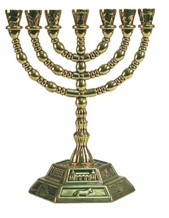
In 167 B.C. a Jewish priest, by the name of Mattathias, was so incensed by the desecration of the temple and the erecting of an idol in the holy place that, not only did he refuse to worship this idol, but also started killing the Hellenistic Jews* who did. (*Jews that had adopted the Greek culture and lifestyle). As a result of this, he and his five sons were forced to flee into the wilderness. After Mattathias’ death about one year later, his son Judas Maccabeus (whose name meant ‘hammer’) formed an army and led a revolt against Antiochus IV, which in 164 B.C. was eventually successful in overthrowing the Seleucid control of Israel. When the Jews finally entered the temple they found only one days supply of the consecrated olive oil that was needed to maintain the light on the great seven-branched lampstand called the ‘Menorah’. According to the Law of Moses this was to be kept continually burning. The Jewish Talmud records that the priests poured the oil into the seven lamps and lit them to bring forth light. Miraculously, to one days supply of oil burned for eight days – which was the length of time it took to press, prepare and consecrate new oil.
To commemorate this event the Jews added the Feast of Hanukkah, also called ‘Festival of Lights’ or ‘Festival of Rededication’ to their annual feasts. Whilst not specifically given by God, the validity of this feast is confirmed in John 10:22: “And it was at Jerusalem the feast of the dedication, and it was winter. And Jesus walked in the temple in Solomon’s porch.” (John 10:22-23). After this event, the Maccabees then founded the Hasmonean royal dynasty and established Jewish independence in the Land of Israel for about one hundred years, from 165 B.C. to 63 B.C.
So, with the historical background covered, we return to the question of what is meant by the 2300 days?
If we take them as literal 24-hour days, then we have a period just short of 7 years, which could correspond to the time between Antiochus’ first incursion into Jerusalem in 170 B.C. until the cleansing of the Temple by Judas Maccabeus in 164 B.C. However, we are told in verse 13 that the period of time in question is concerning the daily sacrifice, and the transgression of desolation, which didn’t occur until 167 B.C. The literal 24-hour day interpretation does not therefore satisfy the requirements. At first glance we now seem to be presented with a problem, that is until we realise that we are reading a translation. As good as the translators were (King James translators that is, – some of the modern ‘versions’ are shocking and completely change the meaning of things – beware!) on some occasions they have translated words into English to the best of their understanding but inadvertently confuse the issue. Such is the case here.
The Hebrew in this verse doesn’t use the word ‘day’ (Hebrew ‘Yom’), but rather ‘erev boker’, which would be literally translated as ‘evening-mornings’. It is easy to see why the translators thought evening-morning = day, however for the Jews who would think in terms of their sacrifices, 2300 evening-morning sacrifices would only equal 1150 days. Thus, this verse would seem to be saying that from the time the sacrifices were to be taken away (by Antiochus), there would be 1150 days, which is 110 days short of three and a half years. This fits with what we know from history and is consistent with what the text actually says.
Daniel 8:15-16
15 And it came to pass, when I, even I Daniel, had seen the vision, and sought for the meaning, then, behold, there stood before me as the appearance of a man.
16 And I heard a man’s voice between the banks of Ulai, which called, and said, Gabriel, make this man to understand the vision.
Daniel sought to understand, God wanted him to understand so Gabriel is instructed to make him understand. “Ask, and it shall be given you; seek, and ye shall find; knock, and it shall be opened unto you: For every one that asketh receiveth; and he that seeketh findeth; and to him that knocketh it shall be opened.” (Matt 7:7-8)
Daniel 8:17-19
17 So he came near where I stood: and when he came, I was afraid, and fell upon my face: but he said unto me, Understand, O son of man: for at the time of the end shall be the vision.
18 Now as he was speaking with me, I was in a deep sleep on my face toward the ground: but he touched me, and set me upright.
19 And he said, Behold, I will make thee know what shall be in the last end of the indignation: for at the time appointed the end shall be.
Here Daniel is told that the vision refers to the time of the end, yet as we have noted, all of these things have been fulfilled in history. Thus here we find confirmation that the events of this vision, whist having an historical fulfilment have a yet future fulfilment when another ‘little horn’ will desecrate the temple and place his image inside; the Jews (just like Judas Maccabeus and his family) will initially be forced to flee to the wilderness (cf Matt 24:15-21); and just as we were 110 days short of the three and a half years, Jesus said to the Jews: “And except those days should be shortened, there should no flesh be saved: but for the elect’s sake[i.e. the Jews] those days shall be shortened.” (Matt 24:22)
As we now continue with the interpretation, we will see even clearer allusions to the yet-future fulfilment of which Antiochus Epiphanies was just a model or type.
Daniel 8:20-22
20 The ram which thou sawest having two horns are the kings of Media and Persia.
21 And the rough goat is the king of Grecia: and the great horn that is between his eyes is the first king.
22 Now that being broken, whereas four stood up for it, four kingdoms shall stand up out of the nation, but not in his power.
As we have already noted, Medo-Persia was conquered by Alexander’s Greece, which itself then broke into four lesser kingdoms.
Daniel 8:23
And in the latter time of their kingdom, when the transgressors are come to the full, a king of fierce countenance, and understanding dark sentences, shall stand up.
Historically this was true of Antiochus, prophetically it is true of Antichrist.
Daniel 8:24
And his power shall be mighty, but not by his own power: and he shall destroy wonderfully, and shall prosper, and practise, and shall destroy the mighty and the holy people.
What Antiochus was, so will Antichrist be, yet ten fold more. Historically, Antiochus destroyed ‘impressively’ and fought against the holy people – the Jews. Prophetically Antichrist will be unlike anyone before him and will be allowed to prosper, i.e. do what he likes and launch such an attack on the Jews that the Nazi Holocaust will seem tame in comparison (cf Zech 13:8-9 / Jer 30:6-7). It is interesting to note that both for Antiochus and Antichrist they do not function by their own power, but will be supernaturally empowered by the ‘god of this world’ (2 Cor 4:4). Of Antichrist (the beast) we read: “And they worshipped the dragon which gave power unto the beast: and they worshipped the beast, saying, Who is like unto the beast? who is able to make war with him?” (Rev 13:4) (cf Eph 6:12).
Daniel 8:25
And through his policy also he shall cause craft to prosper in his hand; and he shall magnify himself in his heart, and by peace shall destroy many: he shall also stand up against the Prince of princes; but he shall be broken without hand.
Gradually the emphasis over the last few verses has shifted from Antiochus being the main focus with Antichrist in the background, to now in this verse, Antichrist being the focus. Antichrist will indeed magnify himself in his heart and bring about a false peace (cf. the white horse in Rev 6 with a bow – the sign of a covenant). Antichrist will stand up against the Prince of princes, the Lord Jesus Christ, but will be broken without hand: “And then shall that Wicked be revealed, whom the Lord shall consume with the spirit of his mouth, and shall destroy with the brightness of his coming:” (2 Thess 2:8).
Daniel 8:26
And the vision of the evening and the morning which was told is true: wherefore shut thou up the vision; for it shall be for many days.
If the historical portion of this vision has been fulfilled literally and with such accuracy, we can be sure that the prophetic (yet to come) elements will be fulfilled just as literally and precisely.
Daniel 8:27
And I Daniel fainted, and was sick certain days; afterward I rose up, and did the king’s business; and I was astonished at the vision, but none understood it.
It is hard for us to imagine how much this affected Daniel, yet if we really understand the impact of these things in the days we are living in, we too should be shaken out of our comfort zones and do two things: Firstly, pray for Israel and the Jews who will have to face what’s coming (Ps 122:6 / 137:5); Secondly: Preach the Word when it is convenient, and when it isn’t! (2 Tim 4:2). There is a dying world that needs to hear the good news that we have, the good news that there is a way of escaping the things that are coming (Luke 21:36).
May you be blessed and encouraged by this study.
The post Daniel Ch8 first appeared on Calvary Chapel Portsmouth.
]]>The post Daniel Ch7 first appeared on Calvary Chapel Portsmouth.
]]>Daniel 7:1
In the first year of Belshazzar king of Babylon Daniel had a dream and visions of his head upon his bed: then he wrote the dream, and told the sum of the matters.
With the historical section of the book now complete, this chapter sees us move back in time to the first year of Belshazzar, which was in about 552 B.C. Thus chronologically this chapter fits about 11 years after chapter 4 and about 12 years before chapter 5. On the surface it may seem that by now Daniel is no longer in a prominent position in Babylon; certainly, Belshazzar needs to be reminded about Daniel in chapter 5; however we will see at the end of chapter 8 that, after the vision recorded there, which we are told occurs in the third year of Belshazzar (two years after this event), Daniel returns to do the kings business. So even as an old man, Daniel was actively involved in the government of Babylon. (NB. At the end of chapter 1 we were told that Daniel served until the 1st year of Cyrus – about 14 years from now). Regardless of what we may have accomplished or what age we may be, God has much work to be done and sadly few who are willing to give Him their all and get on with it. Jesus said: “The harvest truly is plenteous, but the labourers are few; Pray ye therefore the Lord of the harvest, that he will send forth labourers into his harvest.” (Matt 9:37-38).
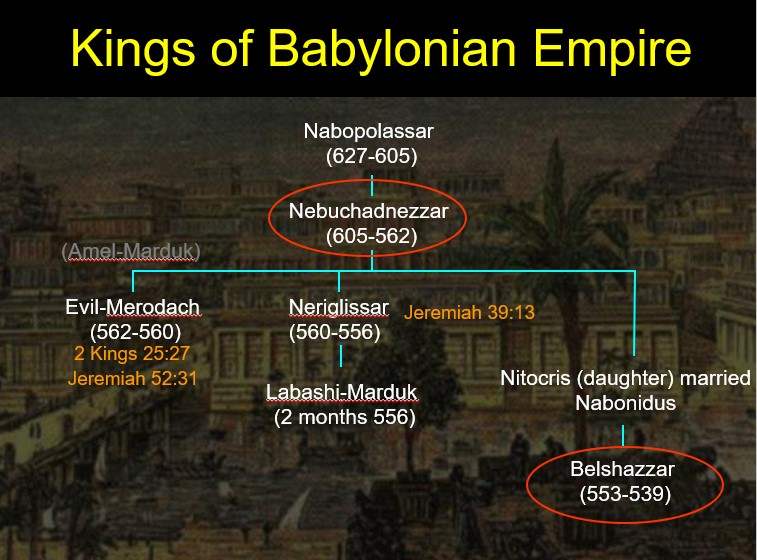 Thankfully Daniel had not gone off the boil and as we saw in chapter 6, he prayed 3 times a day. When you are close to God you are far more likely to hear His voice. And so we have Daniel tucked up in bed one night and he starts to dream. As we will see, this is more akin to a nightmare than a dream; in fact, Daniel seems more troubled by this dream than he would be of the lion’s den. However, Daniel, recognising its importance, writes down the ‘sum of the matters’ i.e. the key points.
Daniel 7:2
Daniel spake and said….
Who did he speak to? In the last verse we read that he told the sum of the matters. Thus it may well be that he was relaying this to a scribe. It is certainly conceivable that a man who had been second in charge of Babylon would have had his own personal secretary.
….I saw in my vision by night, and, behold, the four winds of the heaven strove upon the great sea.
The four winds are mentioned nine times in scripture: Jer 49:36 / Exek 37:9 / Dan 8:8 / Dan 11:4 / Zech 2:6 / Matt 24:31 / Mark 13:27 / Rev 7:1 and here in Dan 7:2. (As an aside, ‘9’ is the number of Judgment). They are seen either ushering in judgement (as would appear to be the case in this vision) or bringing restoration. In each case it implies a global situation, with the ‘four’ seemingly referring to the four cardinal points of a compass (North, South, East and West). The great sea that Daniel refers to may well have been the Mediterranean, as this was known as the ‘great sea’ at that time; however the sea is also used in scripture as an idiom of the peoples and nations of the world (cf Rev 17:15). Thus, whatever is about to happen, it would appear to have a global impact that will affect the people and nations of the earth.
Daniel 7:3
And four great beasts came up from the sea, diverse one from another.
We will be told in verse 17 that these great beasts represent four kings (or kingdoms – the Aramaic could mean either). In chapter 2 we also had a dream and vision of a statue that was representing world kingdoms. On that occasion Daniel interpreted the golden head of the statue to represent Babylon; the chest and arms of sliver represented the Medo-Persian Empire that succeeded Babylon. Then we had the belly and thighs of brass representing the Greeks under Alexander the Great, and finally the two-stage Roman empire represented by the legs of iron (the old Roman Empire) and the feet of iron mingled with clay representing the ten kings who shall arise out of the revived / revised Roman Empire.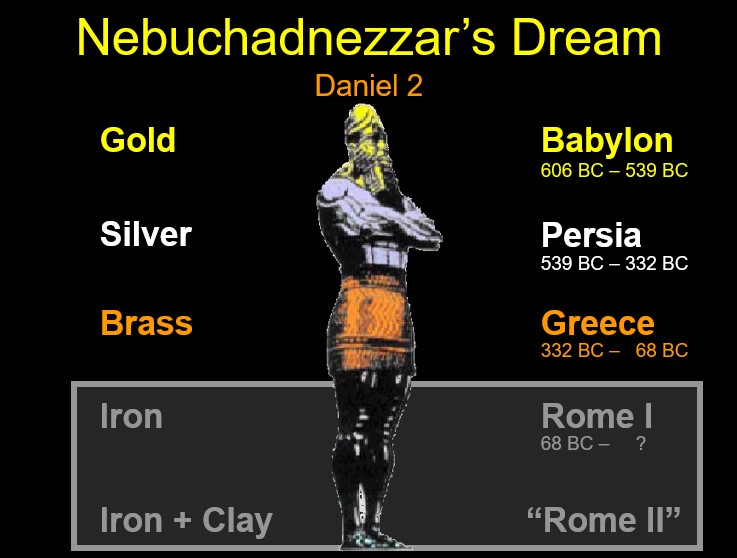
However, regarding the identity of the beasts/kingdoms in chapter 7, scholars are divided: we have essentially two options;
Firstly, the most popular view, often referred to as the classical view, proposes that these four beasts represent Babylon, Medo-Persia, Greece and Rome, mirroring the dream in chapter 2. Whereas in chapter 2 they are seen as an impressive metal image, they are here seen as wild beasts contrasting between man’s view (chapter 2) and God’s perspective of these kingdoms (chapter 7).
The second view suggests that all of these kingdoms are yet to arise at some point in the future, and when they do they will all rise simultaneously.
What is generally agreed upon is that the final phase of the last beast is the same as the ten toes in chapter two and the ten horns / ten kings mentioned in Revelation 17:12.
Because of the following reason, and the subtleties in the text that we will explore as we get there, I am of the opinion that these four beasts do indeed represent Babylon, Medo-Persia, Greece and then Rome in its two phases.
Quite simply, unless this vision is a re-telling of Nebuchadnezzar’s dream in chapter two, we have here presented to us four kingdoms of which history knows nothing and which are not mentioned anywhere else in scripture. If these kingdoms are yet to arise, then they would have to do so before the events of Revelation 6 commence, for from that point there would appear to be no room for them. This would mean that prior to the establishment of the revised Roman Empire as seen by Nebuchadnezzar as the ten toes, seen here as the ten horns, and as seen in Revelation (17:12) as ten kings, there will have to be another four world dominating Empires. Yet such a situation was not mentioned by Jesus in His great ‘end times’ talk in Matthew 24/25, nor is recorded by any other prophet. All of this, combined with the seemingly perfect fit of the description of these beasts to the corresponding Empires of Babylon, Medo-Persia, Greece and Rome, leads I believe, to the inescapable conclusion that in this chapter we have a re-telling of the dream of chapter two but now from God’s perspective.
There are two verses in particular that are highlighted by those holding to the ‘future fulfilment’ opinion that, at first glance, appear to present a difficulty with our ‘classical view’. These are verses 7 & 17, which will be dealt with when we get there. Again it must be stressed that the onus is on each of us to ‘search the scriptures daily to see whether these things are so’ (Acts 17:11), yet at the same time understand that the Holy Spirit came to ‘teach us all things’ (John 14:26) and ‘guide us into all truth’ (John 16:13). Sometimes, ‘agreeing to disagree’ is simply choosing to avoid the issue or even a polite way of saying that ‘I’m right, you’re wrong!…But I’m not prepared to discuss it’ and hardly fulfils 1 Cor 1:10!
Daniel 7:4
The first was like a lion, and had eagle’s wings: I beheld till the wings thereof were plucked, and it was lifted up from the earth, and made stand upon the feet as a man, and a man’s heart was given to it.
As we have mentioned, the classical view sees this beast as being Nebuchadnezzar’s Babylon, just like the head of gold was in chapter two. The lion was the chief of beasts as Babylon was the chief of kingdoms (cf Dan 2:38-39). Creatures re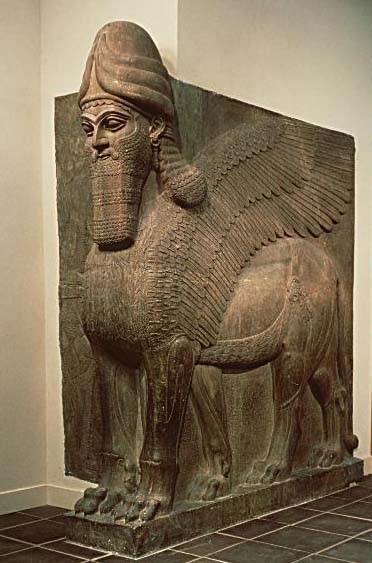 sembling lions with wings were on the walls and gates of Babylon (although some scholars believe that these creatures were meant to depict dragons and not lions). The eagle’s wings suggest swiftness in its ability to conquer, and this is certainly true of Babylon under Nebopolassar and Nebuchadnezzar. When king Neb got proud, his ‘wings were plucked off’ as we saw in chapter 4, but he was ‘made to stand up’ when he had learnt his lesson, at which point he put his trust in the God of Daniel and a ‘new heart’, a mans heart, was given to a man who had been like a beast for seven years.
< Babylonian image of a winged lion with a man’s head. (British Museum, London)
Daniel 7:5
And behold another beast, a second, like to a bear, and it raised up itself on one side, and it had three ribs in the mouth of it between the teeth of it: and they said thus unto it, Arise, devour much flesh.
The second beast represents the second kingdom in Daniel’s vision, and so, if our interpretation is correct, we would expect it to correspond to the empire that succeeded Babylon, namely Medo-Persia. A bear is not as swift as a lion nor as majestic, and so it was with Medo-Persia. We are told in Daniel 2:38-39 that Medo-Persia was to be inferior to Babylon and as we noted in chapter 6, the rulers of the Medo-Persian Empire did not wield the power that Nebuchadnezzar enjoyed. We also know from history that Medo-Persia was bear-like in its lumbering strength, conquering many enemies without even a battle; at one point, Xerxes fielded two and a half million men in his army. It is also an historical fact that Medo-Persia was a united empire of the Meads and Persians, yet Persia was the stronger and would seem to be implied by the bear-like-beast raising up on one side. Also from history we know there were three main conquests that really established the Medo-Persian Empire, namely Babylon, Egypt and Lydia. And thus it would seem that this is what the three ribs represent. Opponents of this view tell us that historically, Medo-Persia was never associated with a bear, and that the Medo-Persian Empire conquered more than just three competing kingdoms. In answer to this, all Daniel tells us is that this second beast was like a bear in its characteristics, something that cannot be denied of Medo-Persia. Secondly, Daniel clearly records what was said to this beast: ‘Arise, devour much flesh’, but by the time this instruction was given, it already had the three ribs in its mouth. Therefore it would appear that there is no difficulty in understanding Medo-Persia as the second beast in Daniel’s dream.
Daniel 7:6
After this I beheld, and lo another, like a leopard, which had upon the back of it four wings of a fowl; the beast had also four heads; and dominion was given to it.
Once again, if our interpretation is correct, we would expect the third beast to correspond to the next historical empire, i.e. Greece. And once again we have a matching ‘pho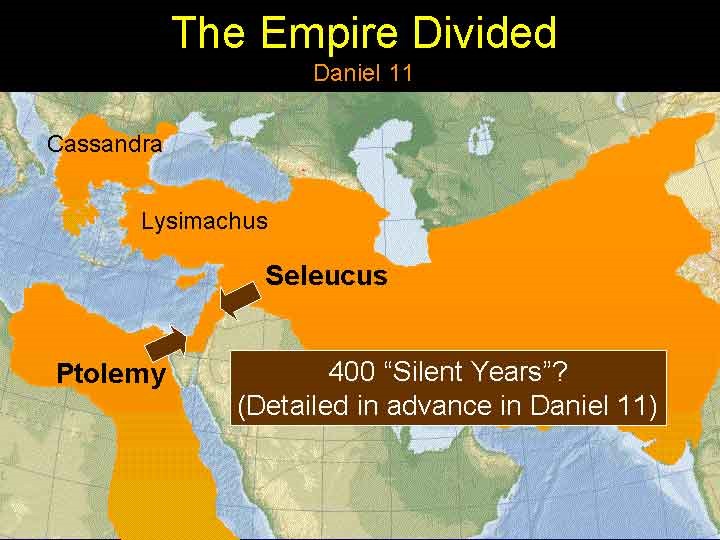 to fit’. The beast is like a leopard – one of the swiftest of all creatures – and in addition it has wings on its back implying even greater speed. This is one of the most compelling reasons to accept this interpretation because the empire of Greece under Alexander the Great conquered the known world in lightning speed, unparallel in history. At the age of 29 it is reported that the young Alexander fell on his bed and wept because there were no more lands to conquer. It is also recorded that, on his deathbed (aged almost 33), Alexander was asked: ‘to whom shall the empire be given’, his answer: ‘give it to the strong’.
Within a year his empire had been divided up between his four generals, Antigonus took Babylon, Ptolemy took Egypt, Cassandra took Macedonia and Lysimachus took Asia Minor.
NB: notice that dominion was given – once again we are reminded that it is God who ‘removeth kings, and setteth up kings’ (Dan 2:21), “to the intent that the living may know that the most High ruleth in the kingdom of men, and giveth it to whomsoever he will” (Dan 4:17)
Daniel 7:7
After this I saw in the night visions, and behold a fourth beast, dreadful and terrible, and strong exceedingly; and it had great iron teeth: it devoured and brake in pieces, and stamped the residue with the feet of it: and it was diverse from all the beasts that were before it; and it had ten horns.
Now we come to the fourth beast which should correspond to the Roman Empire in its two phases as revealed in Nebuchadnezzar’s dream and Daniel’s subsequent interpretation in chapter 2. Once again we find that the ‘shoe fits’, and in fact when we look at the interpretation in verses 23-24, it would appear to vindicate the view here expressed, that the four kingdoms are indeed the same is in chapter 2. What is interesting about this forth beast is that it is so unlike anything else, that Daniel doesn’t even try to compare it to an animal, he just simply tells us that it is ‘dreadful and terrible’.
In chapter two we were told that Rome was “strong as iron: forasmuch as iron breaketh in pieces and subdueth all things: and as iron that breaketh all these, shall it break in pieces and bruise.” (Dan 2:40) Here a similar picture is painted which indeed echoes the history of the Roman Empire, which took delight in crushing and destroying their foes. As we will see in verse 24, the ten horns are to arise out of this kingdom, giving us our ‘two phases’ of Rome and Revised Rome.
A point to note that is often overlooked, is that Rome had both the familiar western leg, and the less publicised eastern leg, which actually outlived the western leg by a thousand years (the two legs corresponding to the legs of the statue in chapter 2). Some, who have studied prophecy in the past, seem to have largely focused on the western ‘European’ element and ignored the eastern empire that actually includes Assyria, Babylon and North Africa. We will deal with this more fully later.
NB: the phrase ‘it was diverse from all the beasts that were before it’ at first glance, would seen to be in reference to time, implying that the other beasts had preceded it. However the Aramaic word literally means ‘in the presence of’, thus the other beasts in the vision are said to be in the presence of this forth beast. Those who hold to a ‘yet future’ fulfilment for all of these beasts / kingdoms use this verse to say that all of these beasts will come up at the same time, so this cannot of yet occurred. However, Daniel is seeing a vision, and clearly in the vision one beast comes up first, then another, then another, and finally a forth. Just because Daniel sees them all at the same time in his vision does not mean that the actual fulfilment of these things cannot happen over a period of time. Daniel is seeing a panoramic of world kingdoms, he is seeing things from God’s perspective and God is outside of time. Likewise, in Nebuchadnezzar’s dream, he saw the whole image at once yet clearly it was representing a succession of kingdoms. So once again there is no difficulty accepting the classical view.
Daniel 7:8
I considered the horns, and, behold, there came up among them another little horn, before whom there were three of the first horns plucked up by the roots: and, behold, in this horn were eyes like the eyes of man, and a mouth speaking great things.
In verse 11 we find that this little horn is given a personal pronoun showing him to be an individual. So from this verse we can see that this little horn that is speaking ‘blasphemous’ things, will subdue three of the original ten horns.
In the vision that John sees in Revelation 17 we are told “And the ten horns which thou sawest are ten kings, which have received no kingdom as yet; but receive power as kings one hour with the beast.” (Rev 17:12)
Thus, here we have introduced the one we commonly label as Antichrist, and he is seen to uproot three of the ten kings that will reign with him during the Great Tribulation.
(For a possible explanation of who these three kings might be, and why they are uprooted by Antichrist, see notes when we get to Daniel 11:40-44).
Daniel 7:9
I beheld till the thrones were cast down, and the Ancient of days did sit, whose garment was white as snow, and the hair of his head like the pure wool: his throne was like the fiery flame, and his wheels as burning fire.
As Daniel is watching he sees thrones ‘set in place’. These are not the thrones of the 10 horns, nor the thrones of the little horn. These are thrones that are placed alongside the Ancient of Days. In Revelation 19 we read: “And I saw thrones, and they sat upon them, and judgment was given unto them: and I saw the souls of them that were beheaded for the witness of Jesus, and for the word of God, and which had not worshipped the beast, neither his image, neither had received his mark upon their foreheads, or in their hands; and they lived and reigned with Christ a thousand years.” (Rev 20:4) There are two distinct groups that we are told will reign with Christ during the Millennium, the bride of Christ (the Church) (2 Tim 2:12 / Rev 5:10), and those who were beheaded for their witness during the Tribulation time. Therefore, these thrones would seem to be the thrones that we (that is, Christians) will sit on! “It is a faithful saying: For if we be dead with him, we shall also live with him: If we suffer, we shall also reign with him” (2 Tim 2:11-12)
Who is the Ancient of Days? From John’s description of Jesus in Revelation chapter 1, it would appear to be Jesus: I John….. was in the Spirit on the Lord’s day, and heard behind me a great voice, as of a trumpet, Saying, I am Alpha and Omega, the first and the last…..And I turned to see the voice that spake with me….His head and his hairs were white like wool, as white as snow; and his eyes were as a flame of fire; And his feet like unto fine brass, as if they burned in a furnace; and his voice as the sound of many waters. And he had in his right hand seven stars: and out of his mouth went a sharp two-edged sword: and his countenance was as the sun shineth in his strength. And when I saw him, I fell at his feet as dead. And he laid his right hand upon me, saying unto me, Fear not; I am the first and the last: I am he that liveth, and was dead; and, behold, I am alive for evermore, Amen; and have the keys of hell and of death. (Rev 1:9-18)
The similarities between Daniel’s and John’s visions would lead us to conclude that this is none other than Jesus Christ. However in verse 13 we find that Jesus comes to the Ancient of Days, meaning that the Ancient of Days must be God the Father. Why do they look so similar? Remember Jesus’ words to Philip in John 14:9 “Jesus saith unto him, Have I been so long time with you, and yet hast thou not known me, Philip? he that hath seen me hath seen the Father” And in John 10:30 Jesus said: “I and my Father are one”
The reference to wheels is consistent with Ezekiel’s vision of God on His throne in Ezekiel chapter 1 and again suggests that this is God the Father.
Daniel 7:10
A fiery stream issued and came forth from before him: thousand thousands ministered unto him, and ten thousand times ten thousand stood before him: the judgment was set, and the books were opened.
A fiery stream coming out from before Him would create a left / right divide. Either you would be on one side or the other. This is reminiscent of Matt 25:31-34: “When the Son of man shall come in his glory, and all the holy angels with him, then shall he sit upon the throne of his glory: And before him shall be gathered all nations: and he shall separate them one from another, as a shepherd divideth his sheep from the goats: And he shall set the sheep on his right hand, but the goats on the left. Then shall the King say unto them on his right hand, Come, ye blessed of my Father, inherit the kingdom prepared for you from the foundation of the world”
What is really interesting about this passage from Matthew is that the deciding factor of who has been good vs. who has been bad, is all down to how they have treated Jesus’ brethren i.e. the Jews!
The ancient systems for counting didn’t go beyond a thousand, so this may imply a countless number, or it may simply mean as it says, ten thousand times ten thousand = one hundred million. If so, it is provocative that this could mean that after the various judgments of the Tribulation period culminating in the battle of Armageddon, one hundred million is all that will be left on the earth! Certainly about one and a half billion people will die under the forth seal in Revelation 6:7-8; and this is only at the beginning of the Tribulation.
How terrifying it would be to be standing in this crowd and see Jesus start to open the books. What information do those books contain? If God has been keeping a list of everything you have ever thought, done and said, and it is all recorded in black and white, what kind of defense could you offer? Praise God that Jesus has nailed to His own cross the handwriting of ordinances that were written against us and paid them in full on our behalf!! (See Col 2:14).
Daniel 7:11
I beheld then because of the voice of the great words which the horn spake: I beheld even till the beast was slain, and his body destroyed, and given to the burning flame.
Revelation 13 is full of this beast speaking blasphemous things (Rev 13:1,5,6,11); finally this beast – who we know better as Antichrist – will get what’s coming! 2 Thessalonians 2:8 says: And then shall that Wicked [one] be revealed, whom the Lord shall consume with the spirit of his mouth, and shall destroy with the brightness of his coming” And in Revelation 19 John records: “And the beast was taken, and with him the false prophet that wrought miracles before him, with which he deceived them that had received the mark of the beast, and them that worshipped his image. These both were cast alive into a lake of fire burning with brimstone.” (Rev 19:20)
Daniel 7:12
As concerning the rest of the beasts, they had their dominion taken away: yet their lives were prolonged for a season and time.
So the last beast of the four is destroyed; that’s easy enough to understand; but as regarding the other beasts…? What this really means we may not find out until we get there, but a plausible answer is that the spiritual powers behind these kingdoms are ‘removed from office’ yet not destroyed until after the Millennium. Certainly the legacy of these kingdoms (Babylon, Medo-Persia and Greece) are prevalent in the world today. Babylon’s current influence was addressed in our study of chapter 4; Greece’s thirst for learning and ‘wisdom’ rejected the simplicity of the gospel and continues to this day in our education systems (see 1 Cor 1:22-23). Medo-Persia has spawned false religions such as Zoroastrianism and modern-day Persia (i.e. Iran) is an area today associated with a passionate hatred of Israel. Thus this verse may mean that this power and influence will be removed, which we would certainly expect as we enter a period of Theocracy (God’s reign) on planet earth.
Daniel 7:13-14
13 I saw in the night visions, and, behold, one like the Son of man came with the clouds of heaven, and came to the Ancient of days, and they brought him near before him.
14 And there was given him dominion, and glory, and a kingdom, that all people, nations, and languages, should serve him: his dominion is an everlasting dominion, which shall not pass away, and his kingdom that which shall not be destroyed.
It is amazing that the Preterists believe that all of this was fulfilled in AD70! Are we really expected to believe that lightning flashing across the sky, the moon being darkened and the stars falling from heaven, with the powers of the heavens shaken and the Son of Man coming in the clouds of heaven with power and great glory, all occurred in AD70, and yet not a single account of this ‘world shaking’ event was recorded and persevered in history? (See Matt 24:27-30). Would the Preterists also have us believe that all would empires and dominions have now ended? – someone forgot to inform our present governments if that’s the case! Preterism is heresy! Jesus said ‘do not be deceived’ (Matt 24:4-5)!
Then we have the Amillennialists. Amillennialism is possibly the most widely held belief in the church regarding the end times. It is believed by both Roman Catholic and Reformation/Denominational churches. They believe that there will not be a time when Christ rules on earth (hence A = not, Millennium = thousand years, i.e. ‘no thousand years’ (cf Rev 20:1-7)). It is proposed that after the church has ‘won the world for Christ’ (something that Jesus neglected to explain to the disciples) Christ will wrap it all up and we go straight to Judgment Day! (It’s more like Monopoly than theology.) This puts all the emphasis on the church, and more specifically, on those who elevate themselves as the leaders of this ‘world takeover bid’ by the church. (NB: The Roman Catholic Church as already tried this with disastrous consequences).
This is also the underlying position of the ‘Emerging Church’ and a subtle undertone of some of the recent popular ‘church growth’ manuals.
Proponents of these things say that the church will unite with our Catholic (and even Muslim) brothers and sisters, and we will become world conquering. A recent ‘emerging church’ author explained that apparently we have all misinterpreted the Bible and actually there is a ‘secret message of Jesus’, which the author reveals is that the kingdom of God will be established on earth by the church. The thought of Jesus coming back and taking us to a place He has prepared for us in Heaven (as He clearly said in John 14:3), and then coming back to establish His kingdom on earth, is scoffed at by this ‘new wave’ of all-embracing, post-modern, emerging-driven scholars.
Paul said to Timothy: “I charge thee therefore before God, and the Lord Jesus Christ, who shall judge the quick and the dead at his appearing and his kingdom; Preach the word; be instant in season, out of season; reprove, rebuke, exhort with all longsuffering and doctrine. For the time will come when they will not endure sound doctrine; but after their own lusts shall they heap to themselves teachers, having itching ears; And they shall turn away their ears from the truth, and shall be turned unto fables.” (2 Tim 4:1-4)
I don’t want to attack any sincere brothers and sisters in Christ who hold different views, but let’s get serious; verses like this (Daniel 7:13-14) are not ambiguous! Jesus is coming back to establish his kingdom and reign on earth as abundant scriptures, such as this one, make absolutely clear! It is not the church that will usher in this new kingdom but Christ Himself. When He does, His kingdom will be everlasting; man’s government will be ended.
Daniel 7:15
I Daniel was grieved in my spirit in the midst of my body, and the visions of my head troubled me.
It is important to understand that Daniel, at this time, was looking for the reestablishment of Israel, as their 70 years in Babylon was drawing to a close. This must have been quite a shocker to see that all of these beasts would come first.
Daniel 7:16
I came near unto one of them that stood by, and asked him the truth of all this. So he told me, and made me know the interpretation of the things.
Who Daniel speaks to here we are not told, presumably an angel.
Please notice Daniel’s attitude here: he is grieved and troubled but he doesn’t ‘kick back’ and say ‘this is all too confusing for me’. No. He sets his heart on finding out the truth.
Daniel 7:17
These great beasts, which are four, are four kings, which shall arise out of the earth.
As the ‘one who stood by him’ starts to interpret these things, it is easy to picture Daniel listening intently.
The first thing he is told is, as we mentioned earlier, that the four beasts represent four kings or kingdoms.
The ‘yet future’ view of these four beasts would draw our attention to the fact that we are told that these four beasts are four beasts that shall – future tense – arise. By the time Daniel is receiving this vision, king Nebuchadnezzar has been dead for almost 10 years. So, it is argued, this cannot be referring to Babylon of the past.”
However, as we have already mentioned, the vision is from God’s perspective and God is outside of time. The Aramaic word translated ‘which shall arise’ is ‘qum’ (pronounced ‘koom’) and means ‘to arise from’ ‘to come on the scene’ or even (and most fitting in this case) ‘to be made to stand’; which is indeed the case as we were reminded back in Daniel chapter 2: “he removeth kings, and setteth up kings: he giveth wisdom unto the wise, and knowledge to them that know understanding” (Dan 2:21)
So this verse literally reads: These great beasts, which are four, are four kings, which shall be made to stand out of the earth.
Thus, this verse presents no problem to the view expressed thus far.
Daniel 7:18
But the saints of the most High shall take the kingdom, and possess the kingdom for ever, even for ever and ever.
Now Daniel is given some great news! But the question for us is: ‘who is meant by ‘the saints’?
Clue: Who would Daniel have understood it to be in 552 B.C.?
Often when we hear the title ‘saints’ we are prone to think of ‘super-Christians’; but according to the New Testament, all who follow Christ are referred to as saints (See 2 Cor 3:13 / Eph 1:1 / Phil 1:1 / 2 Thess 1:10). However, Christians are not the only group in the Bible to be referred to as ‘saints’. Indeed if we were to take this verse as referring to Christians, we have a real problem when we get to verse 21, for there the ‘horn’ prevails over the saints – something that Jesus said not even the gates of hell would do against the Church (Matt 16:18).
This therefore leaves us only one option: as Daniel would have understood, the ones referred to in this verse are Israel, who throughout the Old Testament (of which Daniel is obviously part), are called ‘saints’. (See Deut 33:2-3 / 2 Chron 6:41 / Psalm 132:16 / etc).
So, as is consistent with numerous Old Testament prophecies, and in fulfilment of God’s promise to Abraham in Genesis 12:7, 13:14-17 & 15:18, Daniel is told that Israel will take the kingdom that God promised to Abraham’s seed as a possession for ever.
Daniel 7:19
Then I would know the truth of the fourth beast, which was diverse from all the others, exceeding dreadful, whose teeth were of iron, and his nails of brass; which devoured, brake in pieces, and stamped the residue with his feet;
Now Daniel goes back to look more closely at the fourth beast, which we have already identified as Rome, which did indeed devour and break in pieces, stamping the residue of those whom it conquered.
Daniel 7:20
And of the ten horns that were in his head, and of the other which came up, and before whom three fell; even of that horn that had eyes, and a mouth that spake very great things, whose look was more stout than his fellows.
In particular Daniel wants to know about the ten horns, (whom we know to be the ten kings of Rev 17) and about the ‘other horn’ (whom we know to be Antichrist).
Daniel 7:21
I beheld, and the same horn made war with the saints, and prevailed against them;
(See notes for verse 18).
Daniel watches and, no doubt to his surprise, sees Antichrist making war with the Jews and prevailing against them. So great will be this time of persecution for the Jews that Jeremiah labelled it ‘the time of Jacob’s trouble’ “For thus saith the LORD; We have heard a voice of trembling, of fear, and not of peace. Ask ye now, and see whether a man doth travail with child? wherefore do I see every man with his hands on his loins, as a woman in travail, and all faces are turned into paleness? Alas! for that day is great, so that none is like it: it is even the time of Jacob’s trouble; but he shall be saved out of it.” (Jer 30:5-7)
Zechariah goes even further and explains that only one third of the Jews will survive this ‘holocaust’, but the result will be that they turn to the Lord and repent.
“And it shall come to pass, that in all the land, saith the LORD, two parts therein shall be cut off and die; but the third shall be left therein. And I will bring the third part through the fire, and will refine them as silver is refined, and will try them as gold is tried: they shall call on my name, and I will hear them: I will say, It is my people: and they shall say, The LORD is my God.” (Zech 13:8-9)
Daniel 7:22
Until the Ancient of days came, and judgment was given to the saints of the most High; and the time came that the saints possessed the kingdom.
To Daniel’s (and the Jews) relief there is an ‘until’. God will not let this persecution go on one moment longer than is necessary to accomplish His plans. And at that moment ‘judgment was given’ – God ruled in favour – of the Jews, and they will be given the kingdom. See: Gen 15:18 / Gen 17:1-8 / Psalm 89 / Psalm 105 / 2 Samuel 7:12-13, 16, 24-26, 29 / Luke 1:32-33 / Acts 15:14-16
Daniel 7:23
Thus he said, The fourth beast shall be the fourth kingdom upon earth, which shall be diverse from all kingdoms, and shall devour the whole earth, and shall tread it down, and break it in pieces.
Now, after the brief summary we have just had, Daniel is taken back to the forth beast and given more information.
Daniel 7:24
And the ten horns out of this kingdom are ten kings that shall arise: and another shall rise after them; and he shall be diverse from the first, and he shall subdue three kings.
Once again we have it confirmed that the ten horns (ten kings) will come out of the forth beast (Rome), and Antichrist will himself come out after them and subdue three of them.
Daniel 7:25
And he shall speak great words against the most High, and shall wear out the saints of the most High, and think to change times and laws: and they shall be given into his hand until a time and times and the dividing of time.
Both here and in Revelation 13 we find that Antichrist has a real speech problem! Again we are told he will ‘wear out’ the Jews as we have already noted, but here we are given the duration: time (singular) = 1 year, times (plural) = 2 years, and half a time = half a year. Therefore Antichrist’s oppression of the Jews will last for three and a half years (of 360 day prophetic years – see chapter 9 notes for more on this). This period of time is the same as the Great Tribulation that Jesus spoke about in Matthew 24.
Daniel 7:26
But the judgment shall sit, and they shall take away his dominion, to consume and to destroy it unto the end.
Who is doing this judging? Christ and His bride – the Church.
“Do ye not know that the saints shall judge the world? and if the world shall be judged by you, are ye unworthy to judge the smallest matters? Know ye not that we shall judge angels?” (1 Cor 6:2-3)
Daniel 7:27
And the kingdom and dominion, and the greatness of the kingdom under the whole heaven, shall be given to the people of the saints of the most High, whose kingdom is an everlasting kingdom, and all dominions shall serve and obey him.
So far we have concluded that the Jews will posses the kingdom (verses 18 & 22) in fulfilment of the unconditional promise made to Abraham. To this point the vision has all been about these ungodly earthly kingdoms, all of whom ‘unlawfully’ possessed the land that was given to Abraham by God. Therefore it follows that it is now given to whom it rightly belongs, i.e. the Jews. However this verse now refers to the ‘kingdom under the whole heaven’ and says that the kingdom and dominion, and the greatness under the whole heaven shall be given, not to the saints, but to the people of the saints of the Most High. Could this be a subtle reference to the Church? Could it be said that the Church are the ‘people of the Jews’? Romans 11 tells us that we have been grafted in to olive tree of Israel, Israel being the ‘natural branches’. It is also true in one sense that Israel birthed the Church; all the Apostles were Jews, to the Jews were ‘committed the oracles (words) of God’ (Rom 3:2), i.e. we get our Bible from the Jews. Given the fact that the Church is to reign over the ‘whole heaven’ with Christ: “And he that overcometh, and keepeth my works unto the end, to him will I give power over the nations: And he shall rule them with a rod of iron; as the vessels of a potter shall they be broken to shivers: even as I received of my Father.” (Rev 2:26-27) “To him that overcometh will I grant to sit with me in my throne, even as I also overcame, and am set down with my Father in his throne.” (Rev 3:21) – Surely therefore the ‘people of the saints’ are indeed Christians and therefore the Church!?
What we do know without question is that the ‘him’ whom ‘all dominions shall serve and obey’ is our Lord and Saviour, Jesus Christ!
Daniel 7:28
Hitherto is the end of the matter. As for me Daniel, my cogitations much troubled me, and my countenance changed in me: but I kept the matter in my heart.
Praise God for the faithfulness of Daniel.
May you be blessed and encouraged by this study!
The post Daniel Ch7 first appeared on Calvary Chapel Portsmouth.
]]>The post Daniel Ch3 first appeared on Calvary Chapel Portsmouth.
]]>Daniel 3:1
Nebuchadnezzar the king made an image of gold, whose height was threescore cubits, and the breadth thereof six cubits: he set it up in the plain of Dura, in the province of Babylon.
As we move into this chapter most scholars place these events about 15-23 years after the events of Chapter 2. This would make Daniel and his Hebrew friends around 33 years old, and the year would be around 587 B.C. Although it is only conjecture, the following is provocative:
587 B.C. was the year Nebuchadnezzar laid the final siege against Jerusalem and carried Israel’s last king – Zedekiah – away to Babylon in chains. But back at the end of chapter 2 Nebuchadnezzar was shown that the God of Daniel, Hananiah, Mishael & Azariah, the God of Israel, was not only a God who answers dreams, He was the one who appoints kings and is Sovereign over all. But 17 years had past and king Neb’s fear of the Almighty God had no doubt waned. Time has a way of dulling the senses. Jerusalem had been a thorn in his side and despite that niggling voice that told him to leave God’s people alone, he boldly marches to Jerusalem in 587 B.C., lays siege to it, then overthrows and destroys both the city and the Temple of God within it. Bolstered by this success his mind may well have turned to consider the dream of the statue he had had 17 years earlier, where he was depicted as the head of gold. But if he had now defeated the Jews and destroyed the temple to their God, why couldn’t Nebuchadnezzar be the whole image, not just the head? What nation could defeat the might of his Babylon? Why couldn’t his kingdom be an everlasting one?
But how would you celebrate a success like he had just had in Jerusalem – the city that even the Assyrians had failed to conquer! Maybe the answer would be to build a huge 90ft tall statue overlooking Babylon, completely overlaid with gold to show the world that he was the king of kings, and there was no-one who could defeat him? Nebuchadnezzar had been greeted with ‘O king live forever’ (Dan 2:2:4 / 3:9). Maybe to immortalise his greatness in a golden statue would be a way of doing just that?
As we go through this chapter, whether it was his own idea or not, it would appear that Nebuchadnezzar had been encouraged to do this by the wise men of Babylon who, even after 17 years, were still bitter that that they had been totally upstaged by these Hebrews men. They were clearly looking for an opportunity to exact revenge on the Jews who had humbled them in chapter two. If this is the case it is very much like the events that we will study in chapter 6 where Daniel’s enemies conspired against him and duped king Darius into signing a decree that would entrap Daniel.
Whatever the reasons, this was an act of defiance against the God of Heaven.
It is amazing that people are so insecure and jealous of others achievements that they will seemingly stop at nothing to remove the competition, and this is compounded when the ‘competition’ is morally upright. Those who stand for truth are seen as an irritant to a society that wants to be free from moral constraints. Jesus Himself confirmed this: “If the world hate you, ye know that it hated me before it hated you. If ye were of the world, the world would love his own: but because ye are not of the world, but I have chosen you out of the world, therefore the world hateth you. Remember the word that I said unto you, The servant is not greater than his lord. If they have persecuted me, they will also persecute you; if they have kept my saying, they will keep yours also. But all these things will they do unto you for my name’s sake, because they know not him that sent me. If I had not come and spoken unto them, they had not had sin: but now they have no cloke for their sin. He that hateth me hateth my Father also. If I had not done among them the works which none other man did, they had not had sin: but now have they both seen and hated both me and my Father. But this cometh to pass, that the word might be fulfilled that is written in their law, They hated me without a cause.” (John 15:18-25) Paul reiterated this in 2 Tim 3:12 “Yea, and all that will live godly in Christ Jesus shall suffer persecution.”
A cubit is the measurement from the tip of your finger to your elbow. Although this measurement varies among ancient cultures, it is usually regarded to be about 18 inches. This would make the image approximately 90ft tall, 9ft wide (Nelsons Column in London is about 150ft in comparison). Notice the use of the number 6! 6×10 cubits high, 6 cubits wide. The number six in scripture is ‘the number of man’.
It maybe that the image that Nebuchadnezzar saw in his dream was of similar proportions, but it is an unusual ratio (height to width) for a human. The usual ratio for man is 5:1 or 6:1 (some of us are a little wider than we should be!). The dimensions of this statue are more like the Obelisks of Egypt, and it may well have been that on one of his expeditions Nebuchadnezzar would have seen these erected to immortalise Egyptian Pharaohs and deities and thus became part of the inspiration for him wanting to build one himself. However, unlike an Obelisk, we can be fairly sure that this was still an image of a man.
Interestingly, archaeologists have unearthed a 45ft square & 20ft high ‘base’ in the plain of Dura which many now believe could have been the base for this image, and would have been clearly visible from the walls of Babylon.
If the image was made of solid gold it would be approximately 4320 cubic ft. of gold. With 1200Lbs of Gold per cubic ft. it would equate to 5,184,000 Lbs. of Gold = £30 Billion of Gold! It is not out of the question that this could be solid gold for archaeologists have also discovered a 40ft table in the ruins of ancient Babylon made from solid gold and 15ft high solid gold statues were found in the Temple of Mardoch.
Daniel 3:2
Then Nebuchadnezzar the king sent to gather together the princes, the governors, and the captains, the judges, the treasurers, the counsellers, the sheriffs, and all the rulers of the provinces, to come to the dedication of the image which Nebuchadnezzar the king had set up.
The king is obviously impressed with his creation so calls for all the leaders and chief people of the land to come. There were about 100 provinces in Babylon at this time meaning that anywhere from 200,000 to 300,000 people would have gathered for this ‘grand unveiling’.
From the end of chapter two we know that Hananiah, Mishael, and Azariah were promoted to oversee the affairs of the province of Babylon, hence the reason they were invited. Daniel on the other hand we are told was “ruler over the whole province of Babylon, and chief of the governors over all the wise men of Babylon”. Thus it would appear that Daniel was second only to the king. If this is so and Daniel has so much influence before the king, then why, we may ask, did Daniel not object to this gross act of idolatry? And why does Daniel not appear to attend this event?
Daniel 3:3
Then the princes, the governors, and captains, the judges, the treasurers, the counsellers, the sheriffs, and all the rulers of the provinces, were gathered together unto the dedication of the image that Nebuchadnezzar the king had set up; and they stood before the image that Nebuchadnezzar had set up.
The fact that we have the same phrase repeated here suggests that as Daniel is recording this event, he is copying the decree that had been written by the king (or maybe a decree that was written for the king!).
Daniel 3:4
Then an herald cried aloud, To you it is commanded, O people, nations, and languages,
Notice that this is a command from the king and to people, nations and languages – this is a diverse and mixed crowd from the known world.
Daniel 3:5
That at what time ye hear the sound of the cornet, flute, harp, sackbut, psaltery, dulcimer, and all kinds of musick, ye fall down and worship the golden image that Nebuchadnezzar the king hath set up:
Six instruments mentioned – the number of man.
Music and idolatry have long been close companions. The root of this problem may well be that Satan appears to have been the worship leader in heaven (see Ezekiel 28:13-15). It would seem that he has a great understanding of how powerful and manipulative music can be. Music is a gift from God and is intended to accompany our praise to Him (as even a casual reading of the book of Psalms can confirm), yet in the wrong hands, it can be used for evil with devastating results. Consider the lust, violence and immorality that is communicated to young people through music. Satan always distorts what God has made good.
From what we know of history, the Babylonians had a love for music. This is prophetically seen in Psalm 137:1-4: “By the rivers of Babylon, there we sat down, yea, we wept, when we remembered Zion. We hanged our harps upon the willows in the midst thereof. For there they that carried us away captive required of us a song; and they that wasted us required of us mirth, saying, Sing us one of the songs of Zion. How shall we sing the LORD’s song in a strange land?”
Daniel 3:6
And whoso falleth not down and worshippeth shall the same hour be cast into the midst of a burning fiery furnace.
Two things are out on the plain of Dura. The Image and a fiery furnace – possibly used for melting / moulding the metal for the construction of the image.
Daniel 3:7
Therefore at that time, when all the people heard the sound of the cornet, flute, harp, sackbut, psaltery, and all kinds of musick, all the people, the nations, and the languages, fell down and worshipped the golden image that Nebuchadnezzar the king had set up.
…that is, all except three men who stood out like a sore thumb!
Daniel 3:8
Wherefore at that time certain Chaldeans came near, and accused the Jews.
Notice that it’s the Chaldeans again who had been humbled in ch 2.
‘Accused the Jews’ is literally: ‘chewed them up’ by their words.
Daniel 3:9
They spake and said to the king Nebuchadnezzar, O king, live for ever.
This is the greeting that the king wants to hear, especially today.
Daniel 3:10-11
10 Thou, O king, hast made a decree, that every man that shall hear the sound of the cornet, flute, harp, sackbut, psaltery, and dulcimer, and all kinds of musick, shall fall down and worship the golden image:
11 And whoso falleth not down and worshippeth, that he should be cast into the midst of a burning fiery furnace.
The fact they repeat to the king his decree leads some to conclude that they were the ones who had been responsible for getting the king to write this decree in the first place as a way of trapping these Jews. As we will mention later, Daniel is not present at this time, and it may well be that, knowing Daniel was away on business, they seized this opportunity to entrap his friends. Given the fact that this is some time after chapter two, they may well have been plotting and planning this event for years.
As an aside, ‘Furnace’ is mentioned 30 times in the Bible (KJV), and always in connection with tribulation and/or judgment. Certainly, there is a definite model here of the coming Tribulation, with a world ruler setting up an image to be worshipped, any who do not bow to that image and worship it will be put to death. We also find Jews who are persecuted yet supernaturally protected.
Daniel 3:12
12 There are certain Jews whom thou hast set over the affairs of the province of Babylon, Shadrach, Meshach, and Abed-nego; these men, O king, have not regarded thee: they serve not thy gods, nor worship the golden image which thou hast set up.
We have mentioned that the arguments of the critics regarding the accuracy and legitimacy of the people, names, places and events in the book of Daniel have been thoroughly refuted by competent research and archaeological discoveries. One such example is in regard to Daniel’s three friends. An archaeological dig in the area of ancient Babylon unearthed a five sided clay cylinder now in the Istanbul museum with the names: Hananunu – which is the Aramaic for Hananiah, Mishael-Mardach – obviously a reference to Mishael, and Abou-Nebo, the Aramaic for Abed-nego; these men are mentioned on the cylinder as having a prominent place in the government, thus clearly identifying these men as Daniel’s three friends as recorded in the Bible.
They are accused not just for refusing to bow today, but for not worshipping Nebuchadnezzar’s gods in the past – which the Chaldeans suggest is defying the king himself. This was not an impulse thing for these three men, but a predetermined purposing of heart that was made from the moment they got to Babylon – they will not be defiled!
Daniel 3:13
Then Nebuchadnezzar in his rage and fury commanded to bring Shadrach, Meshach, and Abed-nego. Then they brought these men before the king.
Now the king had already said that whoever would not bow to the image would be thrown into the furnace, yet he calls these men before him to ask them personally. This would suggest that the king was keen to give these men a second chance. We already know from the end of chapter two that these men were in prominent governmental positions in the province of Babylon (Dan 2:49), and no doubt the king wanted to avoid having high ranking officials commit a public act of defiance against him, particularly on this day when all the people were gathered together on the plain of Dura.
Daniel 3:14
Nebuchadnezzar spake and said unto them, Is it true, O Shadrach, Meshach, and Abed-nego, do not ye serve my gods, nor worship the golden image which I have set up?
The fact that the king addresses them by name and the manner in which he does so again suggests that up until this time they had had a good relationship with the king. The idea in the Aramaic is ‘did you intend to do this, was it on purpose?’ The king is hoping that it was just a misunderstanding and was not going to be something that would spoil his special day. But as we will see, these men had purposed in their hearts….(cf Dan 1:8)
“Purpose is something that comes through meditation, you have to think about what you’re going to do if you face this circumstance or that circumstance. And when you are prepared and the circumstance happens, you react to that which you have meditated on. So if you meditate on that which will not be helpful, then when you are in that potentially compromising situation you will do that which you have meditated on”. (Ron Matsen)
This is precisely why we are told to be transformed by the renewing of our minds (Rom 12:1-2), and to ‘think on these things’ (see the list in Phil 4:8), setting our affection on the things above (Col 3:2).
Daniel 3:15
Now if ye be ready that at what time ye hear the sound of the cornet, flute, harp, sackbut, psaltery, and dulcimer, and all kinds of musick, ye fall down and worship the image which I have made; well: but if ye worship not, ye shall be cast the same hour into the midst of a burning fiery furnace; and who is that God that shall deliver you out of my hands?
So the king reiterates the decree and offers them a way out of this situation. How many of us would have had second thoughts at this time? After all, to be given a second chance may be God providing a way of escape. How easy it would have been to rationalise that Idols are not real gods; surely it would have been better to give in to king Neb’s command and ‘live to fight another day’? Would bowing be such a bad thing? As long as they didn’t mean it in their hearts?
What about us? Often we sing our songs in church on Sunday about being completely abandoned, surrendering all, serving God with a whole heart etc. etc. yet on Monday when we are asked questions by the world, how do we answer? Do our lives bring forth fruit ‘worthy of repentance’ (Luke 3:8)? We have all been there, backed into a corner with no apparent way out, and we start to reason to ourselves: “It’s not really lying, the truth would do more harm than good” …. “it’s not really theft, just ‘borrowing’” …. “.It’s not really wrong, it’s just…(fill in the blank)”… it’s not really worshipping an idol to bow down and pretend…is it?
“Their idols are silver and gold, the work of men’s hands. They have mouths, but they speak not: eyes have they, but they see not: They have ears, but they hear not: noses have they, but they smell not: They have hands, but they handle not: feet have they, but they walk not: neither speak they through their throat. They that make them are like unto them; so is every one that trusteth in them. O Israel, trust thou in the LORD: he is their help and their shield” (Psalm 115:4-9)
Of course we know that bowing was not an option to these three men, nor could it be. The reputation of the God of Israel was on the line. The king’s statue was a public act of defiance against their God and the Chaldeans were just waiting for them to crumble. Yet these men knew the law which clearly stated: “Thou shalt have no other gods before me. Thou shalt not make unto thee any graven image, or any likeness of any thing that is in heaven above, or that is in the earth beneath, or that is in the water under the earth: Thou shalt not bow down thyself to them, nor serve them: for I the LORD thy God am a jealous God, visiting the iniquity of the fathers upon the children unto the third and fourth generation of them that hate me; And shewing mercy unto thousands of them that love me, and keep my commandments.” (Exodus 20:3-6)
“Everyday God will find a way of asking you ‘Do you trust Me?” Chuck Missler
In scripture, those who have made great professions of faith have often had that profession tested to breaking point. It is the heating up and subsequent hammering of steel that gives it its strength.
The king asks: ‘and who is that God that shall deliver you out of my hands?’ Great question O king! Remember “He who seeks finds”! (Luke 11:10)
Daniel 3:16
Shadrach, Meshach, and Abed-nego, answered and said to the king, O Nebuchadnezzar, we are not careful to answer thee in this matter.
The Aramaic word that the KJV translates as ‘careful’ is ‘chashach’ (khash-akh’) meaning to ‘have need of’. In other words they were saying to the king ‘we have no need to answer you, we are not accountable to you but to God’. It also implies that they were not anxious about this situation.
Daniel 3:17
If it be so, our God whom we serve is able to deliver us from the burning fiery furnace, and he will deliver us out of thine hand, O king.
This is an incredible statement of faith that comes from a life deeply rooted in God. “Let them now that fear the LORD say, that his mercy endureth for ever. I called upon the LORD in distress: the LORD answered me, and set me in a large place. The LORD is on my side; I will not fear: what can man do unto me? The LORD taketh my part with them that help me: therefore shall I see my desire upon them that hate me. It is better to trust in the LORD than to put confidence in man. It is better to trust in the LORD than to put confidence in princes.” (Psalm 118:4-9) Jesus said “fear not them which kill the body, but are not able to kill the soul: but rather fear him which is able to destroy both soul and body in hell.” (Matt 10:28)
Faith is the substance of things hoped for, the evidence of things not seen….(Hebrews 11:1)
Daniel 3:18
But if not, be it known unto thee, O king, that we will not serve thy gods, nor worship the golden image which thou hast set up.
Thus they make is clear, they will not bow down to this image or worship any other foreign god. There is only one God for these men and they will not compromise regardless of the cost. Remember that these men lived before the cross and without knowing all that Jesus suffered and endured to purchase our freedom.
It is amazing the lengths that some people will go to, to worship false gods and follow false religions. All the effort that was put into making this statue, all the hours spent in rituals and practices that have no eternal value. How much more should we, who know the Truth, refuse to worship false gods, whatever form they come in, and seek to serve our God with all our heart, mind, soul and strength.
In World War II when the British and allied forces had been pushed back by the German army to the beaches of Dunkirk, France, being trapped by the English Channel on one side and the approaching German’s on the other, they sent a simple three word message back home: “But if not”. Immediately this was recognised as being a quote from the book of Daniel and was understood to mean that the trapped British troops would wait to be saved, but if not, they would die fighting and standing up for their cause. This then led to the famous Dunkirk evacuations where hundreds of military, merchant and private fishing boats set sail across the Channel and dramatically rescued in the region of 350,000 British and allied soldiers.
It has been said that if such a message were to be sent today, the soldiers would perish, as no one knows what the Bible says anymore.
In October 1871, tragedy struck Chicago as fire ravaged the city. When it was all over, 300 people were dead and 100,000 were homeless. Horatio Gates Spafford was one of those who tried to help the people of the city get back on their feet. Spafford was a lawyer who had invested much of his money into the downtown Chicago real estate and consequently had lost a great deal to the fire. Also about this time his only son had died leaving him with his wife and his four daughters. For two years Spafford, who was a friend of evangelist Dwight Moody, assisted the homeless, impoverished, and grief-stricken that had been ruined by the fire. Eventually Spafford decided to take his family away for a holiday to Europe with the intention of meeting up with his friends Dwight Moody and Ira Sankey who at that time were on one of their evangelistic crusades.
At the last minute Horatio Spafford was delayed by some business so decided to send his family on ahead; he would catch up with them on the other side of the Atlantic. Their ship, the Ville de Havre, never made it. Off Newfoundland, it collided with another ship, the Loch Earn, and sank in a matter of minutes. Though Horatio’s wife, Anna, was able to cling to a piece of floating wreckage (one of only 47 survivors among hundreds), their four daughters, Maggie, Tanetta, Annie, and Bessie, were killed. Horatio received a telegram from his wife in England informing him of this terrible tragedy; all it said were two words: “saved alone.” Spafford boarded the next available ship to be near his grieving wife. As his own ship passed by the area where his daughters had died he was moved to write a song – the now famous ‘It is well with my soul’. He met up with his wife and they went on to meet up with Dwight Moody. “It is well,” Spafford told him quietly. “The will of God be done.”
When peace, like a river, attendeth my way, When sorrows like sea billows roll; whatever my lot, Thou has taught me to say, It is well, it is well, with my soul.
Though Satan should buffet, though trials should come, Let this blest assurance control, that Christ has regarded my helpless estate, And hath shed His own blood for my soul.
My sin, oh, the bliss of this glorious thought! My sin, not in part but the whole, is nailed to the cross, and I bear it no more, Praise the Lord, praise the Lord, O my soul!
For me, be it Christ, be it Christ hence to live: If Jordan above me shall roll, no pang shall be mine, for in death as in life Thou wilt whisper Thy peace to my soul.
But, Lord, ‘tis for Thee, for Thy coming we wait, The sky, not the grave, is our goal; oh trump of the angel! Oh voice of the Lord! Blessèd hope, blessèd rest of my soul!
And Lord, haste the day when my faith shall be sight, The clouds be rolled back as a scroll; the trump shall resound, and the Lord shall descend, Even so, it is well with my soul.
It is well, with my soul, It is well, with my soul,
Daniel 3:19
Then was Nebuchadnezzar full of fury, and the form of his visage was changed against Shadrach, Meshach, and Abed-nego: therefore he spake, and commanded that they should heat the furnace one seven times more than it was wont to be heated.
The fact that only now do we read that Nebuchadnezzar was full of fury and his face changes shows that prior to this point he wanted to see these men escape from this. But now he really is cross and any compassion gives way to rage.
We have already noted that Furnace speaks of tribulation, so it is interesting to note that use of ‘7 times’! There is a Tribulation coming upon this world soon that will last for ‘7 times’ (7 years).
Daniel 3:20
And he commanded the most mighty men that were in his army to bind Shadrach, Meshach, and Abed-nego, and to cast them into the burning fiery furnace.
At this point we know the story and are expectantly awaiting for the victory. However Hananiah, Azariah and Mishael did not; they must have thought that this is it! Maybe God wasn’t going to deliver them, maybe their lives were to be ended at this point. Maybe their minds were drawn to the words of Solomon in Proverbs: “The fining pot is for silver, and the furnace for gold: but the LORD trieth the hearts” (Prov 17:3), if so they could be confident that their hearts were clean before God. They would also no doubt have been aware of the story of Job who said in faith: “Though he slay me, yet will I trust in him:” (Job 13:15) Later in the book of Romans Paul was to say: “Nay but, O man, who art thou that repliest against God? Shall the thing formed say to him that formed it, Why hast thou made me thus? Hath not the potter power over the clay, of the same lump to make one vessel unto honour, and another unto dishonour?” (Rom 9:20-21)
What right do we have to question God’s judgment when God is infinite in knowledge and understanding and we so limited and finite? James hits the problem of our suffering head on James 1:2-4: “My brethren, count it all joy when ye fall into divers temptations; Knowing this, that the trying of your faith worketh patience. But let patience have her perfect work, that ye may be perfect and entire, wanting nothing”. This is beautiful to know, that God wants to make us perfect and complete, lacking nothing.
If He has to knock off some rough edges here and there He is doing it out of love and compassion. Yes these things can be painful at the time; consider Mary and Martha: Jesus let their brother (Lazarus) die, not just so He could do a miracle (John 11:40), but so that they would believe in Jesus and therefore they themselves would never die (John 11:25) – an infinitely greater gift than seeing their brother raised.
In Hebrews we read: “My son, despise not thou the chastening of the Lord, nor faint when thou art rebuked of him: For whom the Lord loveth he chasteneth, and scourgeth every son whom he receiveth. If ye endure chastening, God dealeth with you as with sons; for what son is he whom the father chasteneth not? But if ye be without chastisement, whereof all are partakers, then are ye bastards, and not sons. Furthermore we have had fathers of our flesh which corrected us, and we gave them reverence: shall we not much rather be in subjection unto the Father of spirits, and live? For they verily for a few days chastened us after their own pleasure; but he for our profit, that we might be partakers of his holiness. Now no chastening for the present seemeth to be joyous, but grievous: nevertheless afterward it yieldeth the peaceable fruit of righteousness unto them which are exercised thereby”. (Heb 12:5-11).
Even Jesus said: “In the world ye shall have tribulation: but be of good cheer; I have overcome the world.” (John 16:33) so we should expect ‘tribulation’ from the world and chastening from the hand of God. It is the former that is the case with these three men, but like Peter and the apostles in Acts 5 (where we read: “…and when they had called the apostles, and beaten them, they commanded that they should not speak in the name of Jesus, and let them go. And they departed from the presence of the council, rejoicing that they were counted worthy to suffer shame for his name.” (Acts 5:40-41)), Hananiah, Azariah and Mishael counted it an honour to stand for the name of the Most High God, for He alone is the One who rules in the kingdoms of men.
“Beloved, think it not strange (lit; stop thinking it strange) concerning the fiery trial which is to try you, as though some strange thing happened unto you: But rejoice, inasmuch as ye are partakers of Christ’s sufferings; that, when his glory shall be revealed, ye may be glad also with exceeding joy.” (1 Peter 4:12-13)
When a metal smith is refining gold in a refining pot, he keeps skimming off the dross (the impurities) that are brought to the surface by the heat. The way of knowing when it is pure is when he can look into the pot and see an unblemished refection. We are the pot, He is the Refiner.
“As for me, I will behold thy face in righteousness: I shall be satisfied, when I awake, with thy likeness.” (Psalm 17:15)
Daniel 3:21
Then these men were bound in their coats, their hosen, and their hats, and their other garments, and were cast into the midst of the burning fiery furnace.
Usually victims were stripped to humiliate them, yet here the king is so cross he just wants them thrown in. Hosen = undergarments, Hats = a turban of some description; other garments = robes of office; coats = usual outer garments.
Daniel 3:22
Therefore because the king’s commandment was urgent, and the furnace exceeding hot, the flame of the fire slew those men that took up Shadrach, Meshach, and Abed-nego.
This give us an idea just how hot this furnace may have been. From the furnaces that have been found in this region, it would probably be that the opening was at the top with a viewing area to the side, thus as the ‘lid’ is lifted, the intense heat was just too much for these mighty men who were overcome by the flames.
Daniel 3:23
And these three men, Shadrach, Meshach, and Abed-nego, fell down bound into the midst of the burning fiery furnace.
This verse would lend support to the idea just stated that the opening was at the top.
Daniel 3:24
Then Nebuchadnezzar the king was astonied, and rose up in haste, and spake, and said unto his counsellers, Did not we cast three men bound into the midst of the fire? They answered and said unto the king, True, O king.
The word translated in the King James as ‘Astonied’ is ‘tevahh’ in Aramaic and conveys the idea of ‘sweeping to ruin’, to ‘take alarm’. We might say that the rug was pulled from under him, that he was well and truly knocked sideways! The answer from his counsellors would suggest that they were looking the other way and were not seeing what the king was. Imagine their surprise when the king then says……
Daniel 3:25
He answered and said, Lo, I see four men loose, walking in the midst of the fire, and they have no hurt…..
By going through this furnace the only thing that was burnt up was what was binding them! How precious that is to us, when in our own furnaces to realise that all that gets burnt is what was binding us before we went in.
…..and the form of the fourth is like the Son of God
The Aramaic actually says ‘the son of the gods’ – Plural. But we need to remember that the Holy Spirit is the real author of scripture. In Genesis 1:1 we read: ‘In the beginning God’ – singular, and we are comfortable with that, except the word in Hebrew is ‘Eloheim’. Whenever a Hebrew word ends with an ‘im’ ending it is plural meaning more than one (eg. Cherub – singular, Cherubim – plural). Thus Genesis 1:1 should read “ In the beginning the Gods”, this is the same throughout the Old Testament whenever ‘Eloheim’ is used. Yet it is always taken as singular in the Hebrew and hence it is translated so. Thus we have in the first verse of the Bible a subtle hint of the Trinity – Father, Son and Spirit. The same is also true in this verse in Daniel; what we have is what scholars call a ‘theophany’ – an Old Testament appearance of Jesus Christ. (See also Joshua 5:13-15 and compare with Exodus 3:4-6).
Note: The Aramaic word used is equivalent of the Hebrew ‘Eloheim’ and is not the same as ‘Bar-Eloheim’ (sons of God) usually translated ‘angels’.
Daniel 3:26
Then Nebuchadnezzar came near to the mouth of the burning fiery furnace, and spake, and said, Shadrach, Meshach, and Abed-nego, ye servants of the most high God, come forth, and come hither. Then Shadrach, Meshach, and Abed-nego, came forth of the midst of the fire.
King Neb gets as close as he can and spake – not shouted ! ‘Hey guys, why don’t you come on out?’ All the people who had gathered on the plain of Dura are now watching something completely different than they were expecting to watch – yet this was what God had gathered them all there to see. Nebuchadnezzar thought they were gathered to worship him, but God had a different idea!
You just have to wonder if Shadrach, Meshach, and Abed-nego just delayed coming out for a little while. After all, how many times do you find yourself standing around talking to the Son of God in the midst of a furnace. There is a reality here also, that other people may look in at us in the midst of our time of tribulation and see that we are ‘not harmed’ by the flames. They may observe the peace and comfort we have in our suffering and wonder how we are able to cope. But as surely as He did with these three young men, God will bring us out of the furnace to glorify His name.
In verse 15 Nebuchadnezzar boasted: ‘and who is that God that shall deliver you out of my hands?’ yet now, somewhat swayed by recent events, says: Shadrach, Meshach, and Abed-nego, ye servants of the most high God. Slowly king Nebuchadnezzar is getting the picture, but as we will see in chapter 4, he still has some way to go!
But what a testimony to these young men, that because of their faith and trust in God, the most powerful ruler on the face of the earth declares that their God is the Most High God!
Only three come out of the furnace. Where’s the forth one? He stays in there waiting for you, so that you know that when you find yourself in the furnace, He will be with you.
‘I will never leave you or forsake you’ (Hebrews 13:5)
Daniel 3:27
And the princes, governors, and captains, and the king’s counsellers, being gathered together, saw these men, upon whose bodies the fire had no power, nor was an hair of their head singed, neither were their coats changed, nor the smell of fire had passed on them.
God’s deliverance is complete – not even the smell of smoke!
We think so small yet our God is so big. Oswald Chambers, commenting on the occasion when Peter walked on the water to meet Jesus says: The wind was actually boisterous, the waves were actually high, but Peter did not see them at first. He did not reckon with them, he simply recognised his Lord, and stepped out in recognition of Him and walked on the water. Then he began to reckon with the actual things, and down he went instantly. Why could not our Lord have enabled him to walk at the bottom of the waves as well as on the top of them? Neither could be done saving by recognition of the Lord Jesus. We step right out on God over some things, then self-consideration enters in and down we go. If you are recognising your Lord, you have no business with where He engineers your circumstances. The actual things are, but immediately you look at them you are overwhelmed, you cannot recognise Jesus, and the rebuke comes: Wherefore didst thou doubt?” Let actual circumstances be what they may, keep recognising Jesus, maintain complete reliance on Him.
Daniel 3:28
Then Nebuchadnezzar spake, and said, Blessed be the God of Shadrach, Meshach, and Abed-nego, who hath sent his angel, and delivered his servants that trusted in him, and have changed the king’s word, and yielded their bodies, that they might not serve nor worship any god, except their own God.
Peter & Paul both taught that we should obey the government, yet they were both put to death for civil disobedience. In Acts 5 Peter and the Apostles openly defy the Jewish leaders and kept publicly preaching in the name of Jesus despite being warned not to. In 1 Peter 2:13-14 Peter says: “Submit yourselves to every ordinance of man for the Lord’s sake: whether it be to the king, as supreme; Or unto governors, as unto them that are sent by him for the punishment of evildoers, and for the praise of them that do well.” So how are we to understand this? Quite simply, we should obey and submit ourselves to every law of man unless it contradicts the higher law of God. Peter himself confirmed this in Acts 5:29“Then Peter and the other apostles answered and said, We ought to obey God rather than men.”
Shadrach, Meshach, and Abed-nego did just that here, and what do we find? that the unbreakable and eternal law of God (Exodus 20:3-5) has caused the fallible word of the king to be changed!
Daniel 3:29
Therefore I make a decree, That every people, nation, and language, which speak any thing amiss against the God of Shadrach, Meshach, and Abed-nego, shall be cut in pieces, and their houses shall be made a dunghill: because there is no other God that can deliver after this sort.
He still hasn’t quite got it! He recognised that God can interpret dreams, now he recognises that God can deliver; but he still has not understood that God is in complete control – it is He alone that rules in the kingdoms of men. At this stage he is really impressed with the signs and wonders (like so many in the church today) but has not truly sought after the source of those things.
Daniel 3:30
Then the king promoted Shadrach, Meshach, and Abed-nego, in the province of Babylon.
They had already proven themselves 10 times better than their contempories (Dan 1:20), now these three Hebrew men, led away as captive from Jerusalem, are promoted to some of the most powerful positions in the most powerful Empire on earth at that time! “Humble yourselves therefore under the mighty hand of God, that he may exalt you in due time: Casting all your care upon him; for he careth for you.” (1 Peter 5:6-7).
May the example and faith of Hananiah, Mishael and Azariah encourage and bless you as you stand for Jesus Christ.
The post Daniel Ch3 first appeared on Calvary Chapel Portsmouth.
]]>The post 1 John ch2 14-29 first appeared on Calvary Chapel Portsmouth.
]]>In this chapter John plainly states that if you are content (and find no real problem) with this world and the things of this world, if you are ‘given over’ to this world, you cannot at the same time be given over to God. You cannot serve two masters. Either God is your real love, so that you gladly forsake worldly gain for the infinitely better reward of a relationship with Him, or you put God to one side and love this world – a world that John reminds us is all going to be burnt up.
What matters most to you? Your career? Your material possessions? Your hobbies? Your football team? Your favorite TV soap or Netflix? Your friends or even your family?
Jesus said: “He that loveth father or mother more than me is not worthy of me: and he that loveth son or daughter more than me is not worthy of me. And he that taketh not his cross, and followeth after me, is not worthy of me. He that findeth his life shall lose it: and he that loseth his life for my sake shall find it.” – Matthew 10:31
John then goes on to warn that false Christ’s will come – and are already around us, offering us alternative ways to ‘God’. These are just to forerunner to the Wicked One who is coming who will deceive the would world.
Deception will abound. Our only safeguard against deception is to abide in Jesus so that we can hear the gentle tender leading of His Holy Spirit.
These may be days full of challenges, there may be some difficult decisions to make, relationship and friendships that have to be severed, habits that must be broken, but there is the promise of reward and blessing greater than any of us can begin to imagine!
John’s message is to hold on! There is not much longer to wait!
The post 1 John ch2 14-29 first appeared on Calvary Chapel Portsmouth.
]]>The post The Coming Judgment of the Church – Part 4 first appeared on Calvary Chapel Portsmouth.
]]>The Bible reveals that in the last days of this age, all religions will blend together into a single world church, which itself will eventually give way to the worship of Antichrist.
What began in ancient Babylon as a Satanic attempt to deceive mankind into following a false ‘seed’ will culminate in where it began, uniting all religions into a single faith.
From what we are told in Revelation 17 & 18, it appears that the Roman Catholic Church will be a major influence in this deception and just as Israel are revealed in Revelation 12 as the ‘clothing’ that protected the real Seed, ensuring the safe arrival of the Messiah, so the Vatican will prove to be the ‘clothing’ that has protected this false seed to make way for the false Messiah.
The Bible reveals that many (even within the Christian Church) will fall for this deception, which will be no doubt be presented to the world as the ultimate in acceptance and tolerance, embracing all and sundry regardless of morals or lifestyle, regardless of what god you worship.
Jesus said that the days before His return would be like it was in the days of Noah and Lot. Maybe only a few have dared to believe just how literally these words would be fulfilled! Yet, looking at the world today, and particularly seeing how quickly mainstream churches are giving in to compromise in the name of tolerance, we can now see these things being fulfilled before our eyes.
May you be blessed, challenged and encouraged by this study.
The post The Coming Judgment of the Church – Part 4 first appeared on Calvary Chapel Portsmouth.
]]>The post The Gospel of Mark 13 21-37 first appeared on Calvary Chapel Portsmouth.
]]>In our previous study, we looked at the individual who will soon make an appearance on the world stage whom we often refer to as Antichrist. In fact, this individual is known by 33 different titles in the Old Testament and 13 in the New Testament.
However, there is another individual that Jesus alludes to in Mark 13, and that is the one referred to as the False Prophet in Revelation 19:20.
But it is in Revelation chapter 13 that we are introduced to the Devil’s two great protagonists, the ‘Beast from the sea’ v.1 (aka Antichrist) and the ‘Beast from the earth’ v.11 (aka the False Prophet). From the beginning, Satan has been a deceiver and master counterfeiter. Now, at the mid-point of the Tribulation, Satan (man’s great opponent) will attempt to deceive mankind through an unholy trinity, with Satan (as he has always wanted) being ‘like God’; Antichrist (as the name means) ‘in the place of Christ’, and the False Prophet assuming a Holy Spirit-like role, pointing people to the false Christ.
In Revelation 13:13 we read: “And he doeth great wonders, so that he maketh fire come down from heaven on the earth in the sight of men”
By this time, the people of the earth will have seen God’s two witnesses (see Revelation 11) call down fire from Heaven on any that tried to harm them; Satan now gives this power to the false prophet as if to counter what God has done. This reminds us of Pharaoh’s magicians in Egypt who tied to counter the signs that Moses and Aaron did in an attempt to harden the people’s hearts.
But the False Prophet will win the hearts of the people with his deceptions and will deceive the people (who have made this world their home) by the ‘signs and wonders’ he performs, and then he’ll suggest that they make an image of Antichrist in a re-run of Nebuchadnezzar in Babylon (Daniel chapter 3) and Antiochus Epiphanes (Daniel chapter 8 & 11).
Somehow the false prophet will make the image of Antichrist (which will be placed in the Holy of Holies in the temple in Jerusalem) to seem as if it’s alive and even cause it to talk. Just like it was with king Neb’ back in Daniel 3, any that don’t worship the image will be killed. He will then cause all, both small and great, rich and poor, free and bond, to receive a mark in their right hand, or in their foreheads
This is of course the infamous ‘Mark of the Beast’.
Everyone will have to receive the mark and buying or selling will be made impossible unless you have either the mark, or Antichrist’s name, or the number of his name. In this way everyone will be forced to pledge allegiance to Antichrist. Whilst some sort of electronic microchip may well be used during this time, the mark is unlikely to be your own personal ID number (such as you currently have with your Credit Card number), because the whole point of this is that you are given Antichrist’s number. Whatever the mark will be it will also probably be visible; again, it is an outward sign that a person has pledged their allegiance to Antichrist. This is also another one of Satan’s poor copies, because back in Revelation chapter 7 the servants of God were marked in their foreheads with the name of God.
Thus this satanic trinity will have their moment – but it will be brief! Jesus will return and destroy the work of the Devil.
In Mark 13 Jesus then goes on to say that Israel will not be destroyed – despite the Devil’s best efforts.
The chapter ends with a warning to all of us to watch! These things are almost upon us, the world is running out of time. It is now more important than ever to share the good news of the Gospel of Jesus Christ with any that have ears to hear.
As usual, the audio of this teaching and Powerpoint slides used are available for free download.
May you be blessed and encouraged by this study.
Every blessing in Christ,
Pastor Barry.
The post The Gospel of Mark 13 21-37 first appeared on Calvary Chapel Portsmouth.
]]>